Category Archives: Allgemein

Urtext = Plain Text ? – An Analysis of the Sarabande in Eb Major, Part 3 (Bar 25-32)

Britain

This is a translation of the post

Urtext = Klartext? – eine Analyse der Sarabande in Es-Dur, Teil 3 (Takt 25-32)

by Dr. Marshall Tuttle.


Michael Bach

This is the third part of the analysis of the

Sarabande in E Flat Major

with performance examples

and the interpretations of the cello competition *)


For glossary, slur-code and facsimile of the manuscript of Anna Magdalena Bach see Analysis Part I:
https://www.bach-bogen.de/blog/thebachupdate/urtext-plain-text-an-analysis-of-the-sarabande-in-eb-major-part-1



Sarabande Es Edition MB 007
Sarabande in Eb Major,  Edition Michael Bach

Sheet music sample mm 25-28
Slurs that are understood from the polyphony and that JSB therefore did not have to notate are added in parentheses.


M 25f

Measures 25 and 26 correspond, in this case a fifth lower, melodically and harmonically to mm 9 and 10. Again, there are two possible harmonic progressions that are parallel, in major or in minor (tonic-Sub or DR-Rel).

M 27

Measure 27 is similar to M 11, launched with a tied note. Now the DR (respectively Dom) is expected here analogous to the previous example. The short irritating sixteenth note Ab3: Does this mean a transformation to the D7-chord? The answer lies in the quarter note in the bass, so that the upper voice is slurred and the note Ab3 can not be clearly classified as a chord tone of the D7-chord, but rather as a passing or suspended tone (see, in contrast, the mm 6, 16 and 18 where the sixteenth can be construed as chord tones).

Important in this context is that this note is tied, and thereafter the emphasis will be placed on the root of the DR, G3. However, the irritation of the coincidence of both pitches of the minor seventh (Bb2-Ab3) may well be highlighted since this peculiarity, a dissonance on the fourth sixteenth note of the first beat, already found in the previous measure continues in the following measures.

Also interesting is the slur on the 3rd beat of this measure which causes a crescendo to the next measure as opposed to mm 11 and 31.

M 28

Now one expects the final measure of the “Sarabande” with the tonic. However, the Rel is strongly emphasized with it, the end of the movement is thus delayed. JSB now writes a slur on each of the two sixteenth notes in the 1st and 2nd beats. This causes accentuations of the top note Eb4 and the note Eb3 on the 3rd beat.

It is striking that the bass note C3 on the first beat is a quarter note. The slur on the two sixteenth notes violates to a certain extent the rule of the “Slur-Code”, that all notes in the upper voice are slurred. In addition, the other rule does not apply, that if two slurs follow each other immediately, then the second slur decrescendos. The top note would not be stressed at all if all the notes in the first beat were slurred, as in this case, in direct connection to the slur of the previous measure, here would be a decrescendo. JSB intends, however a strong prominence of the Rel and just the tonic (root Eb5) in this measure. Both harmonies are equal.

The mixing of these harmonics, Rel and tonic, is demonstrated in particular by the pitch Bb3 which is contained in this measure. For the triads of the tonic and the Rel differ only by the pitches C and Bb. The coincidence of the notes Bb3 and C3 signals, in the context of the two notes Eb3 and G3, the dazzling presence of both harmonies. Therefore JSB has not reduced the bass note C3 to an eighth note so that both pitches C3 and Bb3 are heard together, and thus indicates the ambivalent harmonic situation of this measure.

The end of the phrase arrives back on the note Eb3, the root of the tonic or the third of the Rel, which is tied, as in mm 4, 23 and 25f. One last time, this Eb3 is emphasized and reinforces the tonic character at the end of the measure.

Note:
From m 25 a stepwise building crescendo is generated due to the slurs. There is no let-up of the sound intensity until m 29.

Sound example mm 25-28

*

How was passage has played in the cello competition?

Interpretation of mm 25-28 by the 11 participants

Similar to mm 5f the consistent two voices in the first beats were never heard, in particular the dissonant harmonies of the fourth sixteenth note with the bass, which was regularly shortened to an eighth note. A legato was not played at the dotted rhythms alike, sometimes even the rhythmic impetus was reinforced by over-dotting (32nd notes). A dynamic increase of up to m 28 was rarely heard. Often this measure was conceived as an overtone ornament, as if it were a “triad” of a fundamental.

*



Sarabande Es Edition MB 008
Sheet music example mm 29-32

In the following passage which expands the second half of the movement with four final bars the “tone-defining” harmonies are mingled and lose track of harmonic function. But, in spite of everything, the ties make it possible to deliver a consistent picture of the harmonic sequence.

M 29

The note Eb3 still does not imply transition to the tonic but it is here harmonized with the tritone A2. This is reminiscent of m 23, so that the s6-chord can be expected. However, this time the bass note C2 is missing. The note Gb3 then transforms the harmony to a DD9-chord. But again, as in both previous measures, there is a quarter in the lower voice, so that the dissonant sixteenth note Gb3 is slurred to the previous note. This clouds the clarity of the harmonic progression, similar to the slurring of the seventh Ab3 in m 27. In addition, now a decrescendo is generated with the slur, which causes the questioning character or the weakening effect of this twist.

M 30

The top note Eb4 is tied again. The bass descends by semitone from A2 to Ab2. Although with this Ab2 the seventh of a D7-chord is notated. But why did JSB not simply write the usual bass note Bb2? With a bass note Bb2, in conjunction with a quarter note for the chord, the Dom would be unambiguous. This would otherwise be contrary to the tie since the seventh of a SD is never connected to the suspended fourth of the resolution. As such, the bass note Ab2 is not to be interpreted as seventh of the Dom, it does not sound in this way.

These considerations lead to a different interpretation of the harmonic development in this measure. With the half tone movement A2 in the previous measure to Ab2, this time noticeable downwards, we arrive at the SR. It has the same root as the DD in m 29, where the upper Eb4 acts as seventh in both chords which justifies the tie.

Both the upper part and the chord tones differ now from the preceding measures that would be analagous (mm 2, 4 and 22f). The top note is Eb4 already resolves to the sixth and fifth, D4 and C4 in the first beat. The chord tones are therefore reduced to an eighth note so that no slurring occurs in the upper part (a suspension action is not usually bound in the suites to its resolution). The fact that the chord tones shrink to eighth notes thickens the harmony.

This “resolution” or continuation of the seventh Eb4 (seventh chord on the SR) in the sixth d4 causes the s6-chord of the Rel, which is continued to F4, DR with seventh.

The three-part harmony at the beginning of the measure could suggest an S65-chord (Sub with added sixth F3) which has the identical pitch content. But, the overall context, ie the “voicing” is more prone to interpretation as the SR chord with seventh.
Note:

Only the curved bow allows both the tieing of the seventh Eb4 as well as the chord, without leaving the seventh, so that all three notes of the chord can be played together. Nevertheless, a bow change is inevitable, but the upper voice should not be interrupted (3rd beat of m 29 in the up bow and chord in the down bow). The concave bow however has to move from the upper part to the lower voices and causes an interruption on the tied Eb4. This suggests the “other” harmony, the D7-chord with seventh in the bass and Eb4 as suspended fourth. However, this is clearly in contradiction with the notation, ie the “compositional ” tie. In other words, JSB must have had an opportunity to perform these three voices on the instrument.

The seventh chord on the SR can only be realized with the involvement of the left hand thumb. While this case is a game of extreme technique, it is not an isolated case in the “Suites” (see m 11 and “Prélude” in C major).


M 31

The note Bb3 is now tied. It could continue to be heard as a third of the DR, or as fifth of the tonic. In both interpretations there is no difference in intonation because of the fifth relationship Bb3-Eb3. The fact alone that the last tie does not re-trigger an interpretive conflict in terms of an either-or-decision on the prevailing harmony, signifies a relief of the harmonic ambiguity is initiated.

Again, the chord tones have only an eighth note, so that the sixteenth Ab3 can be clearly articulated (dampen the G-string). This pitch does not belong to the DR, but to the tonic. It is certainly no longer appears that the major keys should again gain the upper hand. However, the Rel is not yet completely ruled out.

Now, with the hint of tonic or Rel, the Sub is now clearer after a last appeal to its Rel in the 2nd beat with the note Eb3. Here, the bass note is also shortened so that the note Eb, fifth of the Sub, is not slurred. So there is no preference between the two harmonies. A quarter note Ab2 in the lower voice would give momentum to the SR, because the note Eb3 would then be regarded as a passing note. And now, in the 3rd beat follows either the Dom, or the DR? This remains open.
Note:

Despite the note Ab3 in this pool of harmonies, the DR is still included. The presence of the DR is even highlighted in the first beat of the following measure again. The note Ab3 could then be regarded as a minor ninth suspension over the root G. This semitone Ab-G is answered in the final measure with the semitone resolution D-Eb.

As it happens, the leading tone suspensions are the subject of this movement. In m 27 the suspension Ab3-G3 of the DR has already been addressed. In m 29, the suspension Gb3-F3 can be heard. In m 30 the suspension is Eb4-D4. These half steps derived from the initial motif with suspended fourth (m 2 and m 4), by transferring them to other pitch and function levels (9-8, or 7-6 suspensions).
M 32

After the penultimate measure failed to clarify motion of the relative major and minor keys towards tonic, there follows with a garland of rising sixteenth notes the very last effort to resolve these ghostly harmonic events. In the first beat again the DR appears through (a 3-slur on the note G2, which integrates the fifth Bb2 of the tonic), The harmony now pivots towards principal key by emphasizing the note Eb3 on the 2nd beat (directly adjoining slurs).

These two harmonies, the tonic and DR, are, similar to the tonic and the Rel in m 28, connected by an interval of a second, namely with the notes D and Eb. The note D3 acts as leading note, creating a stress on the 2nd beat and not on the first. These internal dynamics, created by the placement of the slurs, revives the 2 octave ascending line.

Therefore, the second half of the movement does not end with a triumphant tonic sound. Neither is the bass note Eb2 stressed (no slur in the 3rd beat of m 31, but an octave leap down) nor the final high note Eb4, which is achieved with a decrescendo.
Conclusion:

The last 4 bars show in intensified form the ambiguous harmonic progression. While in m 29 the DD with its ninth is still relatively clear, in m 30 an episode suddenly begins with the tieing of the high note Eb5 and the chord which is so multi-layered that the harmonic complexity can not easily be brought to a common denominator, in the sense that unambiguous chords cannot be determined.

While it is obvious, these bars can be ascribed to the harmonic progression DD9-D7-T which many analysts**) do. This superficial harmonic analysis does not thoroughly describe the end of the “Sarabande”. The two ties also clearly thwart this simple interpretation. It can not be assumed that JSB comes to such a banal conclusion after all these harmonic excursions.

The second part of the movement is more prone to the darker, deeper registers in the minor keys. Only in the final measure does Eb major resurface.

Sound example mm 29-32

*


How was this passage played in the cello competition ?

Interpretation of the mm 29-32 by the 11 participants

The same applies as in the four previous measures, because no cellist realized the coincidence of the ninth Gb3 with the bass note A2 in the first beat of m 29. Some cellists simulated the ties of the upper voice in mm 29ff by playing only the two bass notes of the chords without sustaining the upper voice. Others, however, arpeggiated the chord, so that the upper part was played twice. Thus, these measures were aligned with those that include a suspended fourth. The final measure was regular started with an emphasis (and a tenuto) on the bass note. Some added an ornament to the final note Eb4.

*


Polyphony with the Curved Bow
Although the interpretation of this movement is possible with the today’s commonly used concave bow, the curved bow has great advantages at central points of the composition, eg in m 21, where the bass A2, the third of DD, finally appears for the 1st time, can be fully sustained with the curved bow for a quarter note. The same applies to the root C2 of the s6-chord in m 23. The ties and chords in mm 29ff can only be performed in the notated form with the curved bow.

The advantage of the curved bow is also heard in the chord progression of the m 15, the chord tones can be heard simultaneously and so gain clarity. In the harmonically ambiguous chords in mm 6, 16 and 18 the curved bow allows the simultaneous performance of two harmonies for their full duration of a dotted eighth note.

Similarly, the curved bow is sonically preferable in those places where there is in the upper voice of a chord a suspended note that resolves in the next beat (mm 2, 4 and 22f ), because the bass notes can be sustained, which strengthens the suspended dissonance.

Last but not least, the curved bow is advantageous in all two-voice passages because it facilitates playing technique, because the flexible nature of the bow hair allows a more even sounding of two tones.

JSB’s polyphonic notation cannot be clearer.

The quarter notes in the lower parts of mm 2, 4 , 9, 22f , 25 and 28 signify a clear harmonic situation and require a melodic design of the upper part as a result of the slurring of sixteenth notes.

The sixteenth notes in the upper voices of mm 10f and 26-29 are perceived only as dissonant, but only if they sound simultaneously with the quarter note in the lower voice.

The dotted eighths in mm 6f , 14, 16 and 18 illustrate a harmonically ambivalent situation. The following sixteenth then sounds separately and therefore as a chord tone (and not as a passing note or suspension).


The Ties


Ties in JSB are important clues to understanding the underlying harmonies. In particular, this applies to measures 23f and 29f, which are widely interpreted as Dom In reality they are marked as Sub.

In m 23 the chord C2-A2-Eb3 is not intended to be a DD7-chord which resolves to the Dom In this case, the note Eb3 would first be seventh of the DD and then the suspended fourth over the Dom The note Eb3 should not be tied in this interpretation. But JSB uses a tie, indicating that it is instead the s6-chord, whose presence in the first beat of the following measure is prolonged. This suggests that with these ties those pitches are connected, which are at the same time chord tones in both harmonies and identical in pitch.


Frequencies of pitches connected by ties
M 4f

The tonic is initially retained, the note Eb3 is its third. That is, the harmony does not change.

M 6f

The note Db4 is construed in m 6 as the seventh of the tonic and in m 7 it becomes the ninth of the Dom of the DD. Here the tritone G3-Db4 in both chords is identical and thus the pitch Db4.

M 9ff

No matter what chord progression is assumed (Dom-tonic-Dom (DD) or DD Rel -DR – DD Rel), the pitch Bb3 remains, whether it is the key note or a fifth, unchanged.
Calculation based on D3 : 8/5 – 16/ 15 x 3 /2 = 8/5 – 6/ 5 x 4 /3 = 8/5

Calculated based on Bb2 : 2 – 4 /3 x 3/2 = 2 – 3/2 x 4/3 = 2

M 13f

Same situation as in m 6f : the seventh becomes the ninth.

M 18f

Analogous to mm 9ff is the note C4 once root (Rel) , then (SR) and remains unchanged.

M 23f

The harmonic development in m 24 is unclear. The continuation of the s6-chord is on the 1st beat of m 24 is still open, the bass note Bb2 being a passing note. The harmony initially does not change (see m 5). Therefore, the note Eb3 remains unchanged.

M 25ff

Here the same applies as in mm 9ff.

M 28f

The tritone causes the s6-chord to be expected again as in m 23, i.e. that the frequencies of the third of the Rel and of the third of the s6-chord are identical.

M 29f

The note Eb4 is now the seventh of the DD and of the SR. Both have the same root, and consequently the same seventh.

M 30f

Again, the harmonic situation is ambiguous. The tie is justified in all harmonic interpretations. Either the DR is retained across the bar line, or a modulation from the Dom to the tonic occurs instead. Then Bb3 would be the keynote of the Dom or the fifth of the tonic, in both cases the pitch is identical.


Frequencies of those pitches that are decidedly not connected by ties
M 1f

As shown in the analysis, here is a clear resolution of the SD with seventh Db4 to Sub with suspended fourth Db4. The two pitches are not identical.

M 3f

Again, the resolution of the seventh of the Dom to the suspended fourth of the tonic takes place.

M 5f

Again, with the descending fifth in the bass a resolution with suspended fourth in the upper voice is simulated.

M 15f

The same applies across this bar line.

M 21ff

These bars are similar to mm 1 and 3
In other words, every time a SD seventh is turned into a suspended fourth over the harmonic resolution, there is no tie. To take up the metaphor of Thomas Mann (see analysis of the “Prelude” in G major) again , “Servant tones” obviously are not connected to “Master tones”. Because the suspended fourth does not constitute pitch of the chord of resolution.


Comparison with other manuscripts

It might be of interest, to compare with the other three surviving copies from the 18th century. As for the slurs, these copies are generally much too vague and arbitrary, to be amenable to analysis. In rare cases they can be used to identify pitches.

All copies add ties and as desired additional trills and suspensions. The note durations were not given the attention they deserve by Johann Peter Kellner.


Source B (Kellner)

In mm 3, 8, 13 and 19 trills are added.

Different note durations can be found in m 6 (lower voices eighth note), m 13 (lower voice dotted half note), T 15 (lower voices eighth and dotted eighth notes), m 18 (lower voices eighth note) and m 24 (lower voices dotted eighth note) .

Ties are lacking in the mm 13f and 30f. Additional ties were added in the mm 14f , 21f and 22f .

Slurs are missing in m 2 on the sixteenth notes, in m 27 in the 3rd beat and in m 28 on the first beat.


Source C

In mm 1, 3, 13, 19 trills are added, as well as suspension marks in mm 2, 4, 14, 17 and 20.

The note durations are all correct, except for the dotted half note in the lower part of m 13.

Ties are added to mm 21f and 22f.

A slur is absent in m 14.

The same applies to Source D.

It appears unmistakably in a direct comparison with these other transcripts, that only the AMB mamnuscript can be considered to be authentic.


*)

Cello-Competition for New Music and award of the Domnick Cello Prize

Staatliche Hochschule für Musik und Darstellende Kunst Stuttgart, Germany

January 20-25, 2014


The Participants:

Charles-Antoine Duflot
Raphael Moraly
Armand Fauchère
Magdalena Bojanowicz
Darima Tcyrempilova
David Eggert
Hugo Rannou
Minji Won
Beatrice Holzer-Graf
Hanna Magdaleine Kölbel
Jee Hye Bae


Examples from Secondary Sources

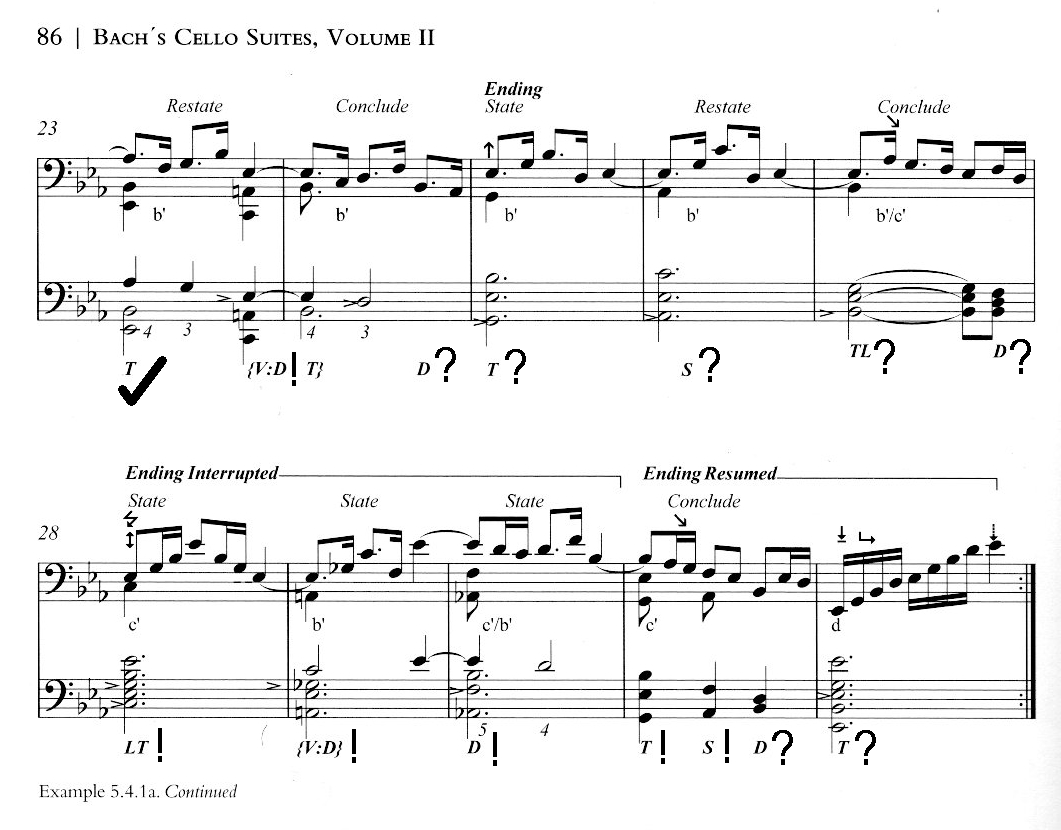
Allen Winold, “Bach’s Cello Suites“, Indiana University Press, Bloomington 2007 Allen Winold,
Winold Sarabande Es korr

musical examples mm 23-32 (Exclamation marks, question marks and hooks added)


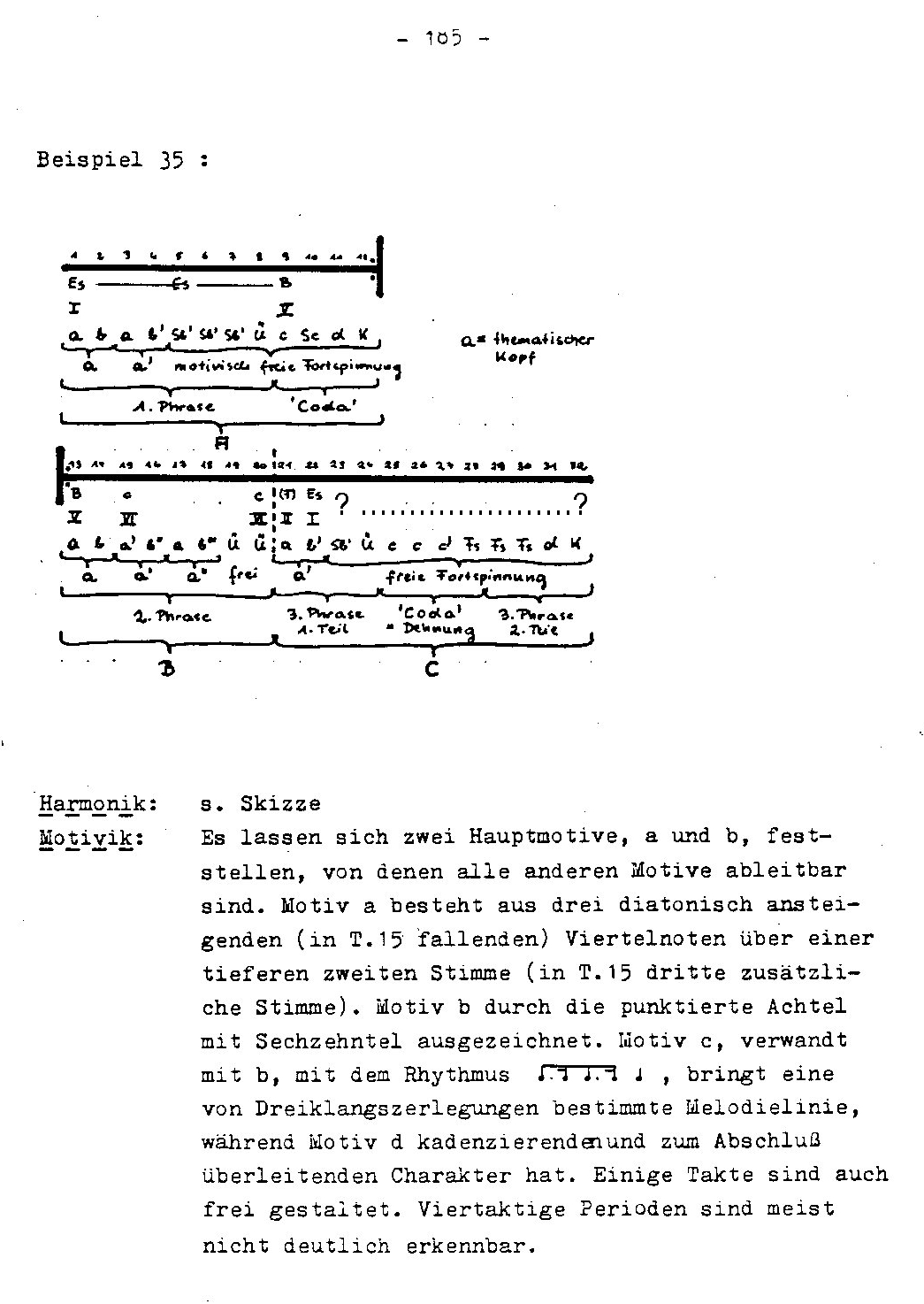
Ingrid Fuchs, “Die Sechs Suiten für Violoncello solo“, Diss. Wien 1980 Ingrid Fuchs,
Ingrid Fuchs Sarabande Es korr

harmonische Skizze der Sarabande in Es-Dur (questions marks added)


Urtext = Plain Text ? – An Analysis of the Sarabande in Eb Major, Part 2 (Bar 13-24)

Britain

This is a translation of the post

Urtext = Klartext? – eine Analyse der Sarabande in Es-Dur, Teil 2 (Takt 13-24)

by Dr. Marshall Tuttle.


Michael Bach

This is the second part of the analysis of the

Sarabande in E Flat Major

with performance examples

and the interpretations of the cello competition *)


For glossary and facsimile of the manuscript of Anna Magdalena Bach see Analysis Part I:
https://www.bach-bogen.de/blog/thebachupdate/urtext-plain-text-an-analysis-of-the-sarabande-in-eb-major-part-1


Sarabande Es Edition MB 004

Sarabande in Eb, Edition Michael Bach
Sheet music example mm 13-16
Slurs that are understood from the polyphony and therefore not notated by JSB are added in parentheses.

M 13

The beginning of the second half of the movement is linked with the tonally indeterminate open fifth at the beginning of the movement. At the same time, this fifth corresponds in a peculiar way with the preceding trill, because the two pitches represent the basic sounds of the dominnat (Bb2) and the DD (F3). On top of that, surprisingly, the note Ab3 sounds without a bass note on the 3rd beat. (In the lower part of this measure there is only a half note, Bb2. The quarter rest on the 3rd beat is missing because it is unnecessary to notate.) Thus, it is questionable whether the note Ab3 on the third beat, is to be regarded again as a seventh. Due to the fact that the two notes in the upper voice are slurred, the note Ab3 on the 3rd beat is highlighted. It is also connected to the first beat of the following measure.

M 14

The bass now does not present Eb2 and Bb2 as in m. 4, but rather B4 as the third of the chord. The note Ab3, 3rd beat of the previous measure in this measure is the ninth of the SD of the Rel. This harmonic shift mirrors the harmonic action of mm 6-7 (with the notes Db4 and E3). The lower voice is reduced to a dotted eighth note so that the subsequent sixteenth note F3, the seventh of the SD, is highlighted as a chord tone. The slurred three sixteenth notes in the 3rd beat again accentuate F3 as the chord seventh.

M 15

The three chords of m 15 are played forte: First, because of the upwards octave leap; Second is the concentration of single chords, consisting for the first time in this movement of a sequence of chords that is unambiguous; Third, there appear here for the first time both the Rel and the SR, which interfere more and more in the harmonic action in the second half of the movement; And fourth, the first chord, i.e. the Rel, is approached by a series of three bound sixteenth notes and is therefore stressed. The Rel follows its s6-chord and its DD7 chord.

M 16

The resolution of the DD7 chord does not occur immediately in m 16 because this chord (as in m 6) again contains two harmonies: the SD of the Rel, and the SDD of Rel (root notes G2 and D3, respectively) both without their third. The dotted eighth note in the lower voices accentuates the subsequent sixteenth note A3, which belongs to the SDD. But, the next two measures unequivocally express the SD of the Rel.


Note:

To express the ambivalence of this chord, it is recommended to sustain all pitches equally (see m 6) and then subsequently to mute the open strings with the appearance of the sounding of the A3 string.


Sound example mm 13-16

*

How was this passage performed in the cello competition?

Interpretation of mm 13-16 by the 11 participants

The performances of cellists are all relatively the same: the chords were broken, although with the concave bow, three notes in the forte would be feasible. The emphasis on the Rel in m 15 was missing in all interpretations. Some cellists transformed the sixteenth notes to thirty second notes. Also, often the bass B2 in m14 note was shortened. A single cellist shortened the bass note Bb2 of m 13 to a quarter note and simulated a “slur” on the note C4 in mm 15f by simply omitting the C4 in the upper part of m 16 . A tie is not justified, as it would negate the suspended fourth, and consequently the harmonic ambivalence of that chord


*

Sarabande Es Edition MB 005

Sheet music example mm 17-20

M 17

What follows now is not return to the Rel, rather by means of a half step alteration the expected pitch Eb3 is substituted by the surprising pitch E3 sounding with its tritone Bb2: the SD of the SR is achieved. The SR appears on the second beat, as in m 15, but without the dissonant added sixth and now prepared with its SD. The octave g2-g3, however, remains harmonically vague, since the third is missing. The two notes will rather be considered as passing notes. This octave now initiates a development that is characterized by an entanglement of SR, Rel, and its SD, and DR, harmonies, which are sliding through by means of stepwise motion.

M 18

The first chord in m 18 can not be unambisuously interpreted as the SR, and the octave g2-g3 in the previous measure can not be considered as its SD. Rather, the chord of the first beat could also be the SD of the Rel, with the ninth Ab3 in the upper voice, the seventh F3 in the bass and a suspended fourth C3 in the middle voice. This chord is also ambivalent as those of mm 6 and 16. The second beat confirms the SD, which resolves to the Rel.

M 19

The tie of the upper part C4 of the previous measure indicates that the pitch also belongs to the subsequent harmony: The root C4 of the Rel becomes the fifth of the SR. However, it lacks the third Ab3. The continuation via the attached sixteenth note D4 to the fifth G3-D4 on the second beat can be seen either as the DR or as the SD of the Rel due to the absence of the third: major or minor? The “harmonic inertia of hearing” tends towards the SD as in the previous measure the B3 was sounded.

As a result of the quarter note and half note in the lower part of m 19, the upper voice is tied in accordance with an emphasis on the second beat. The dissonant fourth G3-C4 at the end resolves not in two parts, but rather clarifies itself quite simply to the single note C4 in the next measure.


Note:

On the top note D4, a trill is often performed, but this is misplaced because with a trill D4-Es4 the third of the Rel or a suspended sixth of the SD would be introduced. This passage “thins”, as more and more thirds and sixths are left out of the harmonies, in order to end on an isolated, fragile C4.

In addition, the top note Eb4 is reserved for m 21.


M 20

The gradual transition to the Rel is completed with the appearance of the third, Eb3, on the 2nd beat. The last sixteenth note, Bb2, however, can not be interpreted as the seventh of the SD of the DD which actually appears, but unexpectedly, because that Bb2 is a diatonic pitch of the Rel and is understood as such in this context. This means there is no modulation, so it lacks the third E3.


Sound example mm 17-20

 *

How would this passage be performed in the cello-competition?

Interpretation of mm 17-20 by the 11 participants

In this passage, the lower voice was almost always reduced in time, especially in the two-part passage of m 17, where a kind of chord breaking was unnecessarily imitated, because the two voices can be easily performed with the concave bow as notated. The same applies to the mm 18f, where almost always the sixteenth note D5 and without exception the eighth note C5 sounded alone. One of the cellists shortened even the sixteenth notes to thirty-second notes, some other cellists also exhibited that tendency. In mm 18f another cellist curiously imitated relatively often the bowing style of three-part passages with the concave bow “tie-play” (eg mm 1-4 ) in which the note C4 in m19 was omitted, playing only the note F3, even though two voices as notated are easily executable. The note Eb4 was always added in m 19, in all cases as trills, except in one case as a long suspended Eb4.


*

Sarabande Es Edition MB 006
Sheet music example mm 21-24


M 21

All the more surprising, after the consistent absence of thirds previously, and as a result of a further half step move, is the entry of the bass note A2 instead of Ab2, which now appears as the third of the DD. The DD came in this movement, despite powerful intensification in mm 5-7 not yet properly ?in sequence?. However, here it is at once “in place”, without a preparatory SD.

The octave leap in the upper voice (similar to m 15) additionally causes an intensification of the sound.

The third A2 in the bass is very important, because with it the motif of the “empty” fifth at the beginning of the movement is now rendered “concrete” with the addition of the third to the harmony. It is the last time that this motive will appear and at the same time the only time where the DD rules unchallenged, now introducing energetic passages.

The DD is clearly established with a three-part chord. The harmony is perfectly clear and the subsequent notes, especially the seventh Eb4, now no longer requires the root F3. Therefore, in the first beat, the note F3 is shortened in the lower voice to a quarter note. The upper voice can now sound brilliantly.


Note:

There is yet another reason for the three-part chord: The answer is provided later in m 23 with the irregularly notated chord on the 3rd beat. This “premature” or additional focus effect in 3/4-time due to the three regularly positioned chords approaching respectively on the first beats of mm 21-23, is thus more “out of sequence” and therefore more expressive.


M 22

In the second beat of m 22 the familiar resolution of the suspended fourth to the dominant appears, with its third D4 in the upper voice. As a result of the slur in the first beat, and the lack of slurring in the previous measure, it also receives an accent. Clearly, in this and the following measure, the emphasis is on the chord, as well as on the 2nd beat. In contrast to mm 2 and 4 this results in a sustained forte .

M 23

A corresponding resolution to the tonic with stress on the second beat occurs in m 23.

Now, on account of the deep bass note C2, the heavily accented chord on the 3rd beat poses a harmonic puzzle. It looks like a DD7-chord, but turns out to be a s6-chord with root note C2 and with an added major sixth A2. This interpretation is actually “enforced” by the tie, because a seventh Eb3 of the DD7-chord, as explained above, can not be bound to the suspended fourth of its resolution (see opening measures).

Second, in order to specify the DD7-chord it would be sufficient to notate the tritone alone. The bass note C2 is not resolved. It can not, in the case of a DD7-chord, be resolved to Bb1, which exceeds the lower range of the cello. The note C2 shifts, actually merely on account of its sonority and force (open C-string) to the tonic keynote from F2 to C2.

The note C2 therefore remains valid as the root over the bar line. That is, it “plays” in about the same way as in m 5 where it indicates there is no chord change at the beginning of the measure. The harmonic twists happen, just as in m 5, only here in the course of m 24. (It is recommended that to allow the C string to resonate beyond the end of the measure.)

And third, a return to the DD7-chord is, according to the harmonies of the previous measure (DD7 – Dom – tonic) unlikely, because in the “Suites” of JSB there are no harmonic “repetitions” – unless, an identical motive is directly repeated.

With the s6-chord the harmonic puzzle continues. But what happens to these harmonic and metric interruptions?

M 24

In the lower voice a relatively inconspicuous eighth note Bb2 now appears, exactly as in m 5. It acts like a passing note. A deliberate and unequivocal resolution of the tritone would have a significant quarter note result. A resolution on the first beat is excluded for a moment, so it is unclear here just as it was in m 5 how the harmonies will progress.

Due to the (unstressed) note D3 in the 2nd beat, and the sixth A2 of the s6-chord in the previous measure, the SD of DR may be suspected. For the adoption of a SD of DR, that would normally follow the s6-chord, the third F#3 is lacking, because we hear instead F3, the minor third.

Then in the third beat, deviating from m 5, there is no quarter note Ab4, and the D7-chord is not clear. Rather, what happens here is a diminuting reconciliation, similar to m 8, for the DR, only here the minor character is more explicit.

Sound example mm 21-24

*


How was this passage performed in the cello competition?

Interpretation of mm 21-24 by the 11 participants

The surprising DD chord at the beginning of m 21 was always broken, and the intensity of this harmonic eruption was never dynamically highlighted. In general, the ties in the first beats of mm 22f were not performed nor the dissonant harmonies of the upper voice, in particular the sixteenth notes with the underlying fifth. Sometimes, however, even the top note of a chord was omitted, following the oft repeated pattern “syncopation – imitation”. In m 21, a single cellist prolonged the lower voice to a half note and so imitated m 13, which (as explained in the analysis above) is absurd. Because this measure is comparable neither with the mm 1 and 3, or even m 13 in its harmonic development.


*)

Cello-Competition for New Music and award of the Domnick Cello Prize

Staatliche Hochschule für Musik und Darstellende Kunst Stuttgart, Germany

January 20-25, 2014


The Participants:

Charles-Antoine Duflot
Raphael Moraly
Armand Fauchère
Magdalena Bojanowicz
Darima Tcyrempilova
David Eggert
Hugo Rannou
Minji Won
Beatrice Holzer-Graf
Hanna Magdaleine Kölbel
Jee Hye Bae


Urtext = Plain Text ? – An Analysis of the Sarabande in Eb Major, Part 1 (Bar 1-12)

Britain

This is a translation of the post

Urtext = Klartext? – eine Analyse der Sarabande in Es-Dur, Teil 1 (Takt 1-12)

by Dr. Marshall Tuttle.


Michael Bach

This is the first part of the analysis of the

Sarabande in E Flat Major

with performance examples

and the interpretations of the cello competition *)


Interpretation of the “Sarabande in Es-Dur”
Michael Bach, Cello with BACH.Bow

https://youtu.be/-Vz9Qs3TiWA


Sarabande Es-Dur AMB-
Copy by Anna Magdalena Bach, digital scan of the Staatsbibliothek in Berlin – PK


Glossary

JSB = Johann Sebastian Bach
AMB = Anna Magdalena Bach

2-slur, 3-slur, 4-slur = Slurs over 2, 3 or 4 notes.
Three 2-slurs = three slurs over 2 notes
m, mm = measure, measures

C4 = middle C

Sub = Subdominant
Dom = Dominant
Rel = Relative minor
SR = Relative minor of the subdominant
DR = Relative minor of the Dominant
DD = Dominant of the Dominant
D7-chord= Dominant seventh chord
D9-chord = Dominant ninth chord
s6-chord = Minor subdominant with sixth instead of fifth (ii6 chord)
SD = Secondary dominant
SDD = Dominant of the secondary Dominant


Foreword

The analysis of the “Sarabande in E Flat Major” by JSB presented here is offered in comparison to the individual interpretations of the participants in this year’s Cello Competition for New Music in Stuttgart* ). This is to elucidate the extent to which today’s current interpretations do justice to the original manuscript. In this “Sarabande” there are no significant deviations in the Urtext editions from AMB’s copy, and there are no scribal errors on the part of AMB. Nevertheless, a performance convention has been established that modifies the musical text. This relates to the polyphony, to the slurs and to the addition of “ornaments”.

It does not seem to be common knowledge (even the Urtext editions do not consider the following) that in polyphonic passages the longer note values dictate the bow stroke. That is, the sounds of other voices which have shorter note values, are slurred accordingly, for example, here in the opening bars.

More important than the slurs, however, are the accents that are implicitly notated. Consequently, the slurs allow clear conclusions to agogical and dynamic processes. Thus, JSB therein had an effective, and at the same time flexible notational symbol at hand.

In general, the slurs are identical to the bow strokes. Nevertheless, for technical reasons, a stroke of the bow can be changed once. The key remains that the meaning of a “compositional” slur is recognized and the resultant sound is implemented accordingly. Nevertheless, the slurs are in the “Suites” almost always identical to the optimal bow strokes. The two exceptions are in this “Sarabande” measures 29f

Ties do not cause accentuation, as they merely extend a pitch. However, in this movement something else is very striking, namely that JSB decidedly notated ties across the barline. In some interpretations this resulted in the misconception that a tie is missing in the first and third measures on the pitch Ab3 and Db4, which would have to be supplemented as well as sometimes in similar looking places.

And so, once again we are brought back to the harmony. Because only deep harmonic analysis gives us the crucial insight as to why no ties are present, for example, in the first 4 measures. The formative ties in this movement are therefore to be understood less as articulatory binding, but rather as a sign that creates harmonic meaning. In the cello competition a mistaken understanding of the meaning of the tie, resulted in ties often being applied to all similar looking musical motives without consideration of their harmonic context.

The usage of ties in this “Sarabande” also explains, for example, why in m 23 the s6-chord is articulated rather than the DD7-chord. This makes it possible to tie the note Eb3 to the note Eb3 of the first beat of the following measure, and has an impact on the weighting of the individual chord tones with one another. The “absence” of a tie in the opening measures, for example, gives us the indication that the seventh of a Dom chord (Ab3 in m 3), and the suspended fourth of its resolution (in musical notation the same note Ab3) is, strictly speaking, not the same pitch frequency. This leads to tangential topics such as micro-tonality.which deal with issues beyond the intonation of tempered tuning.

The key of E flat major is strengthened in the opening measures of the “Sarabande” with its Sub and Dom But the DD, expected in m 8, is “denied” in the first half of the movement, a fact which disturbs the listener. The DD occurs later in m 21, “belatedly” so to speak, and in conjunction with the opening motif, but only once, then all the more surprising and heroic.

In contrast, the minor keys play a dominant role, although they are more likely to remain in the background. They are often confused with the Dom or the DD. They (the minor keys) bring something like anexus of harmonic gravity, but their chords do not explicitly appear.

An outstanding feature is the trill at the end of the first half of the movement. It can be demonstrated that in the Cello Suites no ornaments exist that can be understood in the traditional sense as beautifying or decorative embellishments. Trills in the Cello Suites are always an indication of two or more oscillating harmonies. This trill on the root of the Dom, not on its third, also creates an open end to the first half of the movement, because its resolution is missing. The somewhat clueless trilling of some of the artists in the cello competition is discussed below.

The Curved-Bow-specific issue is not presented in this analysis, although the included sound examples are performed by me with the curved bow. However, there are two places that are definitely not feasible without the curved bow: mm 30f. For other passages the curved bow offers various modes of bowing that correspond to the compositional structure according to the motto: the best instrument is just good enough for JSB.

The polyphony, especially with regard to the note values, is precisely notated. JSB has written nothing alterable in these works. Every pitch and every note value, as well as every slur and every trill has its explanation. The transcript of AMB bears witness.

 *

The Slur-Code

Here I codify some insights that have emerged from my detailed analyses of all the “suites” in the copy of AMB, almost as axioms advance. I call them the “slur-code” in the works for solo cello. In this Sarabande, the following rules apply:

1

The first note under a slur is emphasized, as is the first note after the slur. The longer the slur, the stronger the subsequent noteis emphasized and the weaker is the first note of the slur. This sometimes leads to the extreme case that an exceptionally long slur has to start very quietly, while the subsequent pitch is very strongly accentuated (e.g. m 13 of the “Allemande” in G Major).

2

When one slur directly follows another, the first note of the second slur receives emphasis, and the subsequent, linked notes decrescendo. The first note after the second slur is consequently unstressed.

3

Slurs are not notated when the polyphony makes their necessity clear.


Analysis of the “Sarabande in E Flat Major
… and its interpretations in the Cello Competition *)


Sarabande Es Edition MB 001

Sarabande in Eb Major“, Edition Michael Bach
Sheet music example mm 1-4

Slurs that are understood from the polyphony and which JSB therefore did not have to notate are added in parentheses.


M 1

The open fifth at the beginning lacks the third. (This harmonic ambiguity is in contrast to m 21, where the same motive ipresented in DD with its third). Only with the second note, C4, is the major key clear. The following seventh Db4, sounding with the bass note Eb3, discloses the dominant character of this initial measure. The upper voice is slurred, because in the lower voice a dotted half note is notated.

M 2

The first beat is emphasized due to the three-part chord and, according to the “Slur Code”, because the relatively long slur of of the previous measure naturally creates an emphasis. Also in the first beat of m 2, the upper voice is slurred, since a quarter is notated in the lower voices. According to the “Slur Code”, this first beat gets a decrescendo. The suspension resolves to the third C4 in the second beat, which is thus unstressed.

M 3

This measure begins with an upbeat of three slurred sixteenth notes. Thus, the first beat of m 3 is at this time, in contrast to m 1, emphasized. It follows that the entire m 3 receives a decrescendo.

M 4

It follows further that the first beat of m 4 is now unstressed, despite the three-part chord. The resolution of the suspension to G3 on the second beat is now anticipated after the first two measures by the listener. On account of the slur in the first beat, the resolution to the third G2 of the tonic on the second beat is then slightly accented. The tonic is for the first time clearly established.

Note

In m 2, the short decrescendo and crescendo are balanced so that the m 3 returns to its end at about the samevolume as the beginning of the phrase. Had JSB intended to repeat the dynamics (ie were a crescendo in m 3 intended) the three sixteenth notes would not be slurred. But a repeat of the dynamics of mm 1 and 2 would contradict the harmonic development tonic-Sub-Dom-tonic, which relaxes with the resolution to the tonic in m 4. In addition, a repeated crescendo and decrescendo in these 4 measures would structure the phrase into two 2-measure units that would split the cadential introduction. Particularly revealing, therefore, is the emphasis on each of the first beats of mm 2 and 3 (Sub and Dom), the unstressed first beats of mm 1 and 4, and the accent on the third of the tonic in m 4, so that the cadential conclusion is precisely located.

To further highlight the emphasis on the Dom, a chord in m 3 would be conceivable but illogical, since the subject is marked by the sound of an open fifth without a third. A chord with third at the beginning of this motif is reserved solely for the DD in m 21. A chord in m 4, however, is inevitable on the cello, as a result of the leap of a fifth downward in the bass, because the middle string sounds inevitably if the two outer strings are played. The bass note Eb2 is necessary to specify the suspended fourth in the upper voice.

These four opening bars show precisely how JSB intended the design of the opening cadence. He just needed to write down a single slur, on the three sixteenth notes of m 2. The other slurs, including accents and dynamics, arise naturally from the notated polyphony.

The opening cadence can be seen as a harmonic unit. It is the most prominent feature of this movement that is persistently avoided, except for a few prominent places, new beginnings or separations. Not even the two halves of the movement are clearly separated., because tthe trill destroys a clear resolution to the Dom and does not indicate a stablefinal note.

Moreover: For the repeated notes in the upper voice (the seventh Db4 and the suspended fourth Db4, and the seventh and fourth Ab3 respectively) each is strictly speaking not the same pitch. You could even intone the Seventh slightly lower than the fourth, as a kind of overtone of the fundamental, because it sounds along with the root. (In just intonation the pitch relationship of the two notes Ab3 in the mm 3 and 4 would be the fourteenth (seventh plus fifth) 3/2 x 7/4 = 21/8 = 63/24, and the eleventh (octave plus quart) 8/3 = 64/24. At a frequency of the root note of 78 Hz = Eb2, the Dom of the seventh would be 204.75 Hz and the fourth of the octave would be 208 Hz, which means a difference of about a quarter-tone. (In this pitch range the semitone is approx. 12 Hz.


*

How was this phrase performed in the cello competition?

The performances in the competition rarely implemented the two voices and the legato in the upper voice in mm 1 and 3. Never was the upper voice slurred in the first beats of mm 2 and 4.Sometimes the seventh on the third beat was mistakenly tied to the suspended fourth in the following measure simply by omission of the repetition of the tone in the upper voice on the first beat. Thus, the syncopated patterns of other places was approximated.(see Preface), because with the concave bow only a fictional slurring can be imitated. Bowing the two bass notes requires the upper note to be abandoned.

In addition, all participants in the cello competition demonstrated variants leading to shortening of the bass notes that would otherwise be repeated due to a bow change. But, the shortening of the bass notes in the performances is neither justified by an analysis of the score nor by any performance traditions. (It was also not taken into account that in JSB ‘s notation, mm 13 and 21 do contain shorter bass notes, in contrast to mm 1 and 3. There is a differentiation whose harmonic sense will be explained at the appropriate time.)

*


Sarabande Es Edition MB 002
Sheet music example mm 5-8

M5

The next passage up to and including m 7 now shows why twice a tie occurs over the bar line, but not in m 6. The note Eb3 in m 4 is connected to the first beat of the following measure, because the tonic remains unchanged. A change of harmony or resolution does not happen at this time. In the lower part the 1/8-note Bb2 appears as fifth of the tonic chord. You can not interpret this note as the root of the Dom because the third is missing, and JSB shortened the Bb2 to an 1/8-Note. Therefore the note C3 in the upper voice of the first beat is not tied, and so the note D3 on the second beat is not accented. The dominant function remains for the time being in limbo. Only with the note Ab3 on the third beat, similar to the first and third measures, is the dominant audibly established.

It is perhaps perhaps somewhat speculative at this early point in the “Sarabande“, but a faint foreshadowing of the D Rel might already be intended with the notes Bb2 and D3. The D Rel is never achieved in the entire movement, but it is latently present in many places. Instead of D Rel to suspect the T Rel here would be even slightly more likely, because the sixteenth note C3 is not connected and, together with the Eb3, can be heard as a chord tone of T Rel. These considerations mean that with any new entering pitch of m 5 different harmony can be expected: with C3 the T Rel; with D3,the D Rel; with F3 the Dom Only the tritone D3-Ab3 clarifies the harmonic situation finally to the Dom With the syncopated tie the note Eb3 thus creating a “harmonic vacuum” that occurs directly after the opening cadence. This is puzzling, and is a powerful dramatic agent that is developed more fully in m 24.

M 6

Measure 6 begins with two harmonies, the tonic (Eb2 -Bb2) and the Dom (Bb2- Ab3) shown by articulation and the note values of the chord. The third beat of the preceding measure, here the seventh Ab3, is not tied into the next measure as it was inm 4 to m 5 previously. The articulation does not follow the motivic patterns of mm 2 and 4 and does not lead to the familiar harmonic sequence, a resolution on the second beat. The subtle difference in notation can be found in the shortening of the two lower notes to a dotted eighth, making the remaining sixteenth note F3 a chord tone, the fifth of the Dom Thus again, the second beat (note G3) is unstressed, so that a resolution to the tonic will be placed on hold.

In order to express the harmonic ambivalence of this chord, it is advantageous to play all three notes of the chord simultaneously and of equal duration, as an unresolved dissonance.

With the second beat (note G3) the tonic is apparently achieved, but the top note Db4 on the 3rd beat acts as seventh. The tonic is transformed into a SD. But,due to the fact that there is no Eb3 notated in the bass, JSB has not yet clarified a final unambiguous position on harmonic function of this chord.

M 7

The seventh Db4 is now tied to m 7. In the lower voice surprisingly, the note E3 appears. At first, it is unclear which of the two notes is dissonant. Theoretically, the note E3 could be a neighbor tone, which would return to Eb3. And so, the note Db4 would still be the seventh of the previous measure which could end up in a resolution to the Sub, as in m 2.

But the lower voice does not resolve, and the further course shows with confirming repetition of the third E4 that the harmony of the measure has been transformed, with the notes Db4 and E3 to a D9-chord, namely the SD of the DD. The note E3 is the third. It is indeed shortened to a dotted eighth note but should be fully sustained in order to highlight this surprising twist.

Note

The tieing of the note Db4 actually suggests the continuation of the existing harmony. Nevertheless, a change of harmony takes place. What is interesting is that the seventh of the tonic Db4 (m 6) and the Ninth Db4 of the SD of the DD (in m 7 ) have the same frequency and their slurring is thus possible. (The interval ratio of the fundamentals of the SD of the DD (C3) and of the tonic (Eb4) is a minor third, ie 6/5, and therefore in just intonation the frequency of this natural seventh calculated from C3 would be 6/5 x 7/4 = 21 /10 and that of the ninth of the SD of the DD (fifth and tritone) would be 3/2 x 7/5 = 21/10. Without the use of the 7th partiall calculated because the seventh does not sound together with the root note: minor seventh over minor third 6/5 x 16/9 = 32/15 and octave plus minor second 2 x 16/15 = 32 /15.

Thus, the meaning of harmonic ties over the barline is comprehensible. It becomes clear how closelythe requirements of just intonationthrough pitch relations on integer ratios are related to harmonic processes. JSB was clearly aware of this.

The question of why the lower voice in m 5 is reduced to an eighth note while in mm 6 and 7 only to a dotted eighth note is explained by the fact that in m 5 the harmony is consonant and a harmonic change is only indicated but does not take place, whereas the chords in the first beats of mm 6 and 7 are dissonant. But finally,they leave nothing to the direction in which they are resolved. With the shortening of the bass notes by a sixteenth note an accentuation of the second beat is also avoided. The emphasis in mm 5 to 7 is instead rather on the 3rd beat, including the upbeat sixteenth note, because the new harmony only manifests itself at this point.


M 8

After an ostentatious break due to a sudden octave leap down, the answer to this highly demanding harmonic development remains in the future. Actually, one expects the final DD. However, what sounds is the dissonant fourth F3-Bb3, and it is again unclear which tone will “resolve”. In theory the transformation of the lower note, so here the note F3 to the E3 of the previous measure is conceivable. This would mean a further sounding of the SD.

But there follows the resolution of Bb3 to A4 so that the DD would be much more realistic. However, an extremely unusual slur is now on these two notes, so that the resolution on the 2nd beat is not being highlighted. It is one of the very rare cases in the “Suites”, where the resolution is attached to a suspension. Also, the lower note F3 is not continued in the 2nd beat, which would consolidate the DD, and which would be easily playable.

Both the slur and the “thrifty” quarter bass note F3 cause the slurred note A3 to appear not as a resolution but as a passing tone. The DD becomes “quite small”. Another possible goal would be a false resolution to the minor of the DD, i.e. D minor. This also suggests that the “Sarabande” develops further on in the minor keys.

In any case, JSB frustrates a triumphant conclusion after the three-bar increase and the declamatory turning point. The last sixteenth note Eb3 evaporates over into the next cycle.

Note:This harmonic process is very reminiscent of the “undermining” of the Rel in m 14 of the “Prelude” in G Major (see analysis of the ” Prelude“, part 2).


*

How was this phrase performed in the cello competition?


Some performers shortened the note values in the lower voice, some elongated the note F3 in m 8, to illustrate the resolution to the DD. Some eliminated even the notated Ab3 in the upper part of the 1st beat in m 6 to simulate a syncopated tie because the concave bow does not allow three voices here. The dynamic development here, i.e. the 3-bar increase and the “scared” withdrawal in m 8 remained unclear, and so the distinct caesura before m 8 was rarely realized.

*

Sarabande Es Edition MB 003
Sheet music example mm 9-12

M 9

As described, the “resolution” to DD in m 8 of the composition is not presented very convincingly. The fluctuation or blurring of harmonies is now continued by JSB. In the last passage of the first half the DD, the Dom, and the tonic, establish a close relationship. Their relative minors, however, occur in subsequent measures in an equally harmonious action. Measure 9 is probably in the Dom, although a touch of Rel of the DD is maintained from the measure before, because of the D3 sounding bass note. In this interpretation, the note Bb3 in the upper voice would be an added sixth, which in the second beat resolves to A3 (sixteenth note). The quarter note D3 in the bass implies that the octave D4 in the upper part is slurred and the top note F4 is to be emphasized.

M 10

The lower voice Eb3 in conjunction with the upper voice Bb3 in m 10 suggests the tonic. The fact that it also has a quarter note value, causes the upper D4 to be heard as a dissonance (major seventh). The top note G4 is particularly emphasized as a result of the longer tied two beats.

This dissonance Eb3-D4 shows the harmonic ambivalence of this measure, because it could also be interpreted as Dom, with a note Eb3 as a passing tone in the bass. Or, what moves during the “Sarabande” more and more in the realm of possibility, the DR appears here. The note Eb3 would be an added sixth in this interpretation. (In the second half of the movement, the Rel is obvious in m 26 because this harmony has already been clearly introduced in m 15.)

Incidentally, this dissonance Eb-D4 in the first beat is taken up again and continued as a tonal characteristic in m 27ff in the second half of the movement. Anyway, it should sound clearly, because the following high note G4 shines particularly radiantly.

M 11

The Eb3 from the previous measure is not resolved in this measure to D3 but continues to the note F3. Since the lower part is a quarter note, the upper voice is tied. Now the note A3 sounds together with F3 (as opposed to m 8). The note A3 belongs to the Dom and the DD, but also to their Rel. The following emphasized F3 on the 2nd beat can extent the implication of the DD or the Rel of the DD.


Note

From m 8 there are ambiguous harmonic interpretations conceivable which are parallel. Simplifying is a possible progression in major: DD – Dom – tonic – (DD) – D (tr ?). The other possibility is in the minor: Rel of the DD – Rel of the D – Rel of the DD -Rel of the D (tr). This major-minor ambiguity dominates the entire second half of the movement, leading to the harmonically exuberant five closing bars.


M 12

The trill C3-Bb2 on the final note of the first half of the movement obscures the arrival of the Dom, or D Rel. Besides, how is it actually to be understood: Is this a trill on the root of the Dom? Can it be understood as a trill on the third Bb2 of D Rel, or even as an indication of C3, the root of Rel. This trill acts “unreal” because it follows no regular resolution. The note that would provide completion or “closing harmony” is obviously lacking. Perhaps we can explain this trill only in retrospect, after analysis of the second half of the movement. For it will become more and more obvious, such as the mm 28 and 32, that the chords of two latent harmonies often differ in only two pitches. This leads to the question, to what pitch should this Bb2 trill, C3 or A2? The first option sounds like “Major”, the second like “minor”, which would further lead to the D Rel. But more likely is the first option, because,analogous to the last measure, it turns back to the major keys. In this case, the note C3 would be unique to the DD, the note Bb2 would then stand for the Dom So the trill of m 12 represents a “flicker” of the DD, which still maintains its presence.


 *

How was this phrase performed in the cello competition?

All dotted rhythms were, uniformly, played exactly as in the previous 4 measures, ie the lower voice was reduced to an eighth note and the upper voice was not slurred.

Thus, the intervals D3-D4, Eb3-D4 and F3-A3 were not performed, with an expressive legato in the upper voice. The slurs on the respective first beats were not necessary for JSB to notate, as mentioned, due to the quarter notes in the second voice. In m 11 no emphasis was detected on the note F3 on the 2nd beat. With two exceptions, the trill was ended on the principal note, a more or less sustained B2, which is not notated.


*)

Cello-Competition for New Music and award of the Domnick Cello Prize

Staatliche Hochschule für Musik und Darstellende Kunst Stuttgart, Germany

January 20-25, 2014


The Participants:

Charles-Antoine Duflot
Raphael Moraly
Armand Fauchère
Magdalena Bojanowicz
Darima Tcyrempilova
David Eggert
Hugo Rannou
Minji Won
Beatrice Holzer-Graf
Hanna Magdaleine Kölbel
Jee Hye Bae


Urtext = Klartext? – eine Analyse der Sarabande in Es-Dur, Teil 3 (Takt 25-32)

Germany

Michael Bach

Dies ist der dritte Teil der Analyse der

Sarabande in Es-Dur

mit Klangbeispielen

und den Interpretationen im Cello-Wettbewerb *)


Glossar, Bindebogen-Kodex, Tonaufnahme und Abschrift AMB siehe Analyse Teil 1:
https://www.bach-bogen.de/blog/thebachupdate/urtext-klartext-eine-analyse-der-sarabande-in-es-dur-teil-1-takt-1-12


Sarabande Es Edition MB 007
Sarabande in Es-Dur, Edition Michael Bach
Notenbeispiel T 25-28
Bindebögen, die sich aufgrund der Mehrstimmigkeit von selbst verstehen und die JSB deshalb nicht notieren mußte, sind in Klammern hinzugefügt. 


T 25f

Die beiden Te 25 und 26 entsprechen, hier eine Quinte tiefer, melodisch und harmonisch den Tn 9 und 10. Wieder gibt es zwei denkbare harmonische Fortschreitungen, die parallel verlaufen, in Dur oder in Moll (Tonika-Sub oder Dp-Tp).

T 27

In T 27 wird, ähnlich wie in T 11, mit einer übergebundenen Note eingeleitet. Nun wird analogerweise hier die Dp (respektive Dom) erwartet. Die 1/16-Note as3 irritiert kurzfristig: Bedeutet das nun eine Verwandlung zum D7-Akkord? Die Antwort liefert der 1/4-Notenwert im Baß, wodurch die Oberstimme gebunden wird und die Note as3 nicht als eine akkordeigene Tonhöhe des D7-Akkords eindeutig klassifiziert werden kann, sondern eher als eine Durchgangs- oder Vorhaltsnote (vlg. im Gegensatz dazu die Te 6, 16 und 18, wo die 1/16-Note als akkordeigen aufgefaßt werden kann).

Wichtig ist in diesem Kontext, daß diese Note angebunden wird und die Betonung danach auf dem Grundton g3 der Dp erfolgt. Die Irritation des Zusammenklangs der beiden Töne der kleinen Septim (b2-as3) kann aber durchaus hervorgehoben werden, denn diese Besonderheit, ein dissonanter Klang auf der vierten 1/16-Note der 1. Zz, findet sich bereits im Vortakt setzt sich in den folgenden Takten fort.

Interessant ist weiterhin der Bindebogen auf der 3. Zz dieses Takts, im Gegensatz zu T 11 und T 31, was ein crescendo zum nachfolgenden Takt bewirkt.

T 28

Nun wird der Schlußtakt der “Sarabande” mit der Tonika erwartet. Es wird mit ihr aber auch die Tp stark betont, das Ende des Satzes wird also verzögert. JSB schreibt nun jeweils einen Bindebogen über den beiden 1/16-Noten der 1. und 2. Zz. Dies bewirkt eine Akzentuierung der Spitzennote es4 und der Note es3 der 3. Zz.

Es ist auffällig, daß die Baßnote c3 der 1. Zz einen 1/4-Notenwert hat. Der Bindebogen über den beiden 1/16-Noten durchkreuzt gewissermaßen die Regel des „Bindebogen-Kodex”, daß alle Noten der Oberstimme gebunden sind. Außerdem findet die andere Regel keine Anwendung, daß wenn 2 Bindebögen einander unmittelbar folgen, der 2. Bindebogen decrescendiert. Die Spitzennote würde bei einer Bindung aller Noten der 1. Zz nicht betont werden, da in diesem Fall, im direkten Anschluß an den Bindebogen des Vortakts, hier ein decrescendo erfolgen würde. JSB beabsichtigt hingegen eine kräftige Herausstellung der Tp und ebenso der Tonika (Grundton es5) in diesem Takt. Beide Harmonien sind gleichberechtigt.

Die Durchmischung dieser Harmonien, der Tp und der Tonika, demonstriert insbesondere die Tonhöhe b3, die im Tonvorrat dieses Takts mit enthalten ist. Denn die Dreiklänge der Tonika und der Tp unterscheiden sich nur durch die Tonhöhen c und b. Der Zusammenklang der Noten b3 und c3 signalisiert, im Kontext mit den beiden Noten es3 und g3, die schillernde Gegenwart beider Harmonien. Deshalb hat JSB die Baßnote c3 nicht auf einen 1/8-Notenwert reduziert, damit beide Tonhöhen c3 und b3 einmal zusammen erklingen und derart die ambivalente harmonische Situation dieses Takts signalisieren.

Das Ende der Phrase landet wieder auf der Note es3, dem Grundton der Tonika oder der Terz der Tp, die übergebunden wird, wie in den Tn 4, 23 und 25f. Ein letztes Mal wird dieses es3 betont und verstärkt den Tonikacharakter am Ende dieses Takts.

Anmerkung:

Ab dem T 25 wird infolge der Bindebögen ein sich stufenweise aufbauendes crescendo erzeugt, es gibt in der klanglichen Intensität kein Nachlassen bis zu T29.


Klangbeispiel T 25-28

*

Wie wurde diese Passage nun im Cello-Wettbewerb gespielt?

Interpretation der T 25-28 der 11 Teilnehmer

Ähnlich wie in den Tn 5f wurde nie die konsequente Zweistimmigkeit in den 1. Zzn realisiert, insbesondere nicht die dissonanten Zusammenklänge der vierten 1/16-Noten mit der Baßstimme, die regelmäßg zu einer 1/8-Note verkürzt wurde. Ein legato wurde bei den punktierten Rhythmen gleichermaßen nicht gespielt, ja manchmal sogar der rythmische Impetus durch Überpunktierungen (1/32-Noten) verstärkt. Eine dynamische Steigerung bis zu T 28 war selten erkennbar, oft wurde dieser Takt als obertönige Verzierung aufgefaßt, quasi als “Dreiklang” eines Grundtons.

*

Sarabande Es Edition MB 008
Notenbeispiel T 29-32

Mit der nun folgenden, die 2. Satzhälfte um 4 Schlußtakte erweiternden Passage verlieren oder durchmengen sich die Spuren der „tonangebenden” Harmonien. Aber die Haltebögen ermöglichen es, trotz allem ein konsistentes Bild vom harmonischen Ablauf zu liefern.

T 29

Die Note es3 bildet immer noch nicht die Überleitung zur Tonika sondern es wird ihr der Tritonus a2 hinzugefügt. Dies erinnert an den T 23, so daß der s6-Akkord erwartet werden kann. Allerdings fehlt diesmal die Baßnote c2. Die Note ges3 verwandelt sodann zu einem DD9-Akkord. Doch wieder, wie in beiden Vortakten, steht ein 1/4-Notenwert in der Unterstimme, wodurch die dissonante 1/16-Note ges3 angebunden wird. Dies trübt die Eindeutigkeit der Harmonie, ähnlich wie die Anbindung der Septim as3 in T 27. Außerdem wird mit der Anbindung nun ein decrescendo erzeugt, was den fragenden Charakter oder die abschwächende Wirkung dieser Wendung ausmacht.

T 30

Die Spitzennote es4 wird wieder übergebunden. Mit dem Halbtonschritt im Baß von a2 zu as2 wird zwar die Septim eines D7-Akkords notiert, aber warum schreibt JSB nicht einfach, so wie bisher, die Baßnote b2? Mit einer Baßnote b2, in Verbindung mit einem 1/4-Notenwert des Akkords, wäre die Dom eindeutig. Dies würde andererseits im Widerspruch zum Haltebogen stehen, da die Septim einer ZD nie mit dem Quartvorhalt der Auflösung verbunden wird. Insofern ist die Baßnote as2 nicht als Septim der Dom zu deuten, sie wirkt klanglich auch nicht in dieser Weise.

Diese Überlegungen führen zu einer anderen Deutung der harmonischen Entwicklung in diesem Takt. Mit der Halbtonrückung von a2 im Vortakt nach as2, diesmal auffälligerweise nach unten, wird die Sp erreicht. Sie hat denselben Grundton wie die DD im T 29, wobei, in beiden Akkorden, die übergebundene Note es4 als Septim fungiert, was den Haltebogen rechtfertigt.

Sowohl die Oberstimme als auch die Akkordtöne differieren nun von den vorhergehenden Stellen, die vergleichbar wären (Te 2, 4 und 22f). Die Spitzennote es4 wird bereits in der 1.Zz zur Sext d4 und Quint c4 aufgelöst. Die Akkordtöne sind deshalb auf einen 1/8-Notenwert verkürzt, so daß keine Bindung in der Oberstimme geschieht (ein Vorhalt wird in den Suiten in der Regel nicht an seine Auflösung gebunden). Dadurch, daß die Akkordtöne zu 1/8-Notenwerten schrumpfen, verdichtet sich das harmonische Geschehen.

Diese „Auflösung” oder Fortführung von der Septim es4 (Sp7-Akkord) in die Sext d4 bewirkt den s6-Akkord der Tp, der weitergeführt wird zur Dp mit Septim f4.

Der dreistimmige Zusammenklang zu Beginn des Takts ließe sich auch als S56-Akkord (Sub mit Sixte ajoutée f3) deuten, der identische Tönhöhen besitzt. Aber der Gesamtzusammenhang, d. h. die „Stimmführung” neigt eher zur Deutung als Sp7-Akkord.

Anmerkung:

Nur der Rundbogen ermöglicht sowohl die Überbindung der Septim es4 als auch den Akkord, ohne die Septim zu verlassen, so daß alle drei Akkordtöne zusammen angespielt werden können. Trotzdem ist ein Bogenwechsel unausweichlich, die Oberstimme sollte aber möglichst keine Unterbrechung erfahren (3. Zz des T 29 im Aufstrich und Akkord im Abstrich). Der konkave Bogen hingegen muß von der Oberstimme in die unteren Stimmen wechseln und verursacht eine Unterbrechung der übergebundenen Note es4. Damit wird die „andere” Harmonie suggeriert, der D7-Akkord mit Septim im Baß und es4 als Quartvorhalt. Dies steht aber klar im Widerspruch zur Notation, d. h. zum „kompositorischen” Haltebogen. Mit anderen Worten, JSB muß eine Möglichkeit gehabt haben, diese Dreistimmigkeit am Instrument ausführen zu können.

Der Sp7-Akkord läßt sich nur unter Einbeziehung des Daumens der Griffhand realisieren. Dies ist zwar ein spieltechnischer Extremfall aber kein Einzelfall in den Suiten (vgl. T 11 und „Prélude” in C-Dur).

T 31

Die Note b3 wird nun übergebunden. Sie könnte weiterhin als Terz der Dp oder als Quint b3 der Tonika gehört werden. In beiden Deutungen entsteht keine intonatorische Differenz wegen der Quintbeziehung b3-es3. Dadurch, daß der letzte Haltebogen nicht erneut einen interpretatorischen Konflikt im Sinne eines Entweder-Oder-Entscheids über die herrschende Harmonie auslöst, wird allein schon deshalb eine Entspanung der harmonischen Situation eingeleitet.

Wieder haben die Akkordtöne nur einen 1/8-Notenwert, damit die 1/16-Note as3 deutlich artikuliert werden kann (G-Saite abdämpfen). Diese Tonhöhe gehört nicht der Dp an, sondern der Tonika. Man glaubt es schon gar nicht mehr, daß die Dur-Tonarten nochmals die Oberhand gewinnen sollten. Jedoch, die Tp ist noch nicht ganz auszuschließen.

Jetzt, mit der Andeutung der Tonika oder der Tp, wird nach einem letzten Anklang der Sp in der 2. Zz nun mit der Note es3 die Sub deutlicher. Hier ist die Baßnote ebenso verkürzt, damit die Note es3, die Quint der Sub, nicht angebunden wird. Es gibt also noch keine Präferenz zwischen den beiden Harmonien Sub oder Sp. Eine 1/4-Note as2 in der Unterstimme würde den Ausschlag zur Sp geben, weil dann die Note es3 als Durchgangsnote aufzufassen wäre. Und nun, in der 3. Zz folgt die Dom, oder die Dp? Dies bleibt offen.

Anmerkung:

In diesem „Pool” von Harmonien ist trotz der Note as3, die Dp doch immer noch mit enthalten. Die Präsenz der Dp wird in der 1. Zz des Folgetakts ja sogar nochmals hervorgehoben. Die Note as3 könnte dann als kleine None oder als leittönige Vorhaltsnote zum Grundton g aufgefaßt werden. Dieses Halbtonintervall as-g wird im Schlußtakt mit dem Halbtonintervall d-es „auflösend” beantwortet.

Die leittönigen Vorhaltsbildungen sind ohnehin Thema dieses Satzes. In T 27 wurde der Vorhalt as3-g3 der Dp bereits angesprochen. In T 29 läßt sich der Vorhalt ges3-f3 heraushören. In T 30 ist es der Vorhalt es4-d4. Diese Halbtonschritte haben sich aus dem Anfangsmotiv mit Quartvorhalt herausgebildet (T 2 und T 4), indem sie auf andere Ton- und Funktionsstufen übertragen werden (None-Oktav, Septim-Sext).

T 32

Nachdem der vorletzte Takt sich noch nicht durch die parallelen Dur- und Moll-Tonarten in Richtung Tonika laviert hat, folgt nun mit der Girlande von 1/16-Noten nach oben die allerletzte Anstrengung, sich diesen spukhaften harmonischen Geschehnissen zu entwinden. Nachdem in der 1.Zz noch einmal die Dp durchscheint (ein 3er-B auf der Note g2, der die Quinte b2 der Tonika einbindet), strebt nun die Harmonik, indem die Note es3 der 2. Zz betont wird (direkt aneinander anschließende Bindebögen), der Grundtonart entgegen.

Auch diese beiden Harmonien, die Tonika und die Dp, werden, ähnlich wie in T 28 die Tonika und die Tp, durch ein Sekund-Intervall verkettet, nämlich mit den Noten d und es. Die Note d3 wirkt leittönig, wobei der Schwerpunkt des Schlußtakts auf der 2. Zz und nicht auf der 1. Zz liegt. Diese Innendynamik, bedingt durch die Setzung der Bindebögen, belebt die über 2 Oktaven aufsteigende Linie.

Die 2. Satzhälfte endet deshalb nicht mit einem triumphalen Tonika-Klang. Weder ist die Baßnote es2 betont (kein Bindebogen in der 3. Zz des T 31, aber ein Oktavsprung nach unten) noch die abschließende Spitzennote e5, die mit einem decrescendo erreicht wird.

Schlußbemerkung:

Die letzten 4 Takte zeigen in gesteigerter Form die mehrdeutige harmonische Fortschreitung. Während in T 29 die DD mit ihrer None noch relativ eindeutig ist, setzt urplötzlich mit der Überbindung der Spitzennote es5 und dem Akkord in T 30 eine Episode ein, die so mehrschichtig ist, daß die harmonische Komplexität nicht leicht auf einen Nenner gebracht werden kann, und zwar in dem Sinne, daß dem Cellopart eindeutige Akkorde unterlegt werden könnte.

Es liegt zwar auf der Hand, diesen Takten die Harmoniefolge DD9-D7-T (Sub-Dom)-T zu unterlegen, was viele Analysten**) tun. Diese vordergründige harmonische Auslegung beschreibt den Schluß der „Sarabande” indes nicht annäherungsweise. Die beiden Haltebögen konterkarieren außerdem klar diese simple Deutung. Es kann nicht angenommen werden, daß JSB nach all diesen harmonischen Exkursionen zu einem derart banalen Fazit kommt.

Der 2. Satzteil neigt mehr den dunkleren, tieferen Registern in den Moll-Tonarten zu, wobei erst der Schlußtakt wieder zu Es-Dur emportaucht.

Klangbeispiel T 29-32

*

Wie wurde diese Passage nun im Cello-Wettbewerb gespielt?

Interpretation der T 29-32 der 11 Teilnehmer

Für die 1. Zz des T 29 gilt gleiches, wie in den vier vorangegangenen Takten, denn kein Cellist realisierte den Zusammenklang der None ges3 mit der Baßnote a2. Einige Cellisten simulierten die Überbindungen der Oberstimme in den Tn 29ff, indem nur die beiden Baßtöne der Akkorde gespielt wurden, ohne die Oberstimme fortzuführen. Andere hingegen arpeggierten den Akkord, so daß die Oberstimme zweimal angespielt wurde. Dadurch werden diese Takte denjenigen angeglichen, die einen Quartvorhalt beinhalten. Der Schlußtakt wurde regelmäßig mit einem Schwerpunkt (und einer Dehnung) auf der Baßnote begonnen. Einige fügten der Abschlußnote es4 eine Verzierung hinzu.

*

Mehrstimmigkeit mit dem Rundbogen

Auch wenn die Interpretation dieses Satzes mit dem heute gebräuchlichen konkaven Bogen möglich ist, so hat der konvexe Bogen (Rundbogen) an zentralen Stellen der Komposition große Vorteile, z. B. in T 21, wo im Baß die Terz a2 der DD, die hier -endlich- zum 1. Mal erkingt, mit dem Rundbogen für die Dauer eines 1/4-Notenwerts voll ausgehalten werden kann. Gleiches gilt auch für den Grundton c2 des s6-Akkords in T 23. Die Te 29ff lassen sich einzig und allein mit dem Rundbogen in der notierten Form, mit Haltebögen und Akkorden, ausführen.

Von Vorteil ist der Rundbogen aber auch bei der Akkordfolge des T 15, deren Akkordtöne auf Anhieb zusammen erklingen können und so an Eindeutigkeit gewinnen. Bei den harmonisch zweideutigen Akkorden der Te 6, 16 und 18 ermöglicht der Rundbogen die simultane Präsenz zweier Harmonien mit der vollen Dauer eines 3/16-Notenwerts darzustellen.

Ebenso ist der Rundbogen klanglich zu bevorzugen für diejenigen Stellen, wo sich in der Oberstimme eines Akkords Vorhaltsnoten befinden, die sich in der nächsten Zz auflösen (Te 2, 4 und 22f), denn die Baßnoten können durchgehalten werden, was die Dissonanz mit den Vorhaltsnoten verstärkt.

Letztendlich ist der Rundbogen bei allen zweistimmigen Passagen vorteilhaft, da er infolge der flexiblen Haarspannung ein gleichmäßiges Erklingen der beiden Töne spieltechnisch erleichtert.

Die mehrstimmige Notation JSB’s kann eindeutiger gar nicht sein:

So bedeuten die 1/4-Notenwerte in den Unterstimmen der Te 2, 4, 9, 22f, 25 und 28 eine klare harmonische Situation und verlangen eine melodische Gestaltung der Oberstimme infolge der Anbindung der 1/16-Note.

Die 1/16-Notenwerte in den Oberstimmen der Te 10f und 26-29 werden nur als dissonant empfunden, wenn sie auch zusammen mit der 1/4-Note der Unterstimme real erklingen.

Die 3/16-Notenwerte in den Tn 6f, 14, 16 und 18 verdeutlichen eine harmonisch ambivalente Situation. Die nachfolgende 1/16-Note erklingt danach separat als akkordeigene Tonhöhe (und nicht als Durchgangsnote oder Vorhalt).

Die Haltebögen

JSB gibt mit den Haltebögen die entscheidenden Hinweise zum Verständnis der zugrundeliegenden Harmonien. Insbesondere gilt dies für die Takte 23f und 29f, die vielerorts dominantisch gedeutet werden, in Wirklichkeit aber subdominantisch geprägt sind.

In Takt 23 ist der Akkord c2-a2-es3 nicht als DD7-Akkord aufzufassen, der sich zur Dom auflöst. In diesem Fall wäre die Note es3 zunächst die Septim der DD und dann der Quartvorhalt der Dom. Die Note es3 dürfte in dieser Deutung nicht übergebunden werden. JSB setzt aber einen Haltebogen, was darauf hinweist, daß es sich stattdessen um den s6-Akkord handelt, dessen Präsenz in der 1. Zz des Folgetakts noch erhalten bleibt.
Daraus ist zu schließen, daß mit den Haltebögen jene Tonhöhen verbunden werden, die in beiden Harmonien sowohl akkordeigen als auch in ihrer absoluten Tonhöhe identisch sind.

Frequenzen derjenigen Tonhöhen, die mit Haltebögen verbunden sind

T 4f

Die Tonika bleibt zunächst erhalten, die Note es3 ist deren Terz. D. h. die Harmonie ändert sich nicht.

T 6f

Die Note des4 wird in T 6 als Septim der Tonika aufgefaßt und in T 7 wird sie zur None der Dom der DD. Hier ist der Tritonus g3-des4 in beiden Akkorden identisch und insofern auch die Tonhöhe des4.

T 9ff

Egal, welche Harmoniefolge angenommen wird (Dom-Tonika-Dom (DD) oder DDp-Dp-DDp), die Tonhöhe b3 bleibt, da sie jeweils Grundton oder Quint ist, unverändert.

Berechnung auf Basis d3: 8/5 – 16/15 x 3/2 = 8/5 – 6/5 x 4/3 = 8/5

Berechnung auf Basis b2: 2 – 4/3 x 3/2 = 2 – 3/2 x 4/3 = 2

T 13f

Gleiche Situation wie in T 6f: die Septim wird zur None.

T 18f

Analog zu den Tn 9ff ist die Note c4 einmal Grundton (Tp), dann Quint (Sp) und bleibt unverändert.

T 23f

Die harmonische Entwicklung in T 24 ist unklar. Die Weiterführung des s6-Akkords ist in der 1. Zz des T 24 noch offen, die Baßnote b2 eine Durchgangsnote. Die Harmonie ändert sich vorerst noch nicht (vgl. T 5). Die Note es3 bleibt deshalb unverändert.

T 25ff

Hier gilt gleiches wie in den Tn 9ff.

T 28f

Der Tritonus läßt den s6-Akkord wieder erwarten wie in T 23, d. h. daß die Frequenzen der Terz der Tp und der Terz des s6-Akkords identisch sind.

T 29f

Die Note es4 ist nun die Septim der DD und der Sp, beide haben denselben Grundton folglich auch diesselbe Septim.

T 30f

Auch hier ist die harmonische Situation mehrdeutig. Der Haltebogen ist jedoch in allen harmonischen Auslegungen gerechtfertigt. Entweder bleibt die Dp über den Taktstrich hinweg erhalten, oder es findet eine Modulation von der Dom zur Tonika statt. Dann wäre b3 der Grundton der Dom und Quint der Tonika, in beiden Fällen identische Tonhöhen.

Frequenzen derjenigen Tonhöhen, die dezidiert nicht mit Haltebögen verbunden sind

T 1f

Wie in der Analyse gezeigt, handelt es sich hier um eine klare Auflösung der ZD mit Septim des4 zur Sub mit Quartvorhalt des4. Die beiden Tonhöhen sind nicht identisch.

T 3f

Auch hier findet die Auflösung der Septim der Dom zum Quartvorhalt der Tonika statt.

T 5f

Wiederum wird mit dem Quintfall im Baß eine Auflösung mit Quartvorhalt in der Oberstimme simuliert.

T 15f

Gleiches gilt auch für diesen Taktwechsel.

T 21ff

Diese Takte sind vergleichbar mit den Tn 1 und 3.

Mit anderen Worten, immer dann wenn eine ZD mit Septim sich in einen Quartvorhalt der Auflösung verwandelt, geschieht keine Überbindung dieser Tonhöhe. Um die Metapher Thomas Manns (s. Analyse des „Prélude” in G-Dur) nochmals aufzugreifen, werden offensichtlich „Dienertöne” nicht an „Herrentöne” angebunden. Denn bei dem Quartvorhalt handelt es sich nicht um eine akkordeigene Tonhöhe.

*

Vergleich mit den anderen Abschriften

Es dürfte von Interesse sein, einmal exemplarisch die anderen drei erhaltenen Abschriften aus dem 18. Jhdt. vergleichend heranzuziehen. Was die Bindebögen anbelangt, so sind diese Abschriften generell viel zu ungenau und willkürlich, als daß sie einer Analyse zugänglich wären. Bei Tonhöhen können sie in seltenen Einzelfällen zu Rate gezogen werden.

Alle Abschriften fügen Haltebögen hinzu und setzen nach Belieben zusätzliche Triller und Vorhalte. Den Tondauern wurde von Johann Peter Kellner nicht die ihnen gebührende Aufmerksamkeit gewidmet.


Quelle B (Kellner)

In den Tn 3, 8,13 und 19 werden Triller hinzugefügt.

Abweichende Notendauern finden sich im T 6 (Unterstimmen 1/8-Notenwert), T 13 (Unterstimme 3/4-Notenwert), T 15 (Unterstimmen 1/8- und 3/16-Notenwert), T 18 (Unterstimmen 1/8-Notenwert) und T 24 (Unterstimmen 3/16-Notenwert).

Haltebögen fehlen in den Tn 13f und 30f. Zusätzliche Haltebögen wurden in den Tn 14f, 21f und 22f hinzugefügt.

Bindebögen fehlen in T 2 auf den 1/16-Noten, in T 27 in der 3. Zz und in T 28 in der 1. Zz.

Quelle C

In den Tn 1, 3, 13, 19 werden Triller hinzugefügt, sowie Vorhaltsnoten in den Tn 2, 4, 14, 17 und 20.

Die Notendauern sind durchweg korrekt, bis auf die 3/4-Note in der Unterstimme von T 13.

Haltebögen werden hinzugefügt in den Tn 21f und 22f.

Ein Bindebogen fehlt in T 14.

Ähnliches gilt auch für Quelle D.

Es zeigt sich unmißverständlich im direkten Vergleich mit diesen Abschriften, daß diejenige von AMB alleinig als authentisch gelten kann.


*)

Cello-Wettbewerb für Neue Musik und Verleihung des Domnick-Cello-Preises

Staatliche Hochschule für Musik und Darstellende Kunst Stuttgart

20. – 25. Januar 2014


Die Teilnehmer:

Charles-Antoine Duflot
Raphael Moraly
Armand Fauchère
Magdalena Bojanowicz
Darima Tcyrempilova
David Eggert
Hugo Rannou
Minji Won
Beatrice Holzer-Graf
Hanna Magdaleine Kölbel
Jee Hye Bae


**)

Beispiele aus der Sekundärliteratur

Allen Winold, “Bach’s Cello Suites”, Indiana University Press, Bloomington 2007

Winold Sarabande Es korr
Allen Winold, Notenbeispiel
T 23-32   (Ausrufezeichen, Fragezeichen und Haken hinzugefügt)

Ingrid Fuchs, “Die Sechs Suiten für Violoncello solo”, Diss. Wien 1980

Ingrid Fuchs Sarabande Es korr
Ingrid Fuchs, harmonische Skizze der Sarabande in Es-Dur    (Fragezeichen hinzugefügt)


Urtext = Klartext? – eine Analyse der Sarabande in Es-Dur, Teil 2 (Takt 13-24)

Germany

Michael Bach

Dies ist der zweite Teil der Analyse der

Sarabande in Es-Dur

mit Klangbeispielen 

… und der Interpretationen im Cello-Wettbewerb *)


Glossar und Faksimile der Abschrift von AMB siehe Analyse Teil 1:
https://www.bach-bogen.de/blog/thebachupdate/urtext-klartext-eine-analyse-der-sarabande-in-es-dur-teil-1-takt-1-12


Sarabande Es Edition MB 004

Sarabande in Es-Dur,  Edition Michael Bach
Notenbeispiel T 13-16
Bindebögen, die sich aufgrund der Mehrstimmigkeit von selbst verstehen und die JSB deshalb nicht notieren mußte, sind in Klammern hinzugefügt.


T 13

Der Beginn der 2. Satzhälfte knüpft mit der tonal unbestimmten „leeren” Quint an den Satzanfang an. Gleichzeitig korrespondiert diese Quint in eigentümlicher Weise mit dem Triller zuvor, denn die beiden Tonhöhen repräsentieren die Grundtöne der Dom (b2) und der DD (f3). Hinzu kommt, daß überraschenderweise die Note as3 der 3. Zz freigestellt wird. (In der Unterstimme dieses gesamten Takts findet sich nur eine Halbe Note b2, die 1/4-Pause in der 3. Zz fehlt, weil sie nicht notiert werden muß.) Somit ist fraglich, ob die Note as3, wie beispielweise im T 3, wieder als Septim aufzufassen ist. Dadurch, daß die beiden Noten der Oberstimme gebunden sind, wird die Note as3 der 3. Zz nun akzentuiert. Sie wird außerdem an die 1. Zz des Folgetakts angebunden.

T 14

Im Baß stehen jetzt nicht die Noten es2 und b2, wie in T 4, sondern es erscheint die Terz h2. Die Note as3 der 3. Zz des Vortakts ist in diesem Takt somit die None der ZD der Tp. Dies spiegelt die quintversetzte Wiederholung des harmonischen Vorgangs der Te 6 und 7 (mit den Noten des4 und e3) wieder.

Die Unterstimme wird wieder zu einer 3/16-Note verkürzt, damit die nachfolgende 1/16-Note f3, die Septim der ZD, als akkordeigene Tonhöhe hervorgehoben wird. Die gebundenen drei 1/16-Noten der 3. Zz akzentuieren nochmals die Septim f3.

T 15

Die drei Akkorde des T 15 sind im forte zu spielen: Erstens wegen des Oktavsprungs nach oben. Zweitens findet sich hier die einzige Akkordballung in diesem Satz, bestehend aus einer Harmoniefolge, die zum ersten Mal “auf Anhieb” eindeutig ist. Drittens erscheinen hier erstmalig und unzweifelhaft die Moll-Parallelen, die Tp und die Sp, die in der 2. Satzhälfte stärker in das Geschehen einwirken. Und viertens wird der 1. Akkord, also die Tp, durch einen Auftakt mit drei gebundenen 1/16-Noten eingeleitet und betont. Der Tp folgen ihr s6-Akkord und ihr DD7-Akkord.

T 16

Die Auflösung des DD7-Akkords erfolgt in T 16 noch nicht sofort, denn dieser Akkord enthält, wie in T 6, wieder 2 Harmonien: die ZD der Tp und die ZDD der Tp (Grundtöne g2 respektive d3), beide ohne deren Terz. Der 3/16-Notenwert in den Unterstimmen akzentuiert die nachfolgende 1/16-Note a3, die der ZDD angehört. Die nächsten beiden Zzn geben aber unzweideutig die ZD der Tp zu erkennen.

Anmerkung:

Um die harmonische Ambivalenz des Akkords zum Ausdruck zu bringen, ist es empfehlenswert, alle Tonhöhen gleich lang auszuhalten (vgl. T 6) und anschließend die leeren Saiten mit dem Erklingen der Note a3 abzudämpfen.

Klangbeispiel T 13-16

*

Wie wurde diese Passage nun im Cello-Wettbewerb gespielt?

Interpretation T 13-16 der 11 Teilnehmer

Die Ausführungen der Cellisten sind alle relativ identisch: die Akkorde wurden gebrochen, obwohl mit dem konkaven Bogen dreistimmige Akkorde im forte ausführbar wären. Die Betonung auf der Tp in T 15 fehlte in allen Interpretationen. Einige Cellisten verwandelten die 1/16-Noten zu 1/32-Noten. Auch wurde oft die Baßnote h2 in T 14 verkürzt. Ein einziger Cellist verkürzte auch die Baßnote b2 des T 13 zu einer 1/4-Note und simulierte einen „Haltebogen” auf der Note c4 in den Tn 15f, indem er das c4 in der Oberstimme des T 16 einfach wegließ. Ein Haltebogen ist aber nicht gerechtfertigt, da er den Quartvorhalt der Dom negieren würde und infolgedessen die harmonische Ambivalenz dieses Akkords.

*

Sarabande Es Edition MB 005
Notenbeispiel T 17-20


T 17

Nun folgt nicht die Rückkehr zur Tp sondern durch eine Halbtonrückung der zu erwartenden Tonhöhe es3 zur überraschenden Tonhöhe e3, und den mitklingenden Tritonus b2, wird die ZD der Sp erreicht. Die Sp erklingt in der 2. Zz, wie in T 15, aber ohne dissonante Sext, wobei sie ist jetzt sogar vorbereitet mit ihrer ZD ist. Die Oktav g2-g3 hingegen bleibt harmonisch vage, da die Terz fehlt. Die beiden Noten können eher als Durchgangsnoten aufgefaßt werden. Diese Oktav leitet nun eine Entwicklung ein, die geprägt ist durch eine Verschränkung der Sp, der Tp und deren ZD, und der Dp, Harmonien, welche gleitend, mittels Sekundschritten, durchlaufen werden.

T 18

Der Anfangsakkord in T 18 ist nicht eindeutig als Sp und die Oktav g2-g3 im Vortakt nicht als deren ZD zu betrachten. Vielmehr könnte der Akkord der 1. Zz auch die ZD der Tp sein, mit der None as3 in der Oberstimme, der Septim f3 im Baß und einem Quartvorhalt c3 in der Mittelstimme. Auch dieser Akkord ist ambivalent wie diejenigen der Te 6 und 16. Die 2. Zz bestätigt dann doch die ZD, die sich in die Tp auflöst.

T 19

Die Überbindung der Oberstimme c4 des Vortakts weist darauf hin, daß diese Tonhöhe auch der nachfolgenden Harmonie angehört: Der Grundton c4 der Tp wird zur Quint c4 der Sp. Es fehlt jedoch die Terz as3. Die Weiterführung über die angebundene 1/16-Note d4 zur Quint g3-d4 läßt in der 2. Zz, wegen der fehlenden Terz, offen, ob die Dp oder die ZD zur Tp erklingt: Dur oder Moll? Die “harmonische Trägheit des Gehörs” tendiert aber zur ZD, da im Vortakt die Note h3 erklang.

Infolge der 1/4-Note und der 1/2-Note in der Unterstimme des T 19 ist die Oberstimme entsprechend gebunden mit Betonung auf der 2. Zz. Die dissonante Quart g3-c4 am Ende der Entwicklung löst sich nicht zweistimmig auf sondern klärt sich ganz einfach und schlicht zur einstimmigen Note c4 im nächsten Takt.


Anmerkung:

Auf der Spitzennote d4 wird übrigens oft ein Triller angebracht, der jedoch fehl am Platze ist. Denn mit einem Triller d4-es4 würde die Terz der Tp oder ein Sextvorhalt der ZD eingeführt werden. Diese Passage „dünnt sich” aber harmonisch immer mehr aus, indem Terzen und Sexten ausgespart werden, um dann auf einem vereinzelten, fragilen c4 zu enden.

Außerdem, die Spitzennote es4 bleibt dem T 21 vorbehalten.


T 20

Die allmähliche Überleitung zur Tp wird mit der Terz es3 der 2. Zz vollendet. Die letzte 1/16-Note b2 läßt sich allerdings nicht als Septim der ZD der tatsächlich, aber unvermutet, eintretenden DD deuten, denn das b2 ist eine leitereigene Tonhöhe der Tp und wird als solche auch in diesem Kontext verstanden. Es findet also keine Modulation statt, es fehlt ja die Terz e3.

Klangbeispiel T17-20

*


Wie wurde diese Passage nun im Cello-Wettbewerb gespielt?

Interpretation T 17-20 der 11 Teilnehmer

Auch in dieser Passage wurde die Unterstimme fast immer zeitlich verkürzt, insbesondere im zweistimmigen T 17, womit unnötigerweise eine Art „Akkordbrechung” immitiert wird. Denn die Zweistimmigkeit ist mit dem konkaven Bogen wie notiert leicht ausführbar. Gleiches gilt auch für die Te 18f, wo fast immer die 1/16-Note d5 und ausnahmslos die 1/8-Note c5 alleine erklangen. Einer der Cellisten verkürzte sogar die 1/16-Notenwerte zu 1/32-Notenwerte, einige andere Cellisten hatten ebenso die Tendenz dazu. Ein weiterer Cellist immitierte kurioserweise in den Tn 18f die relativ oft an dreistimmigen Stellen mit dem konkaven Bogen praktizierte „Haltebogen-Spielweise” (z. B. Te 1-4), indem er die Note c4 in T 19 wegließ und nur die Note f3 spielte, obwohl auch hier die notierte Zweistimmigkeit problemlos ausführbar ist. Die Note es4 wurde in T 19 immer hinzugefügt, in allen Fällen als Triller, außer in einem einzigen Fall als langer Vorhalt.


*

Sarabande Es Edition MB 006
Notenbeispiel T 21-24


T 21

Um so überraschender, nach der konsequenten Aussparung der Terz zuvor, und infolge einer erneuten Halbtonrückung, ist der Eintritt der Baßnote a2, anstatt as2, die nun als Terz der DD angehört. Die DD kam in diesem Satz, trotz mächtiger Steigerung in den Tn 5-7 noch nicht richtig „zum Zuge”. Jedoch hier ist sie auf einmal „zur Stelle”, ohne eine vorbereitende ZD.

Der Oktavsprung in der Oberstimme (ähnlich wie in T 15) bewirkt zusätzlich eine Intensivierung des Klangs.

Sehr wichtig ist die Terz a2 im Baß, da mit ihr das Motiv des Satzanfangs, mit dem „leeren” Quintklang, nun mit der Terz harmonisch „konkretisiert” wird. Es ist das letzte Mal, wo dieses Motiv erscheint und zugleich das einzige Mal, wo die DD unangefochten regiert, nun energiegeladene Passagen einleitend,

Die DD wird also mit einem dreistimmigen Akkord eindeutig etabliert. Die Harmonie ist unverrückbar klar und die nachfolgenden Noten, besonders die Septim es4, benötigen jetzt nicht mehr den Zusammenklang mit dem Grundton f3. Deshalb ist in der 1. Zz die Note f3 in der Unterstimme auf einen 1/4-Notenwert verkürzt. Die Oberstimme kann nun strahlend erklingen.

Anmerkung:

Es gibt noch einen weiteren Grund für den dreistimmigen Akkord: Die Antwort bietet der spätere T 23 mit dem irregulär gesetzten Akkord auf der 3. Zz. Dieser im 3/4-Takt „verfrühte” oder zusätzliche Schwerpunkt wirkt infolge der drei regelmäßig gesetzten Akkorde in seinem Vorfeld, jeweils in der 1. Zz der Te 21-23, um so stärker “aus-der-Bahn-werfend” und deshalb ausdrucksstärker.

T 22

In T 22 erfolgt in der 2. Zz die vertraute Auflösung über den Quartvorhalt zur Dom, deren Terz d4 in der Oberstimme, infolge der Bindung in der 1. Zz, und der fehlenden Bindung im Vortakt, auch einen Akzent erhält. Deutlich ist in diesem und dem nachfolgenden Takt die Betonung auf dem Akkord sowie ebenso auf der 2. Zz, im Unterschied zu den Tn 2 und 4. Dies bewirkt ein anhaltendes forte.

T 23

Eine entsprechende Auflösung zur Tonika mit Betonung auf der 2. Zz erfolgt in T 23.

Nun, der wegen der tiefen Baßnote c2 stark akzentuierte Akkord auf der 3. Zz bringt ein harmonisches Rätsel mit sich. Er „sieht” wie ein DD7-Akkord aus, entpuppt sich aber als ein s6-Akkord mit Grundton c2 und mit großer Sext a2. Diese Interpretation wird durch den Haltebogen regelrecht „erzwungen”, denn eine Septim es3 des DD7-Akkords kann, wie bereits erklärt, nicht an den Quartvorhalt seiner Auflösung übergebunden werden (s. Anfangstakte).

Zweitens, für den DD7-Akkord wäre es ausreichend, alleine den Tritonus zu notieren. Die Baßnote c2 wird nicht aufgelöst, sie kann gar nicht, am Cello, im Falle eines DD7-Akkords, zum b1 aufgelöst werden, das den Tonraum des Cellos nach unten hin überschreitet. Die Note c2 verschiebt, eigentlich schon allein wegen ihrer klanglichen Sonorität und Kraft (leere C-Saite), die Grundtönigkeit von f2 zu c2.

Die Note c2 bleibt demnach über den Taktstrich hinaus als Grundton gültig. D. h., es „spielt” sich in etwa das Gleiche wie in T 5 ab, wo es zu Taktanfang auch keinen Harmoniewechsel gibt. Die harmonischen Wendungen geschehen, genauso wie dort in T 5, hier erst im Verlauf des T 24. (Es empfiehlt sich, die C-Saite über das Taktende hinaus erklingen zu lassen.)

Und drittens, eine Rückkehr zum DD7-Akkord ist, nach den Harmonien der Vortakte (DD7-Dom-Tonika), unwahrscheinlich, denn in den „Suiten” von JSB existieren keine harmonischen „Wiederholungszeichen” – es sei denn, daß ein Motiv identisch direkt wiederholt wird.

Mit dem s6-Akkord setzt sich also das harmonische Vexierspiel fort. Aber was geschieht mit dieser harmonischen und metrischen „Störung”?

T 24

In der Unterstimme erscheint nun, genau wie in T 5, die relativ unscheinbare 1/8-Note b2. Sie wirkt wie eine Durchgangsnote. Eine „gewollte” und unmißverständliche Auflösung des Tritonus hätte einen deutlichen 1/4-Notenwert zur Folge. Eine “Auflösung” in der 1. Zz ist ausgeschlossen. Für einen Moment also ist unklar, ebenso wie in T 5, wie es harmonisch weitergehen wird.

Aufgrund der (unbetonten) Note d3 in der 2. Zz, und der Sext a2 des s6-Akkords im Vortakt, kann die DDp vermutet werden. Für die Annahme einer ZD der Dp, die dem s6-Akkord üblicherweise folgen würde, fehlt die Terz fis3, denn es erklingt stattdessen die kleine Terz f3.

Da in der 3. Zz nun, abweichend von T 5, keine 1/4-Note as3 folgt, wird auch der D7-Akkord nicht deutlich. Vielmehr geschieht eine diminuierende Überleitung, ähnlich wie in T 8, zur Dp, nur hier ist der Moll-Charakter eindeutiger.

Klangbeispiel T 21-24

*

Wie wurde diese Passage nun im Cello-Wettbewerb gespielt?

Interpretation T 21-24 der 11 Teilnehmer

Der überraschende Akkord der DD zu Beginn des T 21 wurd immer gebrochen und nie die Intensität dieser harmonisch erruptiven Erscheinung dynamisch hervorgehoben. In der Regel wurde die Bindung in der 1. Zz der Te 22f nicht ausgeführt, auch nicht der dissonante Zusammenklang der Oberstimme, insbesondere der 1/16-Note, mit der darunter liegenden Quint. Ja, es wurde manchmal hingegen die Spitzennote des Akkords weggelassen, um dem Muster der oft praktizierten „Synkoben-Immitation” auch hier zu folgen. Ein einziger Cellist verlängerte in T 21 die Unterstimme zu einem 1/2-Notenwert und immitierte derart den T 13, was, wie in der obigen Analyse erläutert, sinnwidrig ist. Denn dieser Takt ist weder mit den Tn 1 und 3, noch mit dem T 13 in seiner harmonischen Entfaltung vergleichbar.


*)

Cello-Wettbewerb für Neue Musik und Verleihung des Domnick-Cello-Preises

Staatliche Hochschule für Musik und Darstellende Kunst Stuttgart

20. – 25. Januar 2014


Die Teilnehmer:

Charles-Antoine Duflot
Raphael Moraly
Armand Fauchère
Magdalena Bojanowicz
Darima Tcyrempilova
David Eggert
Hugo Rannou
Minji Won
Beatrice Holzer-Graf
Hanna Magdaleine Kölbel
Jee Hye Bae





