
This is a translation of the post „Urtext = Klartext? “, September 13, 2013
by Dr. Marshall Tuttle.
Michael Bach
This is the first part of the transcript of my talk
“Urtext = Klartext?”,
to be given on May 4, 2013, at the Stiftung Domnick in Nürtingen, Stuttgart
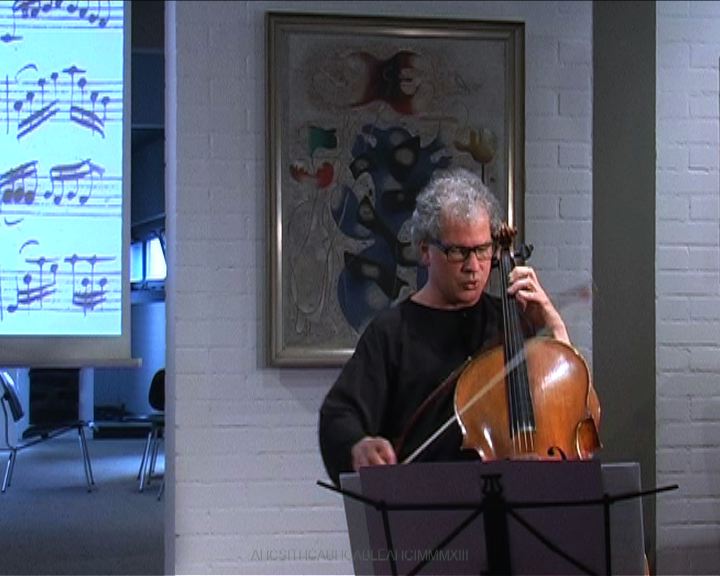
Bach could have written:
[plays the first few bars, but transposed to G minor]
Why have I just now demonstrated this?
I have done so in order to better explain below what it means to represent a sequence of harmonies melodically.
A harmony instrument would play these harmonies as follows:
[plays the harmonies as three-note chords with the curved bow]
You see, this is clear: since all three notes of the triad sound together – and at the same time. So, there is nothing further required to provide harmonic clarity.
But if this harmonic progression is now to be done melodically, then the composer needs to decide which tone comes first and which tone follows and so on.
In addition to the keynote …
[plays the note G2]
the third is the most important part of the chord. Because the third determines whether we hear major or minor.
[plays the notes of the triad of G major and G minor]
Here (in the Prélude) the third is in the upper voice:
[plays again G minor and G major, this time with the thirds B3 and Bb3 in the upper voice]
So, not until we hear this third (B3), do we know that we are in G Major.
Thus can be seen that only when the third sounds …
[plays the first notes of the Prélude]
is the harmony clear, and Bach – or the copy of Anna Magdalena Bach (AMB) – has placed the first slur on the note B3.

In the next measure the following occurs :
[plays the beginning of measure 2]
Note that Bach uses the slur on the 3rd of the chord. With the attack of E3, we know that the harmony will change. We actually hear this change already on the second note of the measure before the root of the subdominant chord appears on the third note.
You can see up here …
[points to the appropriate measure of the projected score]
In the 1st measure the slur is on the 3rd Note and in the 2nd measure the slur is on the 2nd note. Why ?
Because that is where the harmony changes.
In the 3rd measure there is no slur at first …
[plays the 1st Half of the measure 3]
… until the repetition …
[plays the 2nd Half of the measure 3]
… where a slur is placed on the 2nd Note. I will refer to this again below.
To represent the whole thing a bit more clearly, I draw an analogy with Thomas Mann, who in his novel “Doctor Faustus” presents a bizarre character named Johann Conrad Beißel, whose name sounds analogous to Johann Sebastian Bach.
A Native of the Pfalz (Palatinate, Germany), he emigrated to Pennsylvania in his early years and there established himself as the head of a church that called itself “Anabaptists of the Seventh Day of Ephrata”. There he fed the souls with his composition of didactic texts that were sung to familiar church melodies.
At some point, it came into his mind to set his lyrics to his own music. Because he was a man of action, he decreed that all tones should be labelled Masters and Servants. Without further ado, he designated the tones of the triad to be Masters, and all the other to be Servant tones.
On the stressed syllables of text Master tones should be used, and all other unstressed syllables were set with Servants tones.
Seen in this light, JS Bach apparently slurred the Servant tones to Master tones.
So when I ‘m playing again …
[plays the beginning of the Prélude to the B3]
the Master tone is B3. The note A3 is a Servant tone.
[plays the first measure to the end up to measure 2]
Here …
[plays the note E3]
is the first exception, as he now binds two Master tones. The C4 …
[plays the note C4]
is the root of the chord (subdominant). But, unlike Mr. Beißel, Bach assigned relative weight to different Chord tones. So they are not all equal, because here it is the third (E3) that is important: it makes known to us what is the new harmony.
[plays again the second measure]
And here there are 3 Master tones that are really not congruent: we have the root note of G major, the persistent pedal point, which is actually a non-harmonic tone (in the chord of D Major, the dominant) …
[plays the dominant sevenths with c4]
And these are the two tones of the dominant chord
[plays F#3 and C4]
which then resolve back into the tonic.
[plays the resolution]
So in measure 3, there are three tones that are Master tones that are not compatible and which are not slurred.
(Later I will discuss why in the second half of the measure there is a slur.)
Well, does that clarify the impact of slurs?
I conclude from these first bars of the Prélude that the initial note of a slur should be highlighted.
How that happens is up to the artist, who can accentuate the note, play it louder, expand it, make a tenuto, or make agogic changes. The artist can bring the note something sooner or later which does not appear in the written score. But Bach writes a slur, which indicates that 1st sound of a slur is important.
Now, I would anticipate one thing: The sound after the slur is also important. And it is even more important, the longer the slur. That is, if we have a very long slur, then the one note after the long slur is emphasized more so. I will explain this point in more detail later. Now first again:
[plays the first measure to the second B3 note of the 2nd beat]
So, this note B3 (after the slur) is also emphasized.
[continues to play measure 2]
Now one wonders, after the two slurred Master tones, now a Servant tone (B3): why is this Servant tone emphasized? The reason is that we actually have an ambiguity between two harmonies. Although we have clearly a subdominant …
[plays subdominant]
Which also contains the note G, we still have the same tonic, which also has the note G. And in the next measure we will see that we are dealing with a pedal point that we actually have several harmonies in the measure. It is therefore justified to emphasize the central B3 (in measure 2), because this is the third of this root (pedal G2). So, this is not a contradiction (note the emphasis on B3), but also makes sense. Now in measure 3 we have:
[plays the first three notes]
These 3 tones conflict with one another. We have a major seventh, which would have to resolve to the G3, and C4, which would have to resolve to B3:
[playing two voices the notes F#3/C4 and then G3/B3]
The tritone F#3/C4 can not be slurred.
Note:
The tritone is almost never slurred in the Suites, as it consists of two chord tones. But, in this Prélude, there sometimes occurs slur of notes F#3 and C4 respectively G3 and B3. These exceptions are explained at the appropriate places. However, in the second Half of measure 3, the notes are slurred on the third beat …
[plays the 2nd Half of measure 3]
Bach, anticipating the resolution, explicitly stresses the note B3 (the third of the tonic chord).
This measure plays a role later in the piece, as this particular articulation is referenced again.
We also take notice: when the beat is not slurred and then there follows a slur in the repetition as happens here in the 3rd measure, then that always signifies an increased emphasis in Bach, an emphatic increase of the expression.
So, did I mention that the note after the slur is also emphasized?
This has physical reasons. Because the volume on the cello or the violin depends on the bow speed. A simple example: if I play a an eight note scale with 7 notes on one bow stroke and 1 note on the return stroke using the same length of bow, then the single tone is inevitably emphasized:
[plays 2 octave G Major, ascending and descending, each with 7 notes down bow and 1 note up bow]
String players learn naturally to hide this effect. But J. S. Bach explicitly utilizes this technical artifact – his articulation is really very sophisticated . An example can be demonstrated from one measure from the Allemande. Since we have 13 notes to a bow stroke, this is very extreme:
[plays measure 13 from the Allemande in G Major]
There are reasons. Because we have first the parallel minor …
[plays the first four 16th notes of the 1st beat]
followed by the dominant of the dominant …
[plays the note C#4 and continues to the A3]
And … that’s the root of the secondary dominant (A3) and the seventh …
[plays G4]
… resolving to D major. So Bach uses these physical conditions of the bow technique in the extreme. In this light, we consider the first bars of the Prélude as published in the Urtext editions:
[plays the first bars in the versions of the Urtext editions]
Always a slur three notes at the beginning of the first and second halves of each measure. What a burdensome monotony this creates! Yes, it is even distracting, as it highlights secondary elements: always this G2 bass note – and the changing note that follows the slur.
[demonstrates once again on the cello]
This is approximately the same as if you would aim at the wrong goal in a penalty shoot-out. (Audience laughs)
I interrupt the transcription of my talk in order to summarize. The initial pedal cadence with G2 following should be noted: The bowing, clarifies and emphasizes the basic cadential constructiion of this phrase: tonic, subdominant, dominant seventh and tonic, overlayed on the tonic pedal point.
The first measure is harmonically unambiguous. By means of a 2-slur the third B3 of the tonic is four times emphasized.
Note:
When I speak of a two note slur (2-slur) on the note B3, that means that a two note slur begins on B3.
The second measure is harmonically ambiguous. It is home to the tonic and subdominant. The 2-B emphasizes the third of the subdominant E3 and the third of the tonic, B3.
The third measure contains three harmonies: the tonic (root G2), the subdominant (root C4) and the dominant (third F#3). Therefore the first Half measure has no slur, as a slur would create a hierarchical order among these pitches. The 3 pitches are on equal footing. Only in the second Half of the measure the 2-slur leads to an emphasis on the third F#3 of the dominant and through its connection to the note C4 to an emphasis on the third of the tonic, B3. The resolution of the dominant to the tonic is already anticipated here.
Highlighting the B3 in these three opening bars still has a further meaning, which is developed in the course of Prélude: The Parallel Minor (E minor) is next to the tonic in this movement as the second most important harmony. These two harmonies make up something like 2 tonic gravitational fields. The second measure could be heard even as a relative minor first inversion chord with added C4 (sext suspension). That is, the note C4 would be in this harmonic interpretation a Servant tone, which is connected to the root note and the notes E3 and B3 would be strongly stressed Master tones.
However, of this double harmonic complex, more will follow in Part 2 of this transcription …
Michael Bach