Author Archives: Michael Bach

Heute vor 20 Jahren starb Tossi Spiwakowski

23.12.1906 – 20.07.1998

Sein Rundbogenspiel. Seine Bachinterpretation.


Tossi Spiwakowskis Artikel über die Solowerke für Violine von J. S. Bach 1) aus dem Jahr 1967 war mir durch Rudolf Gählers Buch, Der Rundbogen für die Violine – ein Phantom? 2) bekannt und auch die Tatsache, daß Spiwakowski einen Rundbogen, den VEGA BACH BOW des dänischen Geigenbauers Knud Vestergaard verwendete, der ursprünglich für den Geiger Emil Telmányi (1892 – 1988) entworfen wurde. Bedauerlich war aber, daß bislang keine einzige Tonaufnahme mit Spiwakowski und dessen Rundbogen aufzutreiben war. Mehr oder weniger zufällig gelang es mir, Kontakt mit der Fotografin Ruth Voorhis, der Tochter von Spiwakowski, aufzunehmen und erhielt von ihr einige Fotografien von dessen VEGA BACH BOW zugesandt, sowie die Information, daß ein Live-Mitschnitt der Chaconne, gespielt von Spiwakowski mit dem Rundbogen, gerade veröffentlicht wurde 3).

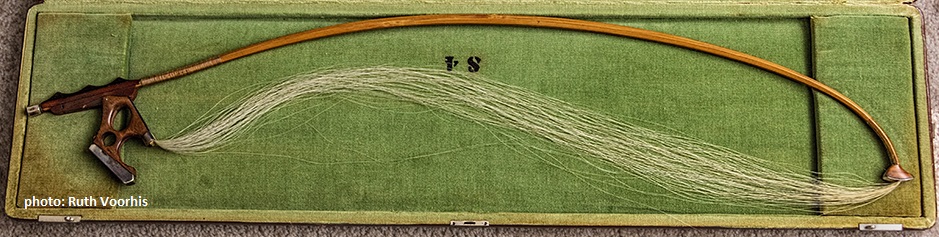
Ich kenne diesen VEGA BACH BOW (Abb. 1) seit Anfang der 90er Jahre genau, da Rudolf Gähler ein Exemplar in seiner Sammlung beherbergt. Eine detaillierte Dokumentation dieses Rundbogens wird auf der ungarischen Website https://www.vonokeszites.hu/de/bogen/emil-telmanyi bereitgestellt.

VEGA BACH BOW 150dpiAbb. 1

Auffallend war für mich, daß der Rundbogen Spiwakowkis sehr starke Gebrauchsspuren aufweist, was für mich die zweifellos beträchtliche Bedeutung dieses Rundbogens für ihn aufzeigt. Hier müssen sich heroische Kämpfe in der Bezwingung dieses Bogenwerkzeugs abgespielt haben. Zweitens, Spiwakowski hatte den Arretiermechanismus ausgebaut 4), welcher eigentlich dafür gedacht ist, den Daumen im einstimmigen Spiel und den damit einhergehenden hohen Zugkräften der Bogenhaare zu entlasten. Diese Elimination des Einrastmechanismus ist für mich ein deutlicher Hinweis dafür, daß Spiwakowski herausfand, daß derartige Mechanismen für die Entlastung der Muskeln umständlich zu handhabend sind, letztendlich doch eher eine spieltechnische Barriere bedeuten, also kontraproduktiv sind. Denn jedwede zusätzliche Apparatur, die die Unmittelbarkeit des Spielvorgangs behindert, minimiert die Kontrolle über die sensiblen haptischen Bewegungsabläufe. Ich selbst erkenne in einem solchen Hilfsmechanismus ein Indiz für eine nicht ausgereifte Konstruktion und sehe mich durch Spiwakowski darin bestätigt, daß mechanische Hilfen genauestens auf ihre Zweckmäßigkeit untersucht werden sollten und sich in der Praxis beweisen müssen.
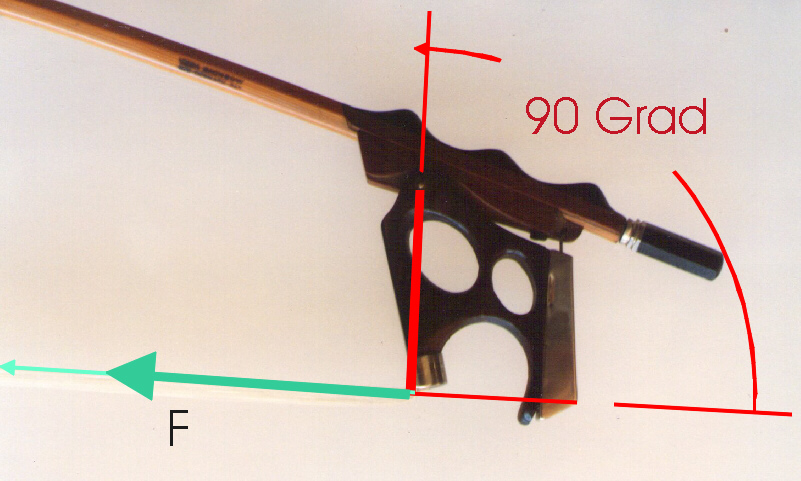
VEGA BACH BOW Kräfteparallelogramm 150dpiAbb. 2

Dieser unvorteilhaft große Kraftaufwand, die der VEGA BACH BOW erfordert, rührt daher, daß der Hebel relativ kurz ist (Abb. 2) und seine Position bei gespannten Bogenhaaren einen Winkel zu den Haaren von etwa 90 Grad aufweist. Beide geometrischen Charakteristika, die physikalisch dazu führen, daß die rechte Hand des Geigers kräftemäßig über Gebühr belastet wird, sind eigentlich unüberbrückbare Hindernisse. Die Griffmulden auf der Oberseite des Griffs sind zusätzliche Behelfe, um die Hand trotz dieser Kraftanstrengungen in Position zu halten. Um die Probleme für die rechte Hand zu verringern, ist es für den Konstrukteur jedoch erforderlich, nicht symptomatisch vorzugehen, sondern zunächst die ursächlichen Prinzipien zu verstehen und dann geeignete Lösungen zu finden. Der Frosch des VEGA BACH BOW hat noch eine weitere Öffnung für den Daumen, damit das einstimmige Spiel im arretierten Zustand des Frosches erleichtert wird. Der Daumen wechselt also während des Spiels zwischen zwei Positionen, was eine abermalige Erschwernis darstellt. Zu den nachteiligen Eigenschaften des Griffs kommt hinzu, daß die Bogenstange in der oberen Hälfte, also von der Mitte bis zur Bogenspitze hin, eine hohe Wölbung beibehält. Somit sind zwar vierstimmige Akkorde über die gesamte Länge des Rundbogens spielbar, der Schwerpunkt liegt aber dementsprechend hoch, so daß das einstimmige Spiel zusätzlich erschwert wird.

Schroeder Rundbogen 150dpiAbb. 3

Diese konstruktiv bedingten Nachteile tauchen bei dem konkurrierenden Rundbogenmodell (Abb. 3) von Rolph Schroeder (1900 – 1980) weit weniger auf, da der Hebel zum Spannen und Entspannen der Haare länger ist. Gemäß dem Hebelgesetz reduziert dies den Kraftaufwand, verlängert aber die Distanzen für den Daumen. Doch dies ist kein wirkliches Manko, wie die Spielpraxis aufzeigt. Zweitens, im gespannten Zustand wird der Hebel in den Griff eingeklappt, so daß der Drehpunkt des Hebels einen Anteil (F1) der Zugkräfte (F) im einstimmigen Spiel aufnimmt (Abb. 4). Telmányi, der seinerseits das Rundbogenspiel in den 30er Jahren von Schroeder vorgeführt bekam, konnte leider nicht dessen Prototyp erstehen, so daß er damals auf eine eigenständige, neu entworfene Konstruktion angewiesen war. Spiwakowski hingegen kannte seinerseits alleinig nur den Rundbogen von Telmányi und hatte kaum eine andere Wahl, als damit zu operieren. Gewissermaßen war es für ihn einfacher und rascher, sich im Jahr 1957 von Vestergaard einen VEGA BACH BOW zu besorgen, als eine zeitaufwendige Neukonstruktion mit ungewissen Ergebnissen zu versuchen.
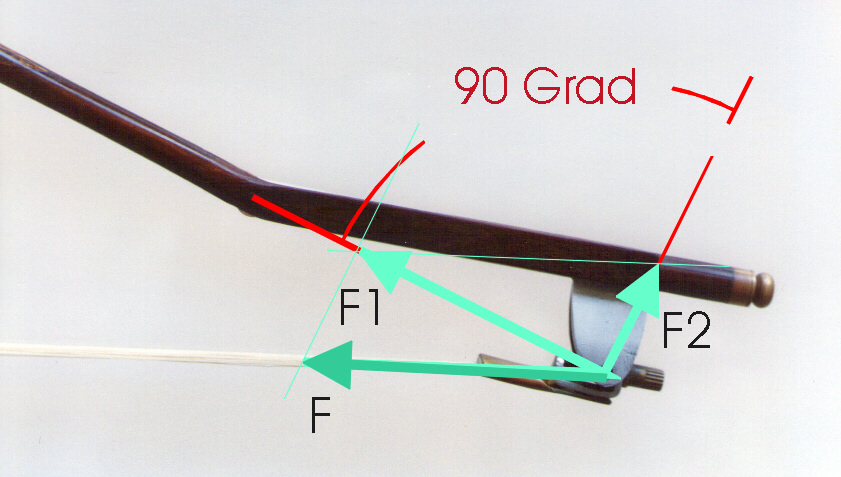
Schroeder Rundbogen Kräfteparallelogramm 150dpiAbb. 4

Ich erinnere mich, als ich im Jahr 1990 erstmals die Aufnahmen der Rundbogenspieler Rolph Schroeder, Emil Telmányi und Otto Büchner (1924 – 2008) von Rudolf Gähler vorgeführt bekam, wie mich allein schon dieser mehrtönige Klang der Geige faszinierte. Trotzdem sind Telmányis Schwierigkeiten der Beherrschung dieses sehr extrem ausgeformten VEGA BACH BOW in seinen Bachaufnahmen von 1954 unüberhörbar. Insofern war ich äußerst gespannt auf die neuerliche Veröffentlichung des Mitschnitts des Schwedischen Rundfunks aus dem Jahr 1969 mit Tossi Spiwakowskis Interpretation der Chaconne. Die Überraschung war perfekt, denn aufgrund dieses Tondokuments möchte man meinen, daß Spiwakowski ein anderes Rundbogenmodell zur Verfügung gehabt hätte. Fast nichts von den enormen spieltechnischen Problemen, die dieser VEGA BACH BOW aufwirft, ist bei seinem Spiel konstatierbar. Diese Leistung Spiwakowskis als eine Selbstverständlichkeit zu goutieren, ist für mich unvorstellbar. Die Zuhörer Spiwakowskis müssen regelrecht vom Stuhl gefallen sein, bei einem so meisterlichen Vortrag der Chaconne mit dem Rundbogen.

Michael Bach


1) Tossy Spivakovsky, Polyphony in Bach’s Works for Solo Violin, published in 1967 in The Music Review, Vol. 28, No. 4

2) Rudolf Gähler, Der Rundbogen für die Violine – ein Phantom?, Conbrio Verlag, Regensburg 1997

3) Live-Mitschnitt, Schwedischer Rundfunk, Stockholm, 26. Januar 1969, DOREMI DHR-8025-8

4) siehe Foto: Tossi Spiwakowski, Einführung zur Interpretation von J. S. Bachs Solowerken für Violine mit dem Rundbogen
Tossy Spivakovsky died 20 years ago today

December 23, 1906 – July 20, 1998

His playing with the curved bow. His Bach interpretation.


Tossy Spivakovsky’s article on the solo works for violin by J. S. Bach 1) from 1967 became known to me through Rudolf Gaehler’s book, The Curved Bow for the Violin – a Phantom? 2) and also by the fact that Spivakovsky used a curved bow, the VEGA BACH BOW made by the Danish violin maker Knud Vestergaard, which was originally designed for the violinist Emil Telmányi (1892 – 1988). I found it regrettable, however, that until now not a single recording of Spivakovsky performing with his curved bow was available. More or less coincidentally, I managed to contact the photographer Ruth Voorhis, the daughter of Spivakovsky, and received some photographs of his VEGA BACH BOW. She told me that a live recording of the Chaconne, played by Spivakovsky with the curved bow, had just been released 3).

Since the beginning of the nineties I was well acquainted with this VEGA BACH BOW (Fig. 1) because Rudolf Gaehler has a copy of it in his collection. A detailed documentation of this curved bow is available on the Hungarian website https://www.vonokeszites.hu/en/bows/emil-telmanyi.

VEGA BACH BOW 150dpi
Fig.1

It is striking to me that Spivakovky’s curved bow shows very strong traces of use, showing me the undoubtedly considerable significance this curved bow had for him. Heroic battles must have taken place in the control of this bow tool. Secondly, Spivakovsky had removed the locking mechanism intended to relieve the thumb 4), since otherwise it would have had to withstand the high pulling power of its hair during single-voice playing. This elimination of the snap-in locking function is a clear indication to me that Spivakovsky found out that such mechanisms, in order to relieve the muscles, are complicated to handle, are ultimately more of a technical barrier and therefore counterproductive. Any additional equipment that hinders the immediacy of the playing process minimizes one’s control over the sensitive haptic movements. I myself recognize in such an auxiliary mechanism an indication of a construction that was not fully developed and see myself confirmed by Spivakovsky in the fact that mechanical aids should be scrupulously examined for their expediency and have to prove themselves through experience.

VEGA BACH BOW Kräfteparallelogramm 150dpi
Fig. 2

This adverse physical exertion of force required by the VEGA BACH BOW is due to the fact that the lever is relatively short (Fig.2), and its position, when the bow hairs are tightened, shows an angle of about 90 degrees to the hairs. Both of these geometrical characteristics, which physically put too much strain on the violinist’s right hand, are actually insurmountable obstacles. The hollows on top of the grip provide an additional way to hold the right hand in place despite the use of extreme force. In order to reduce the problems for the right hand, however, the designer of a curved bow should seek a solution to the cause of the problem, not just its symptoms. The frog of the VEGA BACH BOW has yet another opening for the thumb, facilitating single-voice playing in the locked position of the frog. The thumb thus alternates between two positions while the bow is in use, and this presents a further complication. In addition to the unfavorable properties of the handle, the bow stick maintains a high curvature in the upper half, i. e. from the middle to the bow tip. Thus, four-part chords over the entire length of the curved bow are playable, but the center of gravity is correspondingly high, complicating single-voice playing further.

Schroeder Rundbogen 150dpi
Fig. 3

Fewer constructional disadvantages hamper the competing model of the curved bow (Fig. 3) invented by Rolph Schroeder (1900 – 1980), since the lever for tightening and relaxing the hairs is longer. According to the principle of the lever, this reduces the force but the distances covered by the thumb are bigger. But this is not a real drawback, as playing reveals. Secondly, in the tightened position the lever is folded into the handle, so the pivot of the lever absorbs a proportion (F1) of the tensile force (F) while one string is being played (Fig. 4).  Unfortunately, Telmányi, to whom the curved bow by Schroeder had been demonstrated in the 1930s, was unable to buy the prototype by Schroeder. He had to rely on an independent, newly-designed construction. Spivakovsky, on the other hand, knew only Telmányi’s curved bow and had almost no choice but to operate with a similar bow.  It was probably easier and faster for him to acquire a VEGA BACH BOW from Vestergaard in 1957 than to attempt to design on his own a curved bow with uncertain results.

Schroeder Rundbogen Kräfteparallelogramm 150dpiFig. 4

I remember when in 1990 Rudolf Gaehler first let me listen to the recordings of the curved bow performances by Rolph Schroeder, Emil Telmányi and Otto Buechner (1924 – 2008), how fascinated I was just to hear the multi-toned sounds on the violin. However, Telmányi’s difficulties in mastering this very extremely shaped VEGA BACH BOW are clearly audible in his Bach recording from 1954. Therefore I was very excited about the re-release of the Swedish Radio’s 1969 recording of Tossy Spivakovsky’s Chaconne interpretation. Hearing it was a complete surprise, because such an audio document would make one think that Spivakovsky must have had a different curved bow model at his disposal. Almost none of the enormous technical problems this VEGA BACH BOW presents are noticeable in his performance. To take Spivakovsky’s achievement just for granted is inconceivable for me. Spivakovsky’s listeners must have literally fallen off their chairs over such a masterful performance of the Chaconne with the curved bow.

Michael Bach


1) Tossy Spivakovsky, Polyphony in Bach’s Works for Solo Violin, published in 1967 in The Music Review, Vol. 28, No. 4

2) Rudolf Gaehler, Der Rundbogen für die Violine – ein Phantom?, Conbrio Verlag, Regensburg 1997

3) Live Broadcast, Swedish Radio, Stockholm, January 26, 1969, DOREMI DHR-8025-8

4) see photo: Tossy Spivakovsky, Introduction to the Curved Bow for playing Bach’s violin solo works

Tossy Spivakovsky, Introduction to the Curved Bow for playing Bach’s violin solo works

On the occasion of the 20th anniversary of the death of Tossy Spivakovsky
(December 23, 1906 – July 20, 1998), who became one of the first violinists to interpret the “Sonatas and Partitas” for violin
solo by J. S. Bach with the curved bow, I present this transcript of his introductory speech, which was released recently together with the live recording of the “Chaconne” on the label DOREMI.


BACH Bow Tossy Spivakovsky
VEGA BACH Bow of Tossy Spivakovsky


“The six works for unaccompanied violin by Bach demand of the executant a mastery of seemingly insoluble technical problems such as multiple stops and polyphonic voice progressions. It is sometimes thought, erroneously, that Bach intended all such chords to be arpeggiated. But one can clearly see from Bach’s own handwriting of these works that the composer distinguished broken from unbroken chords quite explicitly. When he wanted them arpeggiated he wrote the sign “arp.” with the respective chords. All chords, as in [those without] such special indications, were of course meant to be played unbrokenly, all notes sounded simultaneously. Therefore the well known sound of notoriously breaking or rolling all chords causes distortions of what is written and is not only unpleasant to listen to but also from a musicological point of view incorrect.

By means of the recently manufactured curved bow patterned approximately after the Renaissance or early Baroque bow the violinist is nowadays able to play even quadruple chords unbrokenly. It might be said that it is anachronistic and therefore incongruous to use a curved bow on a modernized violin with its lengthened neck and bass bar. But this objection is not valid. The violin with these lengths and proportions sounds only fuller, stronger and more resonant. The tone quality remains the same. I think, very little would be accomplished when playing 18th century music to use the old adjustment on violins.

There is of course no tradition of performing Bach’s Solo Sonatas. The manuscripts of these six works remained unpublished throughout Bach’s life. They were performed for the first time more than a hundred years after his death. Thus, the public only gradually learned to know about these works and this happened at the time when the romantic spirit was at its height, a period rather far removed from the essence of Bach’s polyphony.

Therefore the way the violinist played these works at that time, the second half of the 19th century cannot serve as a model for performance of Bach. Indeed according to the latest research it went quite contrary to the composer’s intention.

So, I am using such a curved bow, now.”


Live Broadcast, Swedish Radio, Stockholm, January 26, 1969
DOREMI, Legendary Treasures, DHR – 8025

Tossi Spiwakowski, Einführung zur Interpretation von J. S. Bachs Solowerken für Violine mit dem Rundbogen
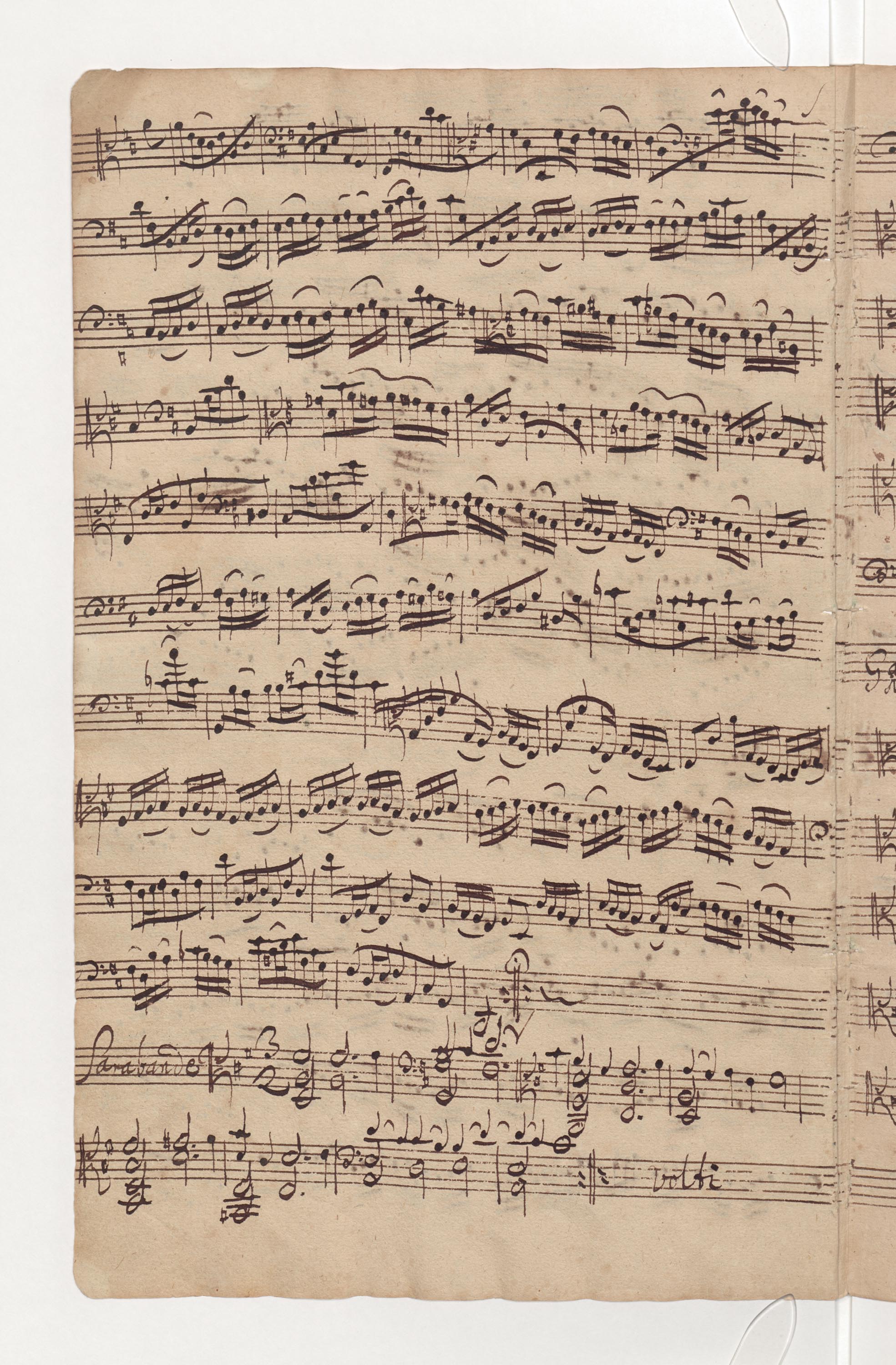
Anläßlich des 20. Todestages von Tossi Spiwakowski ( 23. Dezember 1906 – 20. Juli 1998), welcher sich als einer der ersten Violinisten für die Interpretation der “Sonaten und Partiten” für Violine solo von J. S. Bach mit dem Rundbogen einsetzte, erscheint diese Übersetzung seiner Einführungsrede, die zusammen mit dem Live-Mitschnitt der “Chaconne” kürzlich unter dem Label DOREMI veröffentlicht wurde.


BACH Bow Tossy Spivakovsky
VEGA BACH Bow von Tossi Spiwakowski

Die sechs Werke für Violine solo von Bach verlangen von dem Ausführenden die Beherrschung von anscheinend unlösbaren technischen Problemen wie das Spielen von Mehrklängen und polyphoner Stimmführung. Es wird manchmal irrtümlich angenommen, daß Bach diese Akkorde arpeggiert haben wollte. Aber man kann klar aus Bachs eigener Handschrift dieser Werke erkennen, daß der Komponist deutlich zwischen gebrochenen und nicht gebrochenen Akkorden unterschied. Wenn er sie arpeggiert haben wollte, schrieb er das Zeichen “arp.” bei den entsprechenden Akkorden. Alle anderen Akkorde, ohne diese spezielle Angabe, sollten selbstverständlich ungebrochen gespielt werden, alle Akkordnoten erklangen gleichzeitig. Daher führt der uns wohlbekannte Klang, alle Akkorde notorisch zu brechen oder zu arpeggieren, zu Verzerrungen des geschriebenen Notentexts, was nicht nur klanglich unzufriedenstellend sondern auch unter dem musikwissenschaftlichen Gesichtspunkt inkorrekt ist.

Mithilfe des kürzlich hergestellten Rundbogens, der annähernd dem Renaissance- oder Barockbogen nachgestaltet ist, kann der Geiger heutzutage sogar vierstimmige Akkorde ungebrochen spielen. Man könnte sagen, daß es anachronistisch und deshalb unpassend sei, einen Rundbogen auf einer modernisierten Geige mit ihrem verlängerten Hals und Bassbalken zu benutzen. Doch dieser Einwand zählt nicht. Die Violine mit diesen Längen und Proportionen klingt lediglich voller, stärker und resonanter. Die Tonqualität bleibt dieselbe. Ich glaube, daß sehr wenig erreicht sein würde, wenn man für die Musik des 18. Jahrhunderts die alte Einrichtung der Violinen verwenden würde.

Es gibt freilich für die Solosonaten von Bach keine Aufführungstradition. Das Manuskript dieser sechs Werke blieb zu Bachs Lebzeiten unveröffentlicht. Sie wurden erst mehr als hundert Jahre nach dessen Tod aufgeführt. Infolgedessen lernte die Öffentlichkeit nur allmählig diese Werke kennen und das geschah zu einer Zeit, als der romantische Geist seinen Höhepunkt erreichte, in einer Periode also, die ziemlich weit vom Wesen der Bachschen Polyphonie entfernt war. Deshalb kann die Art und Weise, wie die Geiger in dieser Zeit diese Werke spielten, in der 2. Hälfte des 19. Jahrhunderts, nicht als Leitbild für die Aufführung von Bach dienen. Tatsächlich steht sie, laut den aktuellen Erkenntnissen, den Absichten des Komponisten ziemlich konträr entgegen.

Deshalb verwende ich jetzt einen solchen Rundbogen.”


Live-Sendung des Schwedischen Rundfunks, Stockholm, 26. Januar 1969
DOREMI, Legendary Treasures, DHR – 8025

Urtext = Plain Text ? – An Analysis of the Sarabande in D Major, Part 1 (Bar 1-8)

Britain

This is a translation of the post

Urtext = Klartext? – eine Analyse der Sarabande in D-Dur, Teil 1 (Takt 1-8)

by Dr. Marshall Tuttle


Michael Bach

This is the first part of the analysis of the

“Sarabande” in D Major

Guest:
Burkard Weber

Video:
Interpretation of “Sarabande in D Major”

Michael Bach, Violoncello with BACH.Bogen:
https://youtu.be/YuqXQgfPKkg

Lecture on YouTube:
Bach, Sarabande D-Dur Cello solo | Analyse Michael Bach | Teil 1

Bach Digital

Copy of Anna Magdalena Bach, digital copy from the Staatsbibliothek in Berlin – PK


MB (Michael Bach): Here, in this piece, it there is a harmonic meaning, which is why we have monophony and two-, three-, and four-part passages.

There are many musicians, or almost all, who claim that the note values are not to be taken precisely. In my opinion, it is quite clear that they must be rendered exactly.

Because, in this movement, for example, the bass is usually not resolved. This can only be heard when the bass is held to the end.

Sarab D-Dur Bindebögen- 001

Measure 1

Let us take the first measure. We have D major. [plays bar 1]

What is the second sound? We have a reduced D major sound.

If this were focused on this second sound, Bach would have composed like this: [plays first the two-part and then the three-part harmony]

One would think this version is almost the same.

If you look at the first 8 bars, the second beat is always reduced in the number of notes. Often, a four-voice chord occurs on the 1st beat, and then a two note chord, or sometimes a three note chord, or sometimes even a single note, appears on the second beat

So, I can not imagine it being played like this: [emphasizes the double stop on the second beat instead of the three part chord on the first beat.

It is rather the opposite, that the second beat is “incomplete” and I play it slightly dynamically reduced, because we do not know …

This is always the case with Bach. When he changes from three- or four-parts to two-parts it means something. In this case, it is an opening to other harmonies.

Because, I could imagine this harmony now: [plays in B minor]

Only, the listener does not imagine this, because he has to be moved first of all. He does not imagine a C# in the bass (tonic chord of the mediant, F sharp minor). But it would be possible that the G does not appear at the end of the measure, but a G#. Then we would be in the mediant, or relative minor of the dominant.

But the G appears, and it is interesting again that this is a single note.

If Bach had left this previous A, then a minor seventh would arise. This happens later in measure 13: [plays measure 13]

We’ll talk about that later. In any case, when I hear this seventh, I am already thinking of a dominant, namely: [plays A – C# – E – G]


Measure 2

This does not happen, however. The piece continues with the G of the subdominant in the first beat of the second bar.

And here the focus is effectively on the second beat. That is, the resolution to D major. Although we only have a two-part chord, it is clear, this is D major.

The first chord of the second bar is interesting: First, it is not playable. The 6th Suite is written for a five-string instrument. We have the difficulty that we do not have the E-string and therefore there are a few modifications.

But here, with this chord: [plays G – G – B – E], that would still be playable on a five-string instrument, but not that: [plays G – G – B – C#] because C# is below the E-string.

That is, one must omit a tone here if one does not want to break the chord. By the way, I’ve never heard a cellist playing all four notes.

What sound do we want to leave out now? There are 2 possibilities. We have this chord first: [plays  G – G – B – E]. Here I also omit the doubled G, which is “painless”.

Furthermore, one could play as follows: [plays G – G – C#], leaving out the B, but now playing the previously omitted octave G. Then we have an ordinary resolution of the Tritone (G – C#) to D major (F# – D).

I am not doing this, but I want to intensify the dissonance and play: [plays G – B – C#] this strong dissonance with C# and B.

BW (Burkard Weber): This is a pungent resolution, but it is nice.

MB: Yes, that’s how it is.

There is now one more thing: the notated note values. There are half notes in the lower voices and quarter notes in the upper voices.

Normally these quarter notes would now be slurred. Because always … [plays a short passage from the Gavotte II in D major, bars 12ff] There are also no slurs, but in the lower voice are quarters and in the upper voice are quavers.

As a rule, therefore, in almost all cases in the case of Bach, the upper voice is then slurred. This also means that the tied second note is unstressed.

This is my observation, which I have made when examining the slurs. I am talking about a Slur Codex. There are about 10 rules with small modifications.

One of the rules is that if there are longer note values in a chord, below or above, and one voice moves, it is slurred.

And then there is one more thing that I discovered when studying the Chaconne for violin solo. This is due to the fact that we do not have such highly chordal movements on the cello where such a thing occurs. That if longer and shorter note values are played together, it is played dynamically as if there were a single all-embracing slur.

I take this measure [plays bar 4] to mean that the first note after the slur is emphasized.

This is all a little quick and complicated and maybe not so easy to understand …

Here, in the Sarabande in D major, there is an exception to the fact that Bach sometimes notates slurs (bars 4 and 7) and sometimes does not in such cases (bars 2, 3 and 6).

This means, for example, if he writes a slur in bar 4 [plays the first beat in bar 4], the resolution (F#) is unstressed and the next note (G) is emphasized. If he had not written this slur, the resolution would not be unstressed, let’s say so. This occurs elsewhere (bar 23).

This means that whenever there is no slur, the second chord is not attenuated, but rather is amplified even more [plays the first beat of measure 2].

It is interesting here, again, that the bass is not resolved. He could go from G to F#. The F# is found in the voice above, but not in the bass [plays the second beat of bar 2].

The fact that Bach does not resolve increases the expectation.

In the following measure, D major appears [plays the first beat of measure 3], but that is not a direct resolution.

We will now see how this will develop. The first bar has already given us the clue, a question mark: why does Bach omit the bass here, in the second beat of the bar?

On the other hand, [plays bars 2 and 3], the second beat is emphasized, which is the paradox in this piece, that often the second beat is emphasized, even though the number of notes is reduced. Continue reading
