Author Archives: Michael Bach

Das Original der Abschrift der Suiten für Violoncello von Anna Magdalena Bach

AMB Notizen zur Originalabschrift S 1 -

 Michael Bach, Notizen vom 19.09.2013 zur ersten Seite der Abschrift


Germany

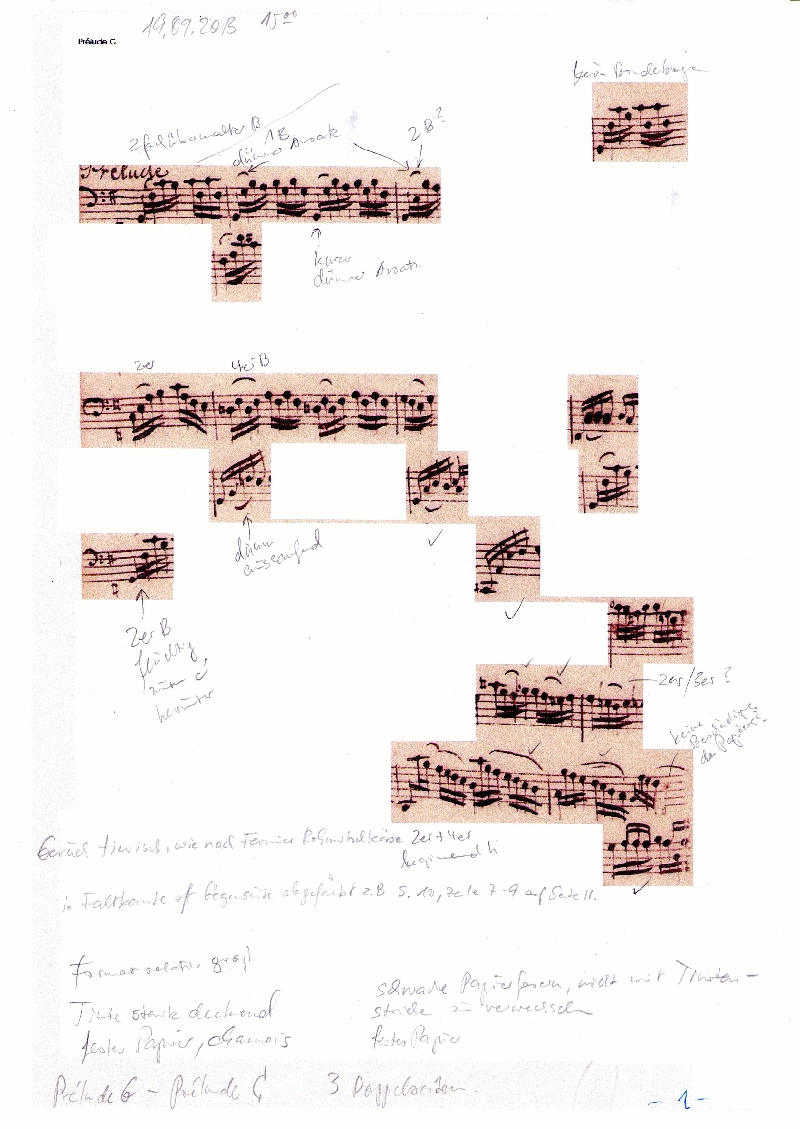
Nach zweieinhalb Jahren intensiver Arbeit an der Analyse der Abschrift von Anna Magdalena Bach (AMB) konnte ich am 19. September 2013 das Original im Lesesaal der Staatsbibliothek zu Berlin eingehend studieren.

Gedankt sei hierfür dem Stellv. Leiter der Musikabteilung Herrn Dr. Roland Schmidt-Hensel.

Ziel und Zweck meiner Untersuchung war es herauszufinden, ob es Korrekturen und Spuren im Original gibt, die in den hochauflösenden Scans von „Bach Digital” nicht mit letzter Sicherheit zu verifizieren sind. Zuweilen sind in den Scans dunklere Fasern im Papier von dünnen Federstrichen kaum unterscheidbar. Zu examinieren war außerdem, ob es überschriebene Bindebögen gibt. Es galt auch festzustellen, ob die Abschrift in erkennbar mehreren Etappen erstellt wurde und ob es Eintragungen von anderer Hand gibt.

Die Größe des Papierformats und der Schrift garantieren eine mühelose Lesbarkeit. Die Tinte ist generell stark deckend und tiefschwarz. Das chamoisfarbene Hadernpapier ist relativ dick und steif und verbreitet einen angenehmen natürlichen Duft. Das Original macht infolge seiner Festigkeit und intensiven Farbigkeit den Eindruck eines dreidimensionalen Objekts und ist als Ganzes in einem sehr gutem Erhaltungszustand.

Das Original der Abschrift wird in losen, in ihrer Mitte gefalteten Doppelblättern, die auf Vorder- und Rückseite beschrieben sind, aufbewahrt. Die Fadenbindung wurde aufgelöst. Infolgedessen gliedert es sich in drei Lagen:

Die 1. Lage enthält drei Doppelblätter: Auf dem ersten Doppelblatt findet sich auf der Außenseite rechts die Titelseite und links der 2. Teil des Préludes in C-dur. Auf der Innenseite findet sich links das Prélude in G-dur, Teil 1 und rechts der 1. Teil des Préludes in C-dur. Die anderen beiden Doppelblätter sind gleichermaßen angelegt und enthalten die übrigen Sätze der Suiten in G-dur und in d-moll.

Die 2. Lage enthält ebenfalls drei Doppelblätter mit den Sätzen der Suite in C-dur ab der Allemande, allen Sätzen der Suite in Es-dur und dem Anfang des Prélude in c-moll.

Die 3. Lage enthält diesmal vier Doppelblätter mit den restlichen Sätzen der Suiten in c-moll und in D-dur sowie drei Leerseiten.

Daraus schließe ich, daß die gesamte Abschrift als Einheit konzipiert ist. Sie hat einen konsistenten, durchgehend gleichen Schreibduktus. Eine Unterbrechung der Kopierarbeit ist nicht erkennbar. Die auffällige Satzbezeichnung „Präludium” zu Beginn der Suite in Es-dur deutet nicht auf einen anderen Schreiber oder auf eine größere Pause während der Kopierarbeit hin. Es scheint indessen eher so zu sein, daß die Satzbezeichnung von AMB zunächst versehentlich nicht angebracht und von ihr später aus Platzmangel über der ersten Notenzeile hinzugefügt wurde. Diese nachträgliche Korrektur erklärt vielleicht die abweichende Satzbezeichnung anstelle der ansonsten üblichen Bezeichnung „Prelude”.

Besonderes Augenmerk galt den Korrekturen und den daraus resultierenden Verletzungen des Papiers. Auch suchte ich bei uneindeutigen Bindebögen an deren Enden nach eventuell verlängernden Vertiefungen, oder Rillen im Papier, die vom Schreibutensil hätten stammen können. Derartige Spuren sind allerdings nicht erkennbar. Die Beschaffenheit der Papieroberfläche ist insgesamt sehr homogen und glatt, auch an den Korrekturstellen, was höchstwahrscheinlich auf eine Restaurierung der Handschrift zurückzuführen ist.

Alles in allem kann von einer sorgsam erstellten Abschrift gesprochen werden. Eine flüchtige, schnelle, gar nachlässige Schreibweise kann nicht unterstellt werden. Allerdings hat AMB’s Handschrift etliche Eigentümlichkeiten, die in meiner Analyse der Bindebögen an den entsprechenden Stellen noch erörtert werden. Ihre Setzung der Bindebögen hat hin und wieder eine gewisse Unschärfe, vergleicht man damit das erhaltene Autograph der Violinsoli von J. S. Bach. Das ist wohl darauf zurückzuführen, daß sie die Werke nicht selbst spielte. Jedenfalls bestätigt, ja bekräftigt das Studium des Originals der Abschrift die Feststellungen, die ich in meinem Text „nicht Artikulation, aber Harmonik” (Blogbeitrag vom 12. August 2013) getroffen habe.

Der ästhetische Eindruck der Abschrift läßt auf die hohe Wertschätzung, die ihr bereits während der Entstehung beigemessen wurde, schließen. Kein Scan oder keine Faksimile-Wiedergabe kann diese Aura des Kostbaren vermitteln.

 Michael Bach 

Urtext = Plain Text ? – An Analysis of the Prélude in G Major, Part 1 (Bar 1-3)

Britain

This is a translation of the post „Urtext = Klartext? “, September 13, 2013
by Dr. Marshall Tuttle.


Michael Bach

This is the first part of the transcript of my talk
“Urtext = Klartext?”,

to be given on May 4, 2013, at the Stiftung Domnick in Nürtingen, Stuttgart

   Urtext Klartext Still 3


The first five bars of the Prélude in G Major:
[plays measures 1-5 on the cello]

Bach could have written:
[plays the first few bars, but transposed to G minor]

Why have I just now demonstrated this?

I have done so in order to better explain below what it means to represent a sequence of harmonies melodically.

A harmony instrument would play these harmonies as follows:

[plays the harmonies as three-note chords with the curved bow]

You see, this is clear: since all three notes of the triad sound together – and at the same time. So, there is nothing further required to provide harmonic clarity.

But if this harmonic progression is now to be done melodically, then the composer needs to decide which tone comes first and which tone follows and so on.

In addition to the keynote …

[plays the note G2]

the third is the most important part of the chord. Because the third determines whether we hear major or minor.

[plays the notes of the triad of G major and G minor]

Here (in the Prélude) the third is in the upper voice:

[plays again G minor and G major, this time with the thirds B3 and Bb3 in the upper voice]

So, not until we hear this third (B3), do we know that we are in G Major.

Thus can be seen that only when the third sounds …

[plays the first notes of the Prélude]

is the harmony clear, and Bach – or the copy of Anna Magdalena Bach (AMB) – has placed the first slur on the note B3.

0

In the next measure the following occurs :

[plays the beginning of measure 2]

Note that Bach uses the slur on the 3rd of the chord. With the attack of E3, we know that the harmony will change. We actually hear this change already on the second note of the measure before the root of the subdominant chord appears on the third note.

You can see up here …

[points to the appropriate measure of the projected score]

In the 1st measure the slur is on the 3rd Note and in the 2nd measure the slur is on the 2nd note. Why ?

Because that is where the harmony changes.

In the 3rd measure there is no slur at first …

[plays the 1st Half of the measure 3]

… until the repetition …

[plays the 2nd Half of the measure 3]

… where a slur is placed on the 2nd Note. I will refer to this again below.

To represent the whole thing a bit more clearly, I draw an analogy with Thomas Mann, who in his novel “Doctor Faustus” presents a bizarre character named Johann Conrad Beißel, whose name sounds analogous to Johann Sebastian Bach.

A Native of the Pfalz (Palatinate, Germany), he emigrated to Pennsylvania in his early years and there established himself as the head of a church that called itself “Anabaptists of the Seventh Day of Ephrata”. There he fed the souls with his composition of didactic texts that were sung to familiar church melodies.

At some point, it came into his mind to set his lyrics to his own music. Because he was a man of action, he decreed that all tones should be labelled Masters and Servants. Without further ado, he designated the tones of the triad to be Masters, and all the other to be Servant tones.

On the stressed syllables of text Master tones should be used, and all other unstressed syllables were set with Servants tones.

Seen in this light, JS Bach apparently slurred the Servant tones to Master tones.

So when I ‘m playing again …

[plays the beginning of the Prélude to the B3]

the Master tone is B3. The note A3 is a Servant tone.

[plays the first measure to the end up to measure 2]

Here …

[plays the note E3]


is the first exception, as he now binds two Master tones. The C4 …

[plays the note C4]

is the root of the chord (subdominant). But, unlike Mr. Beißel, Bach assigned relative weight to different Chord tones. So they are not all equal, because here it is the third (E3) that is important: it makes known to us what is the new harmony.

[plays again the second measure]

And here there are 3 Master tones that are really not congruent: we have the root note of G major, the persistent pedal point, which is actually a non-harmonic tone (in the chord of D Major, the dominant) …

[plays the dominant sevenths with c4]

And these are the two tones of the dominant chord

[plays F#3 and C4]

which then resolve back into the tonic.

[plays the resolution]

So in measure 3, there are three tones that are Master tones that are not compatible and which are not slurred.

(Later I will discuss why in the second half of the measure there is a slur.)

Well, does that clarify the impact of slurs?

I conclude from these first bars of the Prélude that the initial note of a slur should be highlighted.

How that happens is up to the artist, who can accentuate the note, play it louder, expand it, make a tenuto, or make agogic changes. The artist can bring the note something sooner or later which does not appear in the written score. But Bach writes a slur, which indicates that 1st sound of a slur is important.

Now, I would anticipate one thing: The sound after the slur is also important. And it is even more important, the longer the slur. That is, if we have a very long slur, then the one note after the long slur is emphasized more so. I will explain this point in more detail later. Now first again:

[plays the first measure to the second B3 note of the 2nd beat]

So, this note B3 (after the slur) is also emphasized.

[continues to play measure 2]

Now one wonders, after the two slurred Master tones, now a Servant tone (B3): why is this Servant tone emphasized? The reason is that we actually have an ambiguity between two harmonies. Although we have clearly a subdominant …

[plays subdominant]

Which also contains the note G, we still have the same tonic, which also has the note G. And in the next measure we will see that we are dealing with a pedal point that we actually have several harmonies in the measure. It is therefore justified to emphasize the central B3 (in measure 2), because this is the third of this root (pedal G2). So, this is not a contradiction (note the emphasis on B3), but also makes sense. Now in measure 3 we have:

[plays the first three notes]

These 3 tones conflict with one another. We have a major seventh, which would have to resolve to the G3, and C4, which would have to resolve to B3:

[playing two voices the notes F#3/C4 and then G3/B3]

The tritone F#3/C4 can not be slurred.

Note:
The tritone is almost never slurred in the Suites, as it consists of two chord tones. But, in this Prélude, there sometimes occurs slur of notes F#3 and C4 respectively G3 and B3. These exceptions are explained at the appropriate places. However, in the second Half of measure 3, the notes are slurred on the third beat …

[plays the 2nd Half of measure 3]

Bach, anticipating the resolution, explicitly stresses the note B3 (the third of the tonic chord).

This measure plays a role later in the piece, as this particular articulation is referenced again.

We also take notice: when the beat is not slurred and then there follows a slur in the repetition as happens here in the 3rd measure, then that always signifies an increased emphasis in Bach, an emphatic increase of the expression.

So, did I mention that the note after the slur is also emphasized?

This has physical reasons. Because the volume on the cello or the violin depends on the bow speed. A simple example: if I play a an eight note scale with 7 notes on one bow stroke and 1 note on the return stroke using the same length of bow, then the single tone is inevitably emphasized:

[plays 2 octave G Major, ascending and descending, each with 7 notes down bow and 1 note up bow]

String players learn naturally to hide this effect. But J. S. Bach explicitly utilizes this technical artifact – his articulation is really very sophisticated . An example can be demonstrated from one measure from the Allemande. Since we have 13 notes to a bow stroke, this is very extreme:

[plays measure 13 from the Allemande in G Major]

There are reasons. Because we have first the parallel minor …

[plays the first four 16th notes of the 1st beat]

followed by the dominant of the dominant …

[plays the note C#4 and continues to the A3]

And … that’s the root of the secondary dominant (A3) and the seventh …

[plays G4]

… resolving to D major. So Bach uses these physical conditions of the bow technique in the extreme. In this light, we consider the first bars of the Prélude as published in the Urtext editions:

[plays the first bars in the versions of the Urtext editions]

Always a slur three notes at the beginning of the first and second halves of each measure. What a burdensome monotony this creates! Yes, it is even distracting, as it highlights secondary elements: always this G2 bass note – and the changing note that follows the slur.

[demonstrates once again on the cello]

This is approximately the same as if you would aim at the wrong goal in a penalty shoot-out. (Audience laughs)


I interrupt the transcription of my talk in order to summarize. The initial pedal cadence with G2 following should be noted: The bowing, clarifies and emphasizes the basic cadential constructiion of this phrase: tonic, subdominant, dominant seventh and tonic, overlayed on the tonic pedal point.

The first measure is harmonically unambiguous.  By means of a 2-slur the third B3 of the tonic is four times emphasized.

Note:
When I speak of a two note slur (2-slur) on the note B3, that means that a two note slur begins on B3.

The second measure is harmonically ambiguous. It is home to the tonic and subdominant. The 2-B emphasizes the third of the subdominant E3 and the third of the tonic, B3.

The third measure contains three harmonies: the tonic (root G2), the subdominant (root C4) and the dominant (third F#3). Therefore  the first Half measure has no slur, as a slur would create a hierarchical order among these pitches. The 3 pitches are on equal footing. Only in the second Half of the measure the 2-slur leads to an emphasis on the third F#3 of the dominant and through its connection to the note C4 to an emphasis on the third of the tonic, B3. The resolution of the dominant to the tonic is already anticipated here.

Highlighting the B3 in these three opening bars still has a further meaning, which is developed in the course of Prélude: The Parallel Minor (E minor) is next to the tonic in this movement as the second most important harmony. These two harmonies make up something like 2 tonic gravitational fields. The second measure could be heard even as a relative minor first inversion chord with added C4 (sext suspension). That is, the note C4 would be in this harmonic interpretation a Servant tone, which is connected to the root note and the notes E3 and B3 would be strongly stressed Master tones.

However, of this double harmonic complex, more will follow in Part 2 of this transcription …


Michael Bach

Urtext = Klartext? – eine Analyse des Prélude in G-dur, Teil 1 (Takt 1-3)

Germany

Michael Bach

Dies ist der erste Teil der Transkription meiner Präsentation
Urtext = Klartext?
vom 4. Mai 2013 in der Stiftung Domnick in Nürtingen bei Stuttgart
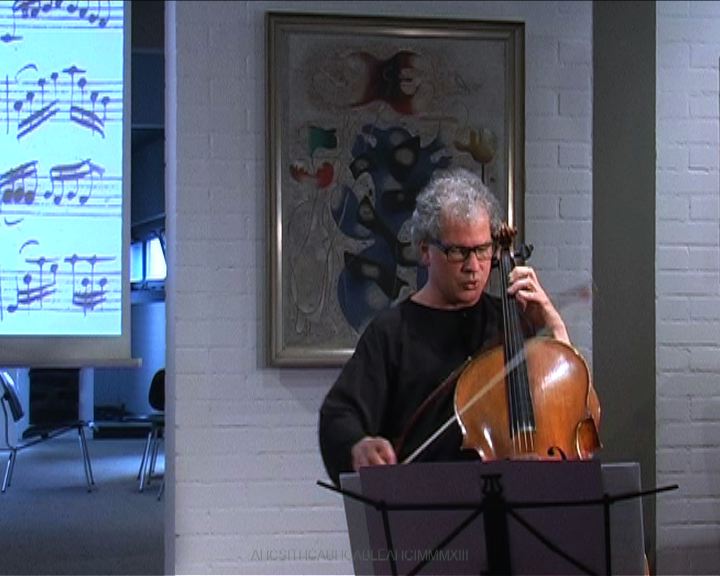
 Urtext Klartext Still 3


Also, die ersten 5 Takte des Prélude in G-dur:

[spielt Takt 1-5 am Cello]

Bach hätte jetzt beispielsweise auch folgendes schreiben können:

[spielt die ersten Takte, aber transponiert nach g-moll]

Warum habe ich Ihnen das jetzt vorgeführt?

Um im Folgenden besser klarmachen zu können, was es heißt, eine Harmoniefolge in der Einstimmigkeit darzustellen.

Ein Harmonieinstrument würde diese Harmonien folgendermaßen spielen:

[spielt die Harmonien als dreistimmige Akkorde mit dem Rundbogen]

Sie sehen, das ist eindeutig: Weil alle 3 Töne eines Dreiklangs zusammen erklingen – und gleichzeitig. Also, das ist an harmonischer Eindeutigkeit nicht mehr zu überbieten.

Wenn aber nun diese Harmoniefolge einstimmig geschehen soll, dann müssen Sie zuerst mal sich fragen, welcher Ton kommt zuerst und welcher folgt, und so weiter.

Neben dem Grundton…

[spielt die Note g2]

…ist die Terz der wichtigste Bestandteil des Akkords. Weil die Terz bestimmt, ob wir Dur oder Moll hören.

[spielt die Noten des Dreiklangs von G-dur und dann von g-moll]

Hier (im Prélude) ist die Terz in der Oberstimme:

[spielt nochmals g-Moll und G-dur, diesmal mit den Terzen b3 und h3 in der Oberstimme]

Also erst, wenn wir diese Terz (h3) hören, dann wissen wir, daß wir in G-dur sind.

So zeigt sich also, daß erst bei dem 3. Ton…

[spielt die ersten Töne des Prélude]

…die Harmonie klar ist, und Bach – oder die Abschrift von Anna Magdalena Bach (AMB) – setzt da den 1. Bindebogen, auf die Note h3.

0

Im nächsten Takt geschieht folgendes:

[spielt den Beginn des Takt 2]

Mit der Note e4 wissen wir, daß die Harmonie sich ändern wird, wir hören eigentlich schon die Subdominante voraus – d. h. Bach setzt den Bindebogen nicht auf die 3. Note sondern auf die 2. Note im Takt.

Sie können das hier oben sehen…

[dreht sich nach hinten um, um auf der projizierten Partiturseite die entsprechende Stellen zu zeigen]

…im 1. Takt ist der Bindebogen auf der 3. Note und im 2. Takt auf der 2. Note. Warum?

Weil sich da die Harmonie ändert.

Im 3. Takt ist kein Bindebogen – zunächst…

[spielt die 1. Hälfte des Takt 3]

…erst bei der Wiederholung…

[spielt die 2. Hälfte des Takt 3]

…kommt ein Bindebogen auf der 2. Note. Ich werde darauf nochmal Bezug nehmen.

Um das Ganze etwas plausibler darzustellen, mache ich jetzt eine Anleihe bei Thomas Mann. In seinem Roman „Doktor Faustus” tritt eine skurile Figur auf namens Johann Conrad Beißel. Das klingt fatal nach Johann Sebastian Bach.

Gebürtig aus der Pfalz war er in jungen Jahren nach Pennsylvania ausgewandert und hatte sich dort zum Haupt einer Gemeinde geriert, die sich „Wiedertäufer des Siebenten Tages von Ephrata” nannte. Und er speiste die Seelen der Seinen mit didaktischen Gesangstexten, die auf bekannte Kirchenmelodien zu singen waren.

Irgendwann kam es ihm aber in den Sinn, seine eigenen Texte in Musik zu setzen. Und weil er ein Mann der Tat war, so dekretierte er, daß unter allen Tönen Herren und Diener sein sollten. Kurzerhand hat er die Töne des Dreiklangs zu Meistern oder zu Herren ernannt, und alle übrigen Töne zu Dienertönen.

Auf die betonten Silben eines Textes sollten nun Herrentöne gesetzt werden und auf alle anderen unbetonten Silben die Dienertöne.

In diesem Licht gesehen, hat J. S. Bach offensichtlich die Dienertöne an Herrentöne angebunden.

Also, wenn ich jetzt nochmals spiele…

[spielt den Anfang des Préludes bis zur Note h3]

…Herrenton (h3). Die Note a3 ist ein Dienerton, kein akkordeigener Ton.

[spielt den 1. Takt zu Ende bis Takt 2]

Hier…

[spielt die Note e3]

…entsteht die 1. Ausnahme, denn er bindet jetzt 2 Herrentöne. Das…

[spielt die Note c4]

…ist der Grundton des Akkords (Subdominante). Aber, er gewichtet – anders als Herr Beißel – Bach gewichtet zwischen den Herrentönen, es sind also nicht alle gleich, weil hier die Terz (e4) wichtiger ist, die uns die neue Harmonie bekannt gibt.

[spielt nochmals den 2. Takt]

Und hier gibt es 3 Herrentöne, die nun wirklich nicht zu vereinen sind: Wir haben einmal den Grundton von G-dur, der bleibt als Orgelpunkt liegen, es ist eigentlich ein harmoniefremder Ton (in D-dur, der Dominante)…

[spielt die Dominante mit Septim c4]

…und das sind die beiden Töne der Dominante,…

[spielt fis3 und c4]

…die sich dann wieder in die Tonika auflöst.

[spielt die Auflösung]

Also in Takt 3 sind es 3 Töne, die Herrentöne sind, die sich nicht vereinbaren lassen, und die sind nicht gebunden.

Ich komme darauf zurück, warum in der 2. Takthälfte doch eine Bindung zu finden ist.

Nun, ist ja klar, welche Auswirkungen hat ein Bindebogen?

Ich schließe aus diesen ersten Takten des Prélude, daß diejenige Note, auf der der Bindebogen steht, hervorgehoben werden soll.

Wie das geschieht, ist dem Interpreten überlassen. Er kann die Note akzentuieren, sie lauter spielen, sie dehnen, also ein tenuto machen, oder er kann agogische Veränderungen machen, er kann sie etwas früher bringen oder später – das schreibt Bach nicht vor, aber er schreibt einen Bindebogen, welcher anzeigt, daß der 1. Ton eines Bindebogens wichtig ist.

Nun möchte ich noch eine Sache vorwegnehmen: Der Ton nach der Bindung ist auch wichtig. Und er ist um so wichtiger, je länger der Bindebogen ist. D. h., wenn wir einen ganz langen Bindebogen haben, dann ist diejenige Note nach dem langen Bindebogen um so mehr betont. Aber das werde ich gleich noch näher erklären, jetzt zunächst nochmal:

[spielt den 1. Takt bis zur 2. Note h3 der 2. Zählzeit]

Also, diese Note h3 (nach dem Bindebogen) wird auch betont.

[spielt weiter bis Takt 2]

Jetzt fragt man sich, nach den beiden gebundenen „Herrentönen”, nun ein „Dienerton” (h3): Ja, warum ist dieser „Dienerton” jetzt betont?

Der Grund liegt darin, daß wir es eigentlich mit 2 Harmonien zu tun haben. Wir haben zwar eindeutig eine Subdominante…

[spielt Subdominante]

…die auch die Note g enthält, wir haben aber gleichzeitig immer noch die Tonika, die auch die Note g hat.

Und im nächsten Takt werden wir sehen, daß wir es mit einem Orgelpunkt zu tun haben, daß wir tatsächlich mehrere Harmonien im Takt haben. Es ist deshalb gerechtfertigt, die Note h3 (in Takt 2) zu betonen, weil das die Terz dieses Grundtons (Orgelpunkt g2) ist.

Also, das ist kein Widerspruch (die Betonung der Note h3) sondern das macht Sinn.

Jetzt im 3. Takt haben wir das:

[spielt die ersten 3 Töne]

Diese 3 Töne stoßen sich gegenseitig ab, wir haben eine große Septim, die sich zur Note g3 auflösen müßte, und ein c4, das sich nach h3 auflösen müßte:

[spielt zweistimmig die Noten fis3/c4 und dann g3/h3]

Den Tritonus fis3/c4 kann man nicht binden,

Anmerkung:
Der Tritonus ist in den Suiten fast nie gebunden, da er aus 2 akkordeigenen Herrentönen besteht. In diesem Prélude tritt aber zuweilen eine Bindung der Noten fis3 und c4 respektive h2 und f3 auf. Diese Ausnahmen werden an den jeweiligen Stellen erklärt.

aber in der 2. Takthälfte werden diese Noten gebunden…

[spielt die 2. Takthälfte]

…weil Bach die Auflösung vorwegnimmt, die Note h4 wird nämlich betont, das ist die Auflösung (Terz der Tonika).

Dieser Takt wird später nochmals eine Rolle spielen, weil auf diese Artikulation (Bindebögen) wird nochmals Bezug genommen.

Es ist auch so, das werden wir auch noch sehen: Wenn zunächst im Takt kein Bindebogen da ist und dann ein Bindebogen folgt, wie hier im 3. Takt, dann bedeutet das immer eine emphatische Steigerung bei Bach – eine emphatische Steigerung des Ausdrucks.

Also, ich habe schon erwähnt, daß die Note nach dem Bindebogen auch betont wird.

Das hat physikalische Gründe. Weil die Lautstärke am Cello oder an der Geige hängt von der Strichgeschwindigkeit ab. Ein einfaches Beispiel: Bei einer Tonleiter, wenn ich 7 Töne auf einen Bogenstrich spiele und 1 Ton auf einen Bogenstrich bei gleicher Haarlänge spiele, dann ist der Einzelton zwangsläufig betont:

[spielt G-dur durch 2 Oktaven, steigend und fallend, jeweils 7 Noten im Abstrich und 1 Note im Aufstrich]

Diesen Effekt lernen natürlich Streicher zu kaschieren. Aber J. S. Bach nutzt diese spieltechnische Gegebenheit – seine Artikulation ist wirklich sehr ausgeklügelt,. Z. B. zeigt sich das in einem Takt der Allemande, dem Folgesatz hier. Da haben wir 13 Noten auf einen Bogenstrich, das ist also sehr extrem:

[spielt Takt 13 der Allemande in G-dur]

Das hat Gründe, weil wir haben zuerst die Tonikaparallele…

[spielt die 4 16tel-Noten der ersten Zählzeit]

…jetzt wird aber die Doppeldominante klar…

[spielt die Note cis3 und weiter bis zur Note a3]

…und das ist der Grundton der Doppeldominante (a3) und das die Septim…

[spielt g4]

…und löst sich auf nach D-dur.

Bach nutzt also diese physikalische Gegebenheiten der Bogentechnik ganz extrem.

Nun, die Urtextausgaben machen übereinstimmend aus den ersten Takten des Préludes nun folgendes:

[spielt die ersten Takte in den Fassungen der Urtextausgaben]

Immer einen Bindebogen über drei Noten zu Beginn der 1. und 2. Takthälfte, was eine monotone Baßlastigkeit bewirkt. Ja, es wird sogar abgelenkt, es wird Nebensächliches hervorgehoben, wie immer dieser Baßton g2 – und die Wechselnote, die nach dem Bindebogen kommt.

[demonstriert nochmals am Cello]

Das ist in etwa so, wie wenn man beim Elfmeterschießen ständig auf das falsche Tor zielen würde. (Publikum lacht)


Ich unterbreche die Transkription meines Vortrags, um zusammenfassend zur Anfangskadenz mit Orgelpunkt g2 folgendes anzumerken:

Diese Grundform einer Kadenz, Tonika, Subdominante, Dominante mit Septim und Tonika, auf dem Grundton der Tonika als Orgelpunkt legt, mittels der Bindebögen ihren konstruktiven Aufbau frei.

Der 1. Takt ist harmonisch eindeutig, betont wird mittels der 2-B viermal die Terz h3 der Tonika.

Anmerkung:
Wenn ich vereinfachend von einem Zweier-Bindebogen (2-B) auf der Note h3 spreche, so ist damit gemeint, daß ein Bindebogen über 2 Noten mit der Note h3 beginnt.

Der 2. Takt ist harmonisch zweideutig. Er beherbergt die Tonika und die Subdominante. Betont wird mittels der 2-B die Terz e3 der Subdominante und die Terz h3 der Tonika.

Der 3. Takt enthält drei Harmonien: die Tonika (Grundton g2), die Subdominante (Grundton c4) und die Dominante (Terz fis3). Es findet sich deshalb in der 1. Takthälfte kein Bindebogen, da ein Bindebogen eine hierarchische Ordnung unter diesen Tonhöhen schaffen würde. Die 3 Tonhöhen stehen gleichberechtigt nebeneinander. Erst in der 2. Takthälfte führt der 2-B zu einer Betonung der Terz fis3 der Dominante und infolge der Anbindung der Note c4 zu einer Betonung der Terz h3 der Tonika. Die Auflösung der Dominante zur Tonika klingt hier somit schon an.

Die Hervorhebung der Note h3, in diesen 3 Anfangstakten hat noch eine weitreichendere Bedeutung, die im weiteren Verlauf des Prélude immer deutlicher wird: Die Tonikaparallele (e-moll) ist neben der Tonika in diesem Satz die zweitwichtigste Harmonie. Diese beiden Harmonien bilden so etwas wie 2 harmonische Gravitationsfelder. Der 2. Takt könnte sogar als Tonikaparallele mit Sextvorhalt c4 gehört werden. D. h. die Note c4 wäre in dieser harmonischen Deutung ein Dienerton (Vorhalt), der an den Grundton e3 angebunden ist und die Note h3 wäre tatsächlich ein betonter Herrenton.

Doch zu diesem harmonischen Doppelbezug im Teil 2 der Transkription bald mehr…


Analyse Teil 2
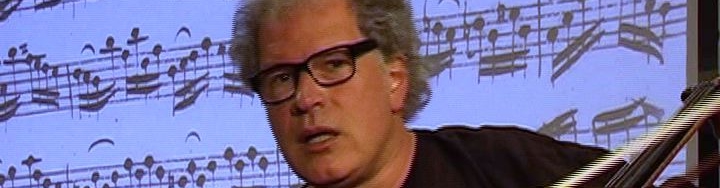
 

not Articulation, but Harmony

Britain


This is a translation of the post „nicht Artikulation, aber Harmonik“, Aug 12, 2013
by Dr. Marshall Tuttle.


A New Perspective on the Music for Unaccompanied Violin and Cello by Johann Sebastian Bach

The slurs in the Anna Magdelana Bach copy of the Bach solo cello Suites are – contrary to conventional beliefs – not indications of articulation. Rather, they characterize harmonic processes and the dominance of harmony. This is a fact which has not been generally recognized.

Johann Sebastian Bach wrote these highly complex works not merely for one solo instrument, but specifically for a melody instrument. Superficially considered, this appears paradoxical. It is therefore not a defect that a harmony instrument is missing. On the contrary, adding a harmonization to the cello Suites is a priori  impossible.

The slurs therefore are not merely articulation markings, binding marks of a so-called legato. The slurs highlight pitches that are harmonic determinants. In sequences, for example, with repetitions of a motive at different pitch levels, harmonic pitches may shift within the motive. The slurs must inevitably shift within the motives to clarify these harmonic relationships.

The harmonic function of slurs stands in contrast to articulation. The noise component, the so-called “attack”, fades into the background. The slurs serve solely to indicate the relative importance of pitches. In this respect the use of slurs defines a third structural parameter in addition to pitch and rhythm.

J. S. Bach’s slurs proceed with no consideration for the meter. On first glance, this appears surprising. Often slurs stress notes that are metrically weak. The result is an agogically varied rhythm. The emphasis on strong beats characteristic of the motivic repetitions is contradicted by the bowings. Thus, an expressive tension is generated between the representation of harmony and notated rhythm. (As if “dance movements”…)

In the slurs in A. M. Bach’s copy the intentions of the composer are clearly manifested. These slurs show the cello Suites to be even more unconventional than is generally supposed. Historical performance practice is peripheral to understanding them. There is nothing comparable in the literature for violin or cello, and therefore no performance tradition for these works.

While no autograph of the cello Suites is preserved, there is an autograph of the solo violin works. In addition to Bach’s single autograph of the solo violin works, there is a copy made by A. M. Bach. The autograph seems to be an earlier version and A. M. Bach’s later version was not merely a copy of the earlier version. A significant period of time seems to have elapsed between the dates of the Autograph and the A. M. Bach copy, up to 10 years. Bach used this time for in-depth experiments on interpretation of his work. The copy of Bach’s solo violin works by A. M. Bach is an independent version that can only have been created and authorized by the composer himself.

Urtext editions of the Suites for solo cello all have to be revised. The standardization of slurs based on a generalized presumption of their function as articulations of motives is incorrect. As a result, about half of the commonly published slurs are inaccurate. The copy of A. M. Bach is only unclear in a few places with an error ratio of about 3%. This ratio is insignificant once one understands the principles behind these slurs. Those errors can be corrected. As an example of the copyist’s art it is both exemplary and authoritative.

Michael Bach


Die Bindebögen im Prélude der Suite in G-dur für Cello solo

Germany

Als erstes Beispiel für die Diskrepanzen in der Deutung der Bindebögen möchte ich den allerersten Satz der Suiten für Violoncello als Beispiel heranziehen.

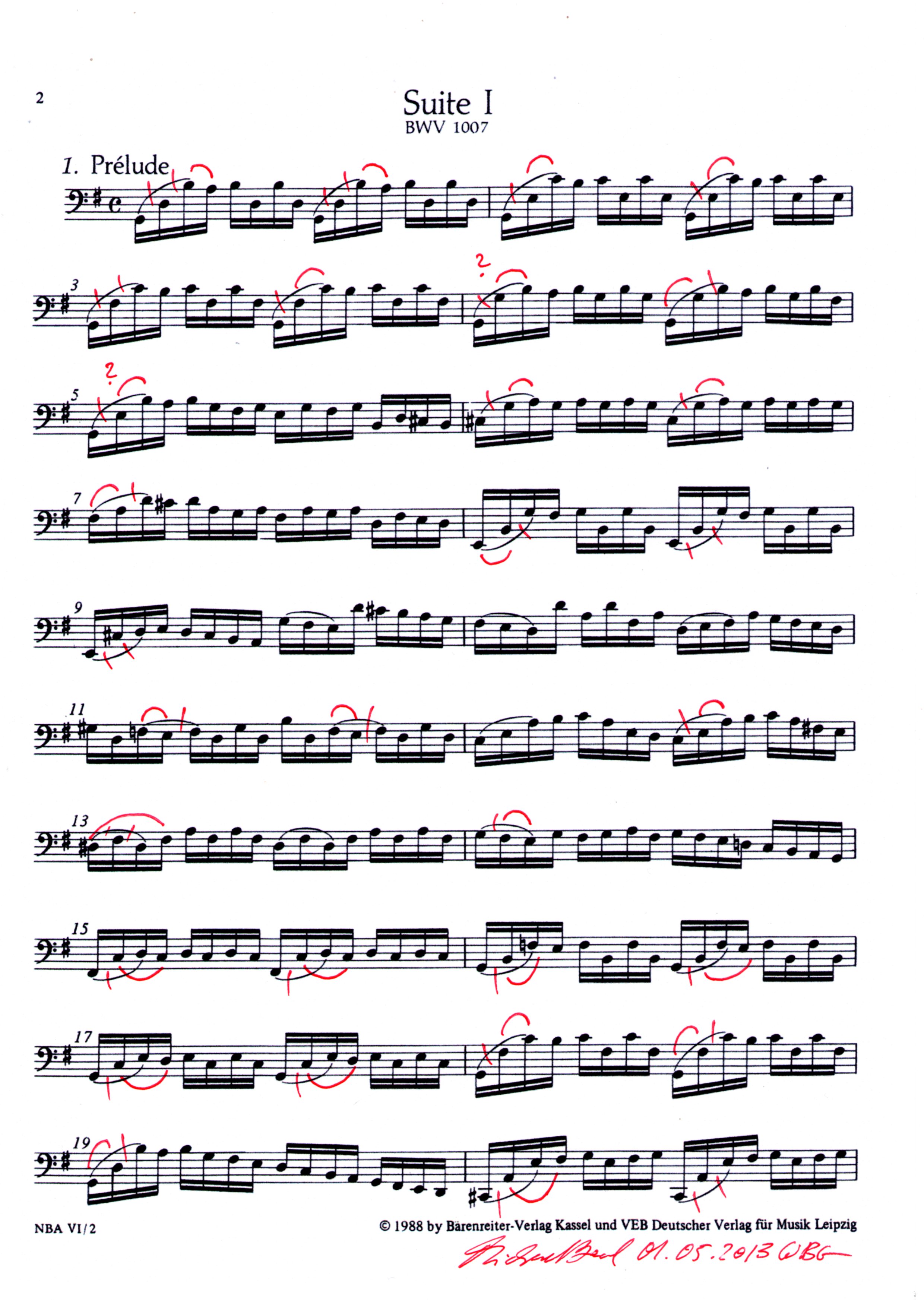
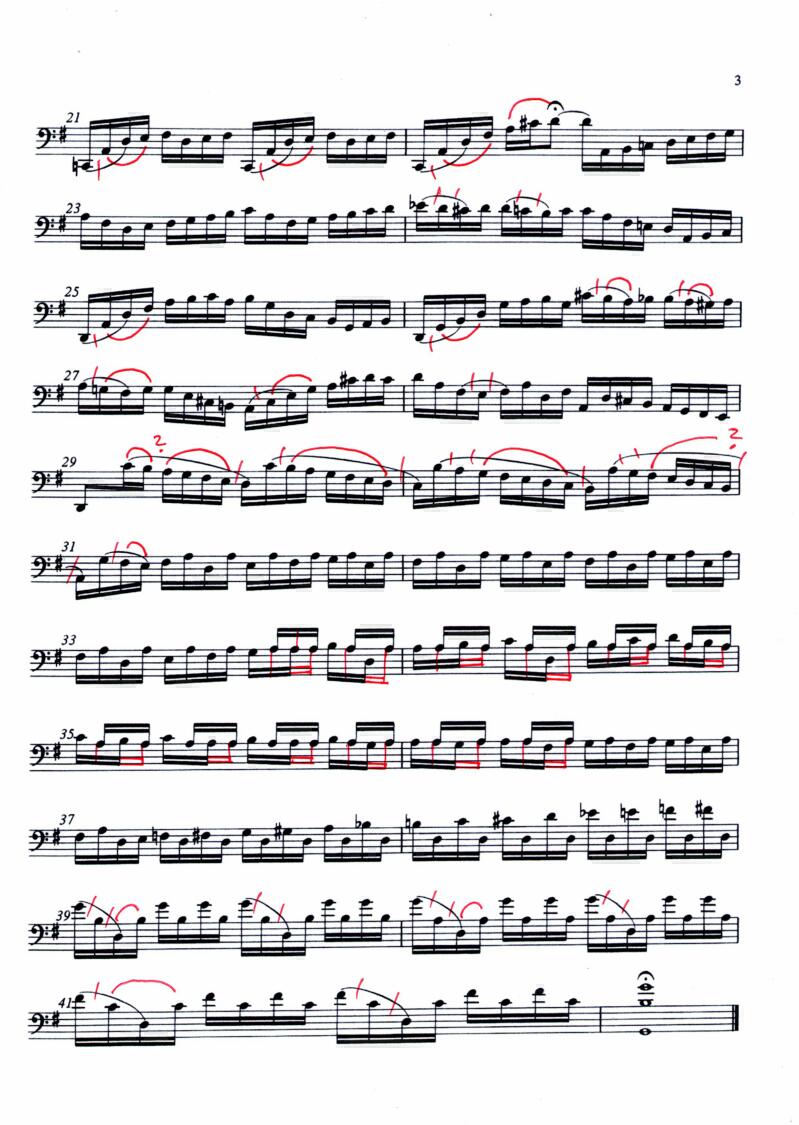
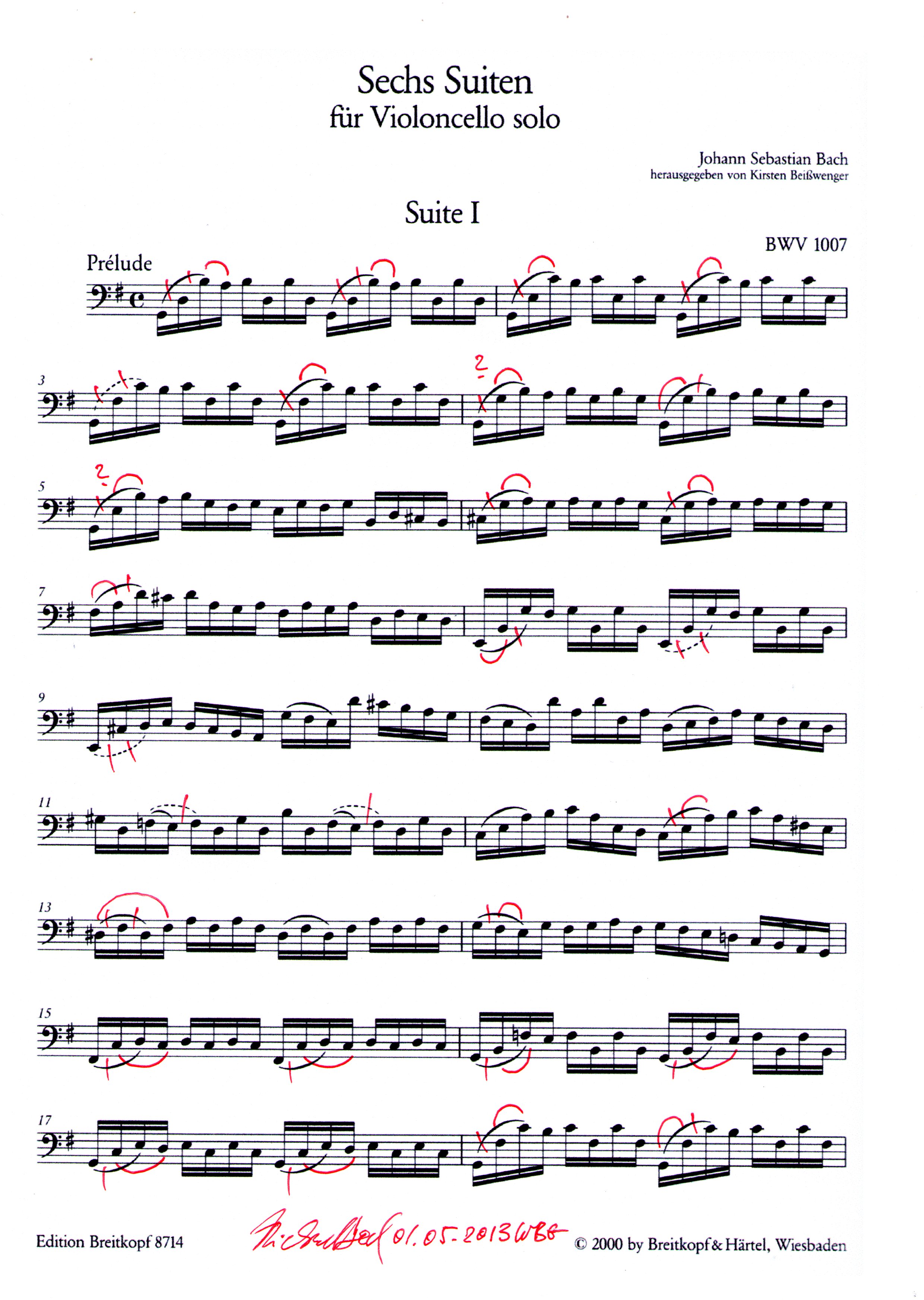
Die drei Ausgaben der Neuen Bachausgabe 1988 (Bärenreiter-Verlag, Kassel und VEB Deutscher Verlag für Musik, Leipzig), des Verlags Breitkopf & Härtel, Wiesbaden 2000 und des G. Henle Verlags, München 2007 weichen relativ stark von den Angaben in Anna Magdalena Bachs Abschrift ab.

Die Korrekturen in rot geben meine Lesart der Bindebögen wieder. Für die Analyse sind die digitalen Scans der Abschrift, von der Staatsbibliothek zu Berlin zur Verfügung gestellt, eine unverzichtbare Voraussetzung.

~

Der nächste Beitrag wird die Begründung für die richtige Setzung dieser Bindebögen in Anna Magdalena Bachs Abschrift liefern.

 Michael Bach


Prélude G Bärenreiter korr 001

Prélude G Bärenreiter korr 0022


Prélude G Breitkopf korr 001

Continue reading