Category Archives: Allgemein

Urtext = Klartext? – eine Analyse der Sarabande in Es-Dur, Teil 1 (Takt 1-12)

Germany

Michael Bach

Dies ist der erste Teil der Analyse der

Sarabande in Es-Dur

mit Klangbeispielen 

 und den Interpretationen im Cello-Wettbewerb *)


Interpretation der “Sarabande in Es-Dur”
Michael Bach, Violoncello mit BACH.Bogen

https://youtu.be/-Vz9Qs3TiWA


Sarabande Es-Dur AMB-
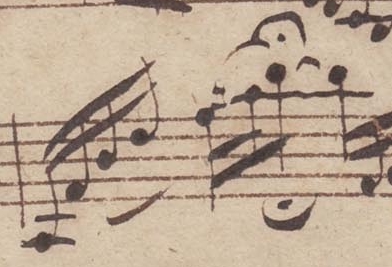
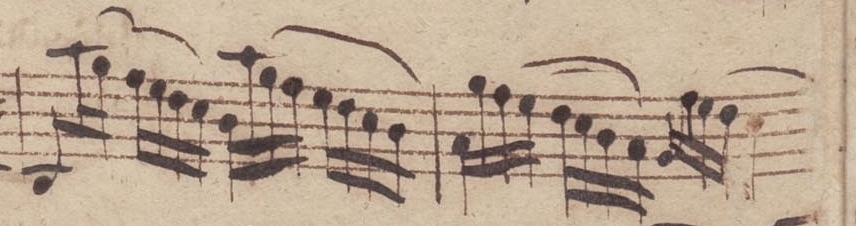
Abschrift von Anna Magdalena Bach, Digitalisat der Staatsbibliothek zu Berlin – PK


Glossar:

JSB = Johann Sebastian Bach
AMB = Anna Magdalena Bach

2-B, 3-B, 4-B = Bindebogen über 2, 3 oder 4 Noten
drei 2-Bn = drei Bindebögen über 2 Noten
1. Zz = 1. Zählzeit eines Takts
Zzn = Zählzeiten
T, Te, Tn = Takt, Takte, Takten

c4 = c’

Sub = Subdominante
Dom = Dominante
Tp = Tonikaparallele
Sp = Subdominantparallele
Dp = Dominantparallele
DD = Doppeldominante
D7-Akkord= Dominantseptakkord
D9-Akkord = Dominantnonakkord
s6-Akkord = Mollsubdominante mit Sext statt Quint
ZD = Zwischendominante
ZDD = Dominante der Zwischendominante


Vorbemerkung

Die Analyse der „Sarabande in Es-dur” von JSB wird hier den einzelnen Interpretationen der Teilnehmer am diesjährigen Cello-Wettbewerb für Neue Musik in Stuttgart *) gegenübergestellt. Dies geschieht deshalb, um die Frage zu erhellen, inwieweit die heutigen, aktuellen Interpretationen dem überlieferten Notentext gerecht werden. Bei dieser “Sarabande” weichen die Urtextausgaben von der Abschrift AMB’s nicht wesentlich ab und es sind keine Schreibfehler AMB’s zu konstatieren. Es hat sich dennoch eine Aufführungskonvention etabliert, die den Notentext im Grunde genommen abändert. Dies betrifft die Mehrstimmigkeit, als auch die Bindebögen und das Hinzufügen von “Verzierungen”.

Es scheint nicht allgemeines Wissensgut zu sein (auch die Urtextausgaben berücksichtigen das Folgende nicht), daß bei zwei- oder mehrstimmigen Passagen, die längeren Notenwerte den Bogenstrich quasi diktieren, d. h. daß die Töne der anderen Stimmen, welche kürzere Notenwerte aufweisen, dementsprechend gebunden sind, z. B. hier in den Anfangstakten.

Wichtiger als die Bindungen sind jedoch die Betonungen, die implizit mitnotiert werden. Folglich lassen die Bindebögen eindeutige Rückschlüsse auf agogische und dynamische Prozesse zu, so daß JSB damit ein effektives und gleichzeitig flexibles Notationssymbol zur Hand hatte.

In der Regel sind die Bindebögen identisch mit den Bogenstrichen. Trotzdem kann aus spieltechnischen Gründen einmal ein Bogenstrich verändert werden. Entscheidend bleibt dabei, daß der Sinngehalt eines „kompositorischen” Bindebogens erkannt ist und klanglich entsprechend umgesetzt wird. Dennoch sind die Bindebögen in den „Suiten” fast immer auch identisch mit den optimalen Bogenstrichen. Die beiden Ausnahmen sind in dieser “Sarabande” die Te 29f.

Haltebögen bewirken keine Akzentuierungen, da sie eine Tonhöhe nur verlängern. Allerdings ist in diesem Satz etwas anderes sehr auffällig, nämlich daß JSB dezidiert Haltebögen über den Taktstrich hinweg notiert. Dies führt in den Tn 1 und 3 bei einigen Interpretationen zu dem Mißverständnis, anzunehmen, daß ein Haltebogen sowohl auf den Tonhöhen des4 und as3 fehlt, als auch manchmal an ähnlich aussehenden Stellen, und zwangsläufig ergänzt werden müßte.

Und somit sind wir wieder bei der Harmonik gelandet. Denn alleinig deren eingehende Analyse gibt uns den entscheidenden Clou an die Hand, warum z. B. in den ersten 4 Tn keine Haltebögen vorhanden sind. Der diesen Satz prägende Haltebogen ist demnach weniger als artikulatorische Bindung zu verstehen, sondern vielmehr als ein Zeichen, das den harmonischen Sinnzusammenhang stiftet. Im Cello-Wettbewerb wurde, in Verkennung der Bedeutung des Haltebogens, dieser oft auf alle gleich aussehenden Motive übertragen, ohne die harmonischen Gegebenheiten zu beachten.

Der Haltebogen in dieser „Sarabande” erklärt uns auch, warum z. B. in T 23 nicht der DD7-Akkord sondern der s6-Akkord erklingt. Dies ermöglicht die Überbindung der Note es3 zur 1. Zz des Folgetakts und hat Auswirkungen auf die Gewichtung der einzelnen Akkordtöne untereinander. Das “Fehlen” eines Haltebogens, in den Eingangstakten beispielsweise, gibt uns den Hinweis, daß es sich bei der Septim eines dominantischen Akkords (z. B. as3 in T 3) und dem Quartvorhalt seiner Auflösung (notationsmäßig diesselbe Note as3) streng genommen frequenzmäßig nicht um diesselbe Tonhöhe handelt. Damit werden heutige Thematiken, wie z. B. die der Mikrotonalität, tangiert, die sich jenseits der temperierten Stimmung mit Fragen der Intonation befassen.

Die Tonart Es-Dur wird in den Eingangstakten der „Sarabande” mit ihrer Sub und Dom gefestigt. Die in T 8 zu erwartende DD wird aber, für den Hörer irritierenderweise, in der 1. Satzhälfte „verleugnet”. Die DD tritt dann später in T 21 auf, sozusagen “verspätet” und in Verbindung mit dem Anfangsmotiv, dann aber nur ein einziges Mal und um so überraschender und heroischer.

Hingegen spielen die Moll-Tonarten eine dominierende Rolle, obwohl sie eher im Hintergrund verbleiben. Oft sind sie mit der Dom oder der DD verwechselbar. Sie bewirken so etwas wie ein harmonisches Gravitationsgeflecht, deren Massekörper (Akkorde) nicht explizit in Erscheinung treten.

Eine hervorstechende Besonderheit ist der Triller am Ende der 1. Satzhälfte. An ihm läßt sich exemplarisch zeigen, daß es in den „Suiten” für Cello keine Verzierungen, im herkömmlichen Sinn als „verschönerndes” Ornament verstanden, gibt. Triller sind hier immer ein Indiz für zwei oder mehrere oszillierende Harmonien. Dieser Triller, auf dem Grundton der Dom, nicht auf deren Terz, bewirkt außerdem ein offenes Ende der 1. Satzhälfte, weil dessen Auflösung fehlt. Das etwas ratlose „Trillern” einiger Interpreten im Cello-Wettbewerb findet hierin seine Aufklärung.

Die Rundbogen-Thematik wird in dieser Analyse nicht dargelegt, obwohl die von mir eingespielten Klangbeispiele mit dem Rundbogen ausgeführt sind. Es gibt jedoch 2 Stellen, die ohne den Rundbogen definitiv nicht ausführbar sind: die Te 30f. Für andere Passagen bietet der Rundbogen differenzierte Spielweisen, die der kompositorischen Struktur eher entsprechen, gemäß dem Motto: das beste Instrument ist gerade gut genug für JSB.

Die Mehrstimmigkeit ist, gerade auch was die Notenwerte anbelangt, genauestens notiert. JSB hat nichts Beliebiges oder Austauschbares in diesen Werken niedergeschrieben. Jede Tonhöhe und jeder Notenwert, sowie jeder Bindebogen und jeglicher Triller haben ihre Bewandtnis. Die Abschrift von AMB gibt davon Zeugnis.

*

Der Bindebogen-Kodex

Ich setze hier einige Erkenntnisse, die sich aus meiner detaillierten Analyse aller „Suiten” in der Abschrift  von AMB ergeben haben, quasi als Axiome voraus. Ich bezeichne sie als den „Bindebogen-Kodex” in diesen Solowerken für Cello. In der „Sarabande” kommen folgende Regeln in Betracht:

1

Die erste Note unter einem Bindebogen ist betont, sowie die erste nachfolgende Note. Je länger der Bindebogen ist, um so stärker wird die darauffolgende Note betont und um so schwächer ist die erste Note des Bindebogens. Dies führt manchmal zu dem Extremfall, daß außergewöhnlich lange Bindebögen sehr leise beginnen müssen, wobei die Tonhöhen im Anschluß sehr stark akzentuiert sind (z. B. T 13 der “Allemande” in G-dur).

2

Folgen zwei Bindebögen unmittelbar einander, so erhält die erste Note des 2. Bindebogens eine Betonung, wobei die nachfolgenden, angebundenen Noten decrescendieren. Die erste Note nach dem 2. Bindebogen ist infolgedessen unbetont.

3

Bindebögen werden in der Regel nicht notiert, wenn die Mehrstimmigkeit diese sowieso vorgibt.


Die Analyse der „Sarabande in Es-Dur”
… und deren Interpretationen im Cello-Wettbewerb
*)

Sarabande Es Edition MB 001
Sarabande in Es-Dur,  Edition Michael Bach
Notenbeispiel T 1-4

Bindebögen, die sich aufgrund der Mehrstimmigkeit von selbst verstehen und die JSB deshalb nicht notieren mußte, sind in Klammern hinzugefügt.


T 1

Der Quintklang zu Beginn spart die Terz aus. (Dieser harmonisch offene Anfang steht im Gegensatz zu T 21, wo das gleiche Motiv in der DD mit Terz erklingt.) Erst mit der 2. Note, dem c4, wird die Durtonart klar, wobei die nachfolgende Septim des4, im Zusammenklang mit der Baßnote es3, das eigentliche Ziel, den dominantischen Charakter dieses Anfangstakts, offenbart. Die Oberstimme ist gebunden, weil in der Unterstimme ein 3/4-Notenwert steht.

T 2

Die 1. Zz wird betont aufgrund des dreistimmigen Akkords und, laut „Bindebogen-Kodex”, weil dem relativ langen Bindebogen des Vortakts naturgemäß eine Betonung folgt. Auch in der 1. Zz des T 2 ist die Oberstimme gebunden, da in den Unterstimmen 1/4-Notenwerte notiert sind. Entsprechend des „Bindebogen-Kodex”, erhält diese 1. Zz nun ein decrescendo. Die Vorhalte lösen sich in der 2. Zz zur Terz c4 der Sub auf, die somit unbetont ist.

T 3

Dieser Takt wird mit einem Auftakt von drei gebundenen 1/16-Noten eingeleitet. Dadurch wird diesmal, im Gegensatz zu T 1, die 1. Zz des T 3 betont. Hieraus folgt, daß der gesamte T3 ein decrescendo erhält.

T 4

Es folgt weiterhin, daß die 1. Zz des T 4 nun unbetont ist, trotz des dreistimmigen Akkords. Die Auflösung der Vorhalte wird nach den beiden Vortakten nun vom Hörer antizipiert. Wegen der Bindung in der 1. Zz wird sodann die Auflösung zur Terz g3 der Tonika in der 2. Zz leicht akzentuiert, sie ist erstmalig eindeutig etabliert.


Anmerkung:

Im T 2 halten sich das kurze decrescendo und das crescendo die Waage, so daß der T 3 an seinem Ende in etwa wieder zur Lautstärke des Satzanfangs zurückkehrt. Hätte JSB eine Wiederholung der Dynamik, d. h. ein crescendo in T 3 gewollt, so wären die drei 1/16-Noten ungebunden. Aber eine Wiederholung der Dynamik der Te 1 und 2 würde der harmonischen Entwicklung widersprechen: Tonika-Sub-Dom-Tonika, die mit der Auflösung zur Tonika in T 4 eine Entspannung bietet. Außerdem würde ein zweimaliges crescendo und leichtes decrescendo in diesen 4 Tn eine Gliederung in 2 mal 2 Takteinheiten kreieren, die die kadenzartige Einleitung spalten würde.

Besonders aufschlußreich sind demnach die Betonungen auf der jeweils 1. Zz der Te 2 und 3 (Sub und Dom), die unbetonten 1. Zzn der Te 1 und 4 und der Akzent auf der Terz g3 der Tonika in T 4, womit die Kadenz ihren Abschluß findet.

Um die Betonung der Dom noch stärker hervorzuheben, wäre ein Akkord in T 3 denkbar, hier aber unlogisch, da das Motiv vom Quintklang ohne Terz geprägt ist. Ein Akkord mit Terz zu Beginn dieses Motives bleibt alleinig der DD in T 21 vorbehalten. Ein Akkord in T 4 hingegen ist auf dem Cello, infolge des Quintfalls im Baß, unausweichlich, denn die mittlere Saite erklingt zwangsläufig, wenn die beiden äußeren Saiten angespielt werden. Die Baßnote es2 ist notwendig, denn durch sie wird der Quartvorhalt in der Oberstimme evident.

Schon in diesen vier Anfangstakten zeigt sich also präzise, wie JSB sich die Gestaltung dieser Eingangskadenz dachte. Er brauchte nur einen einzigen Bindebogen zu notieren, auf den drei 1/16-Noten des T 2. Die anderen Bindebögen, samt Betonungen und Dynamik, ergeben sich wie selbstverständlich aus der komponierten Mehrstimmigkeit.

Die Eingangskadenz ist als harmonische Einheit zu sehen. Es ist das hervorstechendste Merkmal dieses Satzes, daß beharrlich, bis auf wenige markante Stellen, Neuanfänge bzw. Trennungen vermieden werden. Noch nicht einmal werden die beiden Satzhälften klar getrennt, denn der Triller vereitelt eine klare Auflösung zur Dom und bildet keinen deutlichen Schlußton.

Weiterhin: Bei den Tonrepetitionen in der Oberstimme, also der Septim des4 und dem Quartvorhalt des4 respektive der Septim und Quart as3, handelt es sich genau besehen nicht um diesselbe Tonhöhe. Man könnte sogar die Septim etwas tiefer intonieren als die Quart, quasi als Oberton des Grundtons, weil sie mit ihm zusammen erklingt. (In reiner Stimmung wäre das Tonhöhenverhältnis der beiden Noten as3 in den Tn 3 und 4 folgendermaßen: die Quartdezim (Septim plus Quint) 3/2 x 7/4 = 21/8 = 63/24 und die Undezim (Oktav plus Quart) 8/3 = 64/24. Bei einer Frequenz von 78 Hz für den Grundton es2 wäre die Septim der Dom 204,75 Hz und die Quart der Oktav 208 Hz. Das bedeutet eine Differenz von ca. einem Viertelton, denn in diesem Oktavbereich beträgt der Halbtonschritt ca. 12 Hz.)

Klangbeispiel T 1-4

 *

Wie wurde dieser Satzanfang nun im Cello-Wettbewerb gespielt?

Interpretation T 1-4 der 11 Teilnehmer

Die Wettbewerbsbeiträge haben selten die Zweistimmigkeit in den Tn 1 und 3 und das legato in der Oberstimme in den Tn 1 und 3 realisiert. Nie wurde in der 1. Zz der Te 2 und 4 die Oberstimme gebunden.

Manchmal wurde irrtümlicherweise die Septim der 3. Zz an den Quartvorhalt im Folgetakt quasi „gebunden”, indem in der 1. Zz die Tonrepetition in der Oberstimme schlicht weggelassen wurde. Damit soll das synkopische Muster anderer Stellen in etwa kopiert werden (s. Vorbemerkung), denn mit dem konkaven Bogen läßt sich eine fiktive Überbindung nur derart immitieren, da für die Ausführung der beiden Baßnoten die Oberstimme definitiv verlassen werden muß.

Alle im Cello-Wettbewerb vorgeführten Varianten zwingen außerdem zu einer Verkürzung der Baßnoten, die ja ansonsten, infolge eines Bogenwechsels, repetiert werden würden. Die Verkürzung der Baßnoten in den Darbietungen wird aber weder durch eine Analyse des Notentextes noch durch irgendwelche Aufführungstraditionen gerechtfertigt. (Es wird zudem nicht berücksichtigt, daß In JSB’s Notation die Te 13 und 21 ja kürzere Baßnoten enthalten, im Unterschied zu den Tn 1 und 3. Es handelt sich um eine Differenzierung, deren harmonischer Sinn an den entsprechenden Stellen erklärt wird.)

*

 

Sarabande Es Edition MB 002
Notenbeispiel T 5-8


T 5

Die nächste Passage bis einschließlich T 7 zeigt nun, warum zweimal eine Überbindung (Haltebogen) über den Taktstrich hinweg erfolgt, jedoch ein einziges Mal nicht (T 6).

Die Note es3 in T 4 wird an die 1. Zz des Folgetakt angebunden, weil die Tonika weiterhin erhalten bleibt. Ein Harmoniewechsel oder eine Auflösung geschieht hier diesmal nicht. In der Unterstimme erscheint die 1/8-Note b2, die Quint der Tonika. Sie kann gehörsmäßig noch nicht als Grundton der Dom erfaßt werden, weil die Terz fehlt, und zumal JSB das b2 auf eine 1/8-Note verkürzt.

Dadurch wird die Note c3 in der Oberstimme der 1. Zz nicht angebunden und somit wird auch nicht die Note d3 der 2. Zz akzentuiert. Die dominantische Funktion bleibt vorerst noch in der Schwebe. Erst mit der Note as3 der 3. Zz, ähnlich wie in den Tn 1 und 3, hat sich die Dom gehörsmäßig etabliert.

Es ist vielleicht an dieser frühen Stelle in der „Sarabande” noch etwas spekulativ, aber ein leiser Anklang der Dp könnte mit den Noten b2 und d3 bereits beabsichtigt sein. Die Dp tritt im gesamten Satz nie prononciert auf, sie ist aber an vielen Stellen latent gegenwärtig.

Statt der Dp hier die Tp zu vermuten, wäre sogar noch etwas wahrscheinlicher, weil die 1/16-Note c3 nicht angebunden ist und, zusammen mit der Note es3, als eine akkordeigende Tonhöhe der Tp aufgefaßt werden kann.

Aus diesen Erwägungen heraus kann mit jeder neu eintretenden Tonhöhe des T 5 eine andere Harmonie erwartet werden: mit c3 die Tp, mit d3 die Dp, mit f3 die Dom. Erst der Tritonus d3-as3 klärt die harmonische Situation schlußendlich zur Dom. Mit der synkopischen Überbindung der Note es3 entsteht also ein „harmonisches Vakuum”, das direkt nach der Eingangskadenz eintritt. Dies wirkt ratlos, fragend und ist ein starkes dramaturgisches Mittel, das in wesentlich effektvollerer Gestalt in T 24 nochmals angewandt wird.

T 6

Der T 6 beginnt mit zwei Harmonien, der Tonika (es2-b2) und der Dom (b2-as3). An der Artikulation und den Notenwerten des Akkords ist dies ablesbar. Denn die 3. Zz des Vortakts, hier die Septim as3, wird diesmal nicht, wie in den Tn 4 auf 5, übergebunden. Auch folgt die Artikulation nicht dem motivischen Muster der Te 2 und 4 und führt nicht zur vertrauten harmonischen Abfolge, einer Auflösung in der 2. Zz. Der feine Notationsunterschied findet sich in der Verkürzung der beiden Noten der Unterstimmen auf einen 3/16-Notenwert, was die verbleibende 1/16-Note f3 nun zu einer akkordeigenen Tonhöhe macht, zur Quint der Dom. Somit ist wiederum die 2. Zz (Note g3) unbetont, so daß eine Auflösung zur Tonika noch hintangestellt wird.

Um die harmonische Ambivalenz des Akkords zum Ausdruck zu bringen, ist es vorteilhaft, alle 3 Töne des Akkords gleichzeitig anzuspielen und gleichlang auszuhalten, als unaufgelöste Dissonanz.

Mit der 3. Zz wird die Tonika offenbar nun doch erreicht, aber die Spitzennote des4 fungiert als Septim, die Tonika wird zu einer ZD umfunktioniert. Da in der Unterstimme der 3. Zz jedoch nicht der Grundton es3 notiert ist, legt JSB sich noch nicht endgültig fest.

T 7

Die Septim des4 wird nun zu T 7 übergebunden. In der Unterstimme erscheint überraschend die Note e3. Es ist zunächst unklar, welche der beiden Noten dissonant ist. Theoretisch könnte die Note e3 ein Sekundvorhalt sein, der sich nach es3 auflösen würde. Und somit wäre die Note des4 immer noch die Septim des Vortakts, was in einer Auflösung zur Sub, wie in T 2, enden könnte.

Aber die Unterstimme löst sich nicht auf und der weitere Verlauf zeigt, mit der bestätigenden Wiederholung der Terz e4, daß sich die Harmonie des Takts mit den Noten des4 und e3 verwandelt hat zu einem D9-Akkord, nämlich zur ZD der DD. Die Note e3 ist deren Terz. Sie ist zwar zu einer 3/16-Note verkürzt, aber voll auszuhalten, um dieser überraschenden Wendung Nachdruck zu verleihen.


Anmerkung:

Die Überbindung der Note des4 suggeriert eigentlich den Fortbestand der geltenden Harmonie. Trotzdem findet ein Harmoniewechsel statt. Interessant ist nun, daß die Septim des4 der Tonika (in T 6) und die None des4 der ZD der DD (in T 7) die gleiche Frequenz besitzen und deren Verbindung insofern möglich ist. (Das Intervallverhältnis der Grundtöne der ZD der DD (c3) und der Tonika (es4) ist eine kleine Terz, also 6/5. In reiner Stimmung wäre demnach die Frequenz dieser Natursept, von c3 aus berechnet, 6/5 x 7/4 = 21/10 und die der None der ZD der DD (Quint und Tritonus) 3/2 x 7/5 = 21/10, Ohne Verwendung des 7. Partialtons berechnet, weil die Septim nicht zusammen mit dem Grundton erklingt: kleine Septim über kleiner Terz 6/5 x 16/9 = 32/15 und Oktav plus kleine Sekund 2 x 16/15 = 32/15.

Damit wird die harmonische Bedeutung der Haltebögen über den Taktstrich hinweg verständlich. Es wird ersichtlich, wie eng die Maßgaben der reinen Intonation, also den Tonhöhenbeziehungen über ganzzahlige Verhältnisse errechnet, mit denen der harmonischen Prozesse verwandt sind. JSB war sich dessen klar bewußt.

Die Frage, warum die Unterstimme in T 5 zu einer 1/8-Note und in den Tn 6 und 7 nur zu einer 3/16-Note verkürzt wird, erklärt sich daraus, daß in T 5 der Zusammenklang konsonant ist und ein harmonischer Wechsel nur angedeutet wird, aber noch nicht stattfindet, währenddessen die Zusammenklänge in den 1. Zzn der Te 6 und 7 dissonant sind. Letztendlich lassen sie offen, in welche Richtung sie sich auflösen werden. Mit der Verkürzung der Baßnoten um einen 1/16-Notenwert wird zudem eine Akzentuierung der 2. Zz vermieden. Die Betonung in den Tn 5 bis 7 liegt stattdessen eher auf der 3. Zz inklusive der auftaktigen 1/16-Note, weil sich die neue Harmonie erst an dieser Stelle manifestiert.


T 8

Nach einer ostentativen Zäsur, bedingt durch einen abrupten Oktavsprung nach unten, bleibt die Antwort auf diese stark fordernde harmonische Entwicklung weiterhin aus. Eigentlich erwartet man die abschließende DD. Es erklingt jedoch die dissonante Quart f3-b3 und unklar ist erneut, welcher Ton sich „auflösen” wird. Denn theoretisch wäre die Weiterführung der unteren Note, hier also die Note f3 zur Note e3 des Vortakts, denkbar. Dies würde ein Weitererklingen der ZD bedeuten.

Es erfolgt aber die Auflösung von b4 zu a4, was die DD nun realistischer werden läßt. Allerdings findet sich jetzt ein äußerst ungewöhnlicher Bindebogen auf diesen beiden Noten, so daß die Auflösung auf der 2. Zz gerade nicht hervorgehoben wird. Es ist einer der sehr seltenen Fälle in den „Suiten”, wo die Auflösung an einen Vorhalt angebunden ist. Außerdem wird die untere Note f3 nicht in der 2. Zz weitergeführt, was die DD ja festigen würde, und was problemlos spielbar wäre.

Beides, der Bindebogen und der “sparsame” 1/4-Notenwert der Baßnote f3, läßt die angebundene Note a3 noch nicht als Auflösung sondern als Durchgangsnote erscheinen. Die DD macht sich “ganz klein”. Anheim gestellt wird auch, alternativ, ein Trugschluß zur Parallele der DD, also d-moll. Hierfür spricht auch, daß sich die „Sarabande” im weiteren Verlauf den Moll-Tonarten zuwendet.

Jedenfalls wurde derart von JSB ein triumphaler Abschluß nach der dreitaktigen Steigerung und der deklamatorischen Zäsur vereitelt. Die letzte 1/16-Note es3 leitet nur noch „flüchtig” zum nächsten Takt über.


Anmerkung:

Dieser harmonische Vorgang erinnert sehr stark an das “Unterlaufen” der Tp in T 14 des “Prélude” in G-Dur (s. Analyse des “Prélude”, Teil 2).

Klangbeispiel T 5-8

*

Wie wurde diese Passage nun im Cello-Wettbewerb gespielt?

Interpretation T 5-8 der 11 Teilnehmer


Einige Interpreten verkürzten die Notenwerte in der Unterstimme, einige verlängerten in T 8 die Note f3, um die Auflösung zur DD zu verdeutlichen. Einige eliminierten sogar die Note as3 in der Oberstimme der 1. Zz des T 6, um eine synkopische Überbindung zu simulieren, da der konkave Bogen hier keine Dreistimmigkeit zuläßt. Die dynamische Entfaltung, also die 3-taktige Steigerung und deren “erschrockene” Zurücknahme in T 8, blieb unklar, und derart wurde selten die überdeutliche Zäsur vor T8 realisiert.

*

Sarabande Es Edition MB 003
Notenbeispiel T 9-12


T 9

Wie beschrieben, manifestiert sich in T 8 der Komposition die „Auflösung” zur DD nicht sehr überzeugend. Die Fluktuation oder Verwischung der Harmonien wird nun von JSB fortgesetzt. In der letzten Passage der 1. Satzhälfte gehen die DD und die Dom, auch die Tonika, eine enge Verbindung ein. Deren Moll-Parallelen treten jedoch in den Folgetakten ebenso ins harmonische Geschehen ein. Der T 9 steht wohl in der Dom, wiewohl ein Hauch der DDp aus dem Takt zuvor erhalten bleibt, wegen der hier erklingenden Baßnote d3. In dieser Deutung wäre die Note b3 in der Oberstimme ein Sextvorhalt, der sich in der 2. Zz zu a3 (1/16-Note) auflöst. Die 1/4-Note d3 im Baß bewirkt, daß die Oktav d4 in der Oberstimme angebunden und die Spitzennote f4 betont ist.

T10

Die Unterstimme es3 in T 10 suggeriert in Verbindung mit der Oberstimme b3 die Tonika. Dadurch, daß sie ebenfalls einen 1/4-Notenwert besitzt, erklingt das obere d4 als Dissonanz (große Septim). Die Spitzennote g4 wird infolge der längeren Bindung über zwei Zzn besonders betont.

Diese Dissonanz es3-d4 verdeutlicht die harmonische Ambivalenz dieses Takts, denn er könnte auch dominantisch gedeutet werden, mit der Note es3 als Quartvorhalt, ein Vorhalt, der diesmal im Baß liegt. Oder, was im Verlauf der „Sarabande” immer mehr in den Bereich des Möglichen rückt, es erscheint hier die Dp. Die Note es3 wäre in dieser Deutung ein Sextvorhalt. (In der 2. Satzhälfte ist die Tp in T 26 naheliegender, weil diese Harmonie bereits in T 15 überdeutlich eingeführt wurde.)

Übrigens wird diese Dissonanz es3-d4 in der 1. Zz als ein klangliches Charakteristikum in den Tn 27ff der 2. Satzhälfte wieder aufgegriffen und fortgesetzt. Jedenfalls sollte sie deutlich zum Klingen kommen, denn danach wirkt die Spitzennote g4 besonders strahlend.

T 11

Der Vorhalt es3 des Vortakts wird in diesem Takt nicht zu d3 aufgelöst sondern weitergeführt zur Note f3. Da die Unterstimme einen 1/4-Notenwert hat, wird die Oberstimme gebunden, wobei jetzt die Note a3 zusammen mit f3 erklingt (im Gegensatz zu T 8). Die Note a3 gehört der Dom und der DD an, aber auch deren Parallele. Die folgende Betonung der Note f3 der 2. Zz läßt insofern die DD oder die DDp vermuten.


Anmerkung:

Es sind ab T 8 mehrdeutige harmonische Interpretationen denkbar, die parallel verlaufen. Vereinfachend ist eine Linie in Dur beschreibbar: DD – Dom – Tonika – (DD) – D (tr?), die andere in Moll: DDp – Dp – DDp – Dp (tr). Diese Dur-Moll-Ambivalenz beherrscht die gesamte 2. Satzhälfte und führt zu den harmonisch überbordenden 5 Schlußtakten.


T 12

Der Triller c3-b2 auf der Abschlußnote der 1. Satzhälfte verunklart das Erreichen der Dom, oder der Dp. Außerdem, wie ist das eigentlich zu verstehen: Handelt es sich dabei um einen Triller auf dem Grundton der Dom? Kann er als Triller auf der Terz b2 der Dp verstanden werden, oder gar als eine Andeutung des Grundtons c3 der Tp? Dieser Triller wirkt „unwirklich”, da ihm keine reguläre Auflösung folgt. Der Abschlußton bzw. die „Endharmonie” fehlt offensichtlich.

Vielleicht läßt sich dieser Triller erst im Nachhinein aufklären, nach der Analyse der 2. Satzhälfte. Denn es wird immer offensichtlicher werden, z. B. in den Tn 28 und 32, daß die Akkorde von zwei latent vorhandenen Harmonien sich oft nur in zwei Tonhöhen unterscheiden.

Dies führt zur Frage, mit welcher Tonhöhe getrillert wird, mit c3 oder a2? Die erste Variante klingt nach “Dur”, die zweite nach “Moll”, was zur Dp weiterführen würde. Näherliegend ist aber die erste Variante, weil sie, analog zum Schlußtakt, sich wieder den Dur-Tonarten zuwendet. In diesem Fall wäre die Note c3 eindeutig der DD zuzuordnen, die Note b2 stünde dann für die Dom. So repräsentiert in T 12 der Triller das “Flimmern” der DD, welche sich immer noch behauptet und “gegenwärtig” ist.

Klangbeispiel T 9-12

 *

Wie wurde diese Passage nun im Cello-Wettbewerb gespielt?

Interpretation T 9-12 der 11 Teilnehmer


Alle punktierten Rhythmen wurden, vereinheitlichend, exakt wie in den vorherigen 4 Tn gespielt, d. h. die Unterstimme wurde auf einen 1/8-Notenwert verkürzt und die Oberstimme nicht gebunden.

Somit erklingen nicht, mit einem ausdrucksstarken Legato in der Oberstimme, die Intervalle d3-d4, es3-d4 und f3-a3. Die Bindebögen in den jeweils 1. Zzn mußte JSB, wie erwähnt, aufgrund der Zweitstimme nicht zusätzlich notieren. In T 11 wurde auch nicht die Betonung der Note f3 der 2. Zz erkannt. Bis auf 2 Ausnahmen wurde der Triller „grundtönig” geendet mit einer mehr oder weniger langen Schlußnote b2, die nicht notiert ist.


*)

Cello-Wettbewerb für Neue Musik und Verleihung des Domnick-Cello-Preises

Staatliche Hochschule für Musik und Darstellende Kunst Stuttgart

20. – 25. Januar 2014


Die Teilnehmer:

Charles-Antoine Duflot
Raphael Moraly
Armand Fauchère
Magdalena Bojanowicz
Darima Tcyrempilova
David Eggert
Hugo Rannou
Minji Won
Beatrice Holzer-Graf
Hanna Magdaleine Kölbel
Jee Hye Bae



Urtext = Plain Text? – An Analysis of the Prélude in G Major, Part 4 (Measures 31-42)

 Britain

This is a translation of the post „Urtext = Klartext? “, January 21, 2014
by Dr. Marshall Tuttle.


Michael Bach

This is the fourth part of my presentation transcription
Urtext = Klartext?

of 4 May 2013 at the Foundation Domnick Nürtingen near Stuttgart


Note:
It is helpful to open a second browser window with the blog post “The slurs in the Prelude of the Suite in G Major for Solo Cello ”
https://www.bach-bogen.de/blog/thebachupdate/die-bindebogen-im-prelude-der-suite-in-g-dur
in order to have the score visible.

Glossary:

JSB = Johann Sebastian Bach
AMB = Anna Magdalena Bach
2-slur, 3-slur, 4-slur = slurs over 2, 3 or 4 notes
1. Zz = 1st beat of a measure
c4 = c ‘ (middle C)
DD = dominant of the dominant
D7 chord = dominant seventh chord
D9 chord = dominant ninth chord

The terms “Master tone” and “Servant tone” are borrowed from Thomas Mann ‘s novel Doctor Faustus. They distinguish between chord tones and non-chord such as passing notes. For details see Part 1 of the analysis.


Preliminary remark:

The aforementioned sequence of thirds c4 – a3 – fis3 – d3 – h2 – g2 – e2 includes, as discussed, the triads of the D7 chord, the tonic and the relative minor. The triad of the relative minor to the dominant is also included:

 Prélude G Terzfolge e2-c4

Looking at sequence of thirds starting with the note C2 and rising up to A3, the result is the triads of the subdominant, the relative minor, the tonic, the relative minor of the dominant, and the dominant. That is, the seventh C4 of the D7 chord is in this order the root of the subdominant chord.

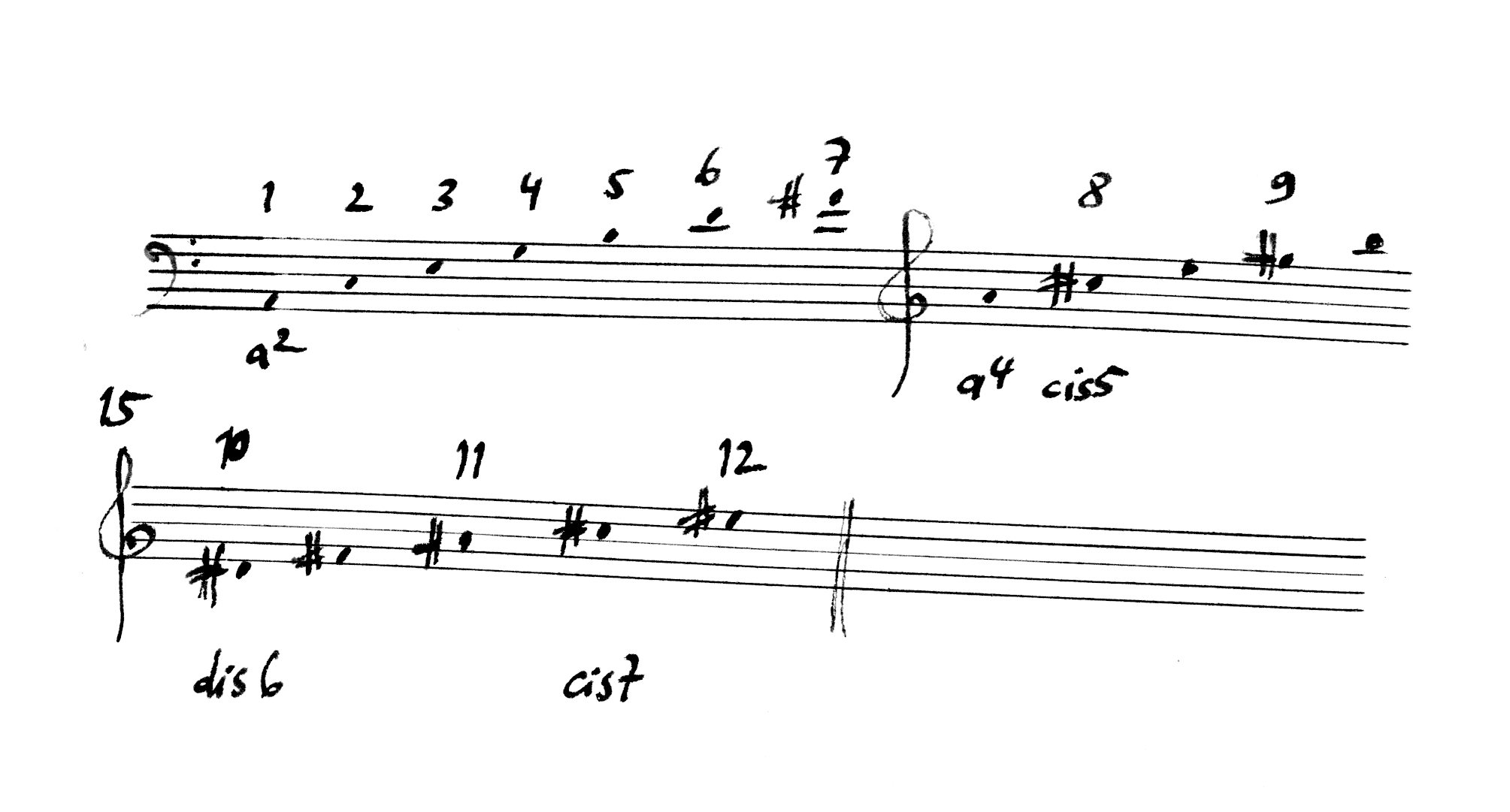
If you start this sequence of thirds with the note A2 (the first note after the F#2) and continues on up to the touch E#7, you get all 12 notes of the chromatic scale:

Prélude G Terzfolge a2-eis7

It is interesting that JSB introduced the non-diatonic pitches of G major in this Prélude, almost in the same order in the composition as they appear in this sequence of thirds. First, the note C#3 in measure 5, then the note G#3 in measure 11 where E#3 is prematurely presented enharmonically as F3. This creates a strong tonal friction and harmonic voltage which resolves to the relative minor of the subdominant (a minor), the starting point of this sequence of thirds. In bar 13 the next note D#3 is added, as a leading tone to the parallel minor.

Only in measure 26 is the last remaining score A#3 (enharmonically changed to Bb3) added in conclusion. This is the said place where the tonality vanishes for a brief moment. It is the moment where the note B4 completes the 12-tone (atonal) pitch space.


Now a passage begins [at measure 31, second beat], which has no slurs – and his explanation. Exactly these three harmonies: D7 chord …

[plays D7 chord]

… Tonic …

[plays tonic and relative minor]

… and relative minor … are united here, re-introduced through the central F#3:

[plays the beginning of measure 31 with emphasis on the note F#3 that has a 2-slur]

It is again this tone range, which I have called the “nucleus” …

[plays G3, F#3 and E3 ]

… between G3 and E3, the tonic and the relative minor:

[plays bars 31 to 33]

What are these sounds? And why is the passage so long? – The rest of this passage is called a Bariolage, when one note remains the same and the others change. It is a very popular effect in the literature for strings. JSB uses the Bariolage for a specific reason. He uses it to make clear once again that the dominant, the tonic and the relative minor are close together.

[plays again the triads of the dominant, the tonic and the relative minor]

So, tonic:

[plays up to the note G3 in measure 31]

relative minor:

[continues to play to the note E3 in measure 31]

dominant:

[continue to play to the note F#3 in measure 32]

tonic:

[continue to play to the note G3 in measure 32]

relative minor:

[continues to play to the E3 in measure 32]

dominant:

[continues to play to the F#3 in the 3rd beat of bar 32 and sets the Bariolage continued to the note A3 in the third beat of bar 33]

Now the Bariolage goes beyond this sound space …

[plays the 2nd Half of bar 33]

… and JSB writes something which is missing in many Urtext editions (from two or three editions), namely the Prime.

The A3 he doubled, he writes only one note head, but 2 stems, which is typical of his notation.


Note:

A Prime consists of two notes on the same pitch and is usually notated with two note heads and optionally with 2 stems. In rare cases, JSB writes a primary note with two stems as found in these cello Suites.


[plays the three 16th notes with the primary A3 of the third beat of measure 33, then B3 and Prime A3]

Prime …

[continues to play D3 and Prim A3]

Prime … So it will be played 2 tones … together:

[plays open A string and the note A3, on the D-string]

None of the famous cellists perform this.

But this is important because JSB has 2 possible harmonies in mind, you remember, we have the double pedal with D2-A3, so it could also be the dominant of the dominant …

[plays triad DD: A2-C#3-E3-A3]

… which is still a possibility. So he adds [to the dominant with its fifth A3] the DD [with root A3], and doubles the A3. This is not only because it is now about the tonal range of A3 going to B3 …

[plays beat three of measure 33 to the note D4 in measure 34]

… and to D4. You could look at A4 on the one hand, as a “pitch barrier” which is exceeded, on the other hand JSB presents to us that a second harmony is possible. This is perhaps speculative, but a double A3 sounds different than a single A3.

What’s even stranger is that the whole thing starts with a thrice repeated Prime, so successively three times a Prime:

[plays the 3rd beat of measure 33]

06

This three-time Prime stands there. And since it is very close AMB might have dedicated the note stems themselves, the middle, and too much has accidentally been recorded.

Now this is a place where I actually looked at other copies from the 18th century. There are a student of JSB [Kellner], which originated from AMB earlier and two that have arisen after JSB’s death. As for pitch, you can already look there once – and I realize that in all 3 copies the Prime in measure 33, beat three appears three times. So, it is not a scribal error of AMB.

Now, what could it be? Of course, the secondary dominant to the parallel minor, so:

[plays parallel minor]

Parallel minor …

[plays measure 13]

… Do you remember? The secondary dominant of the relative minor also has an A3 as its seventh. JSB reminds us of this secondary dominant. But he also turns right back because here …

[plays beat 4 of measure 33, and then continues up to beat 2 of measure 34]

… he brings D3. With this two-time D3 it exchanges the note D#3 [third of the secondary dominant to relative minor]. And JSB writes henceforth only a “two-fold” Prime [only on the second and fourth 16th notes of a beat] – and in the end he leaves the Prime …

[plays measure 36]

… which causes a natural decrescendo. But it is also shown that the dominant of the dominant is finally abandoned, leaving only the dominant.

Note:

Furthermore, since the note C#4 is omitted, the presence of the DD ultimately remains in the balance. The absence of C# from bar 31 makes the harmonic character of this passage vague.

It must be mentioned in this connection that the relative minor of the subdominant also has A3 as the root. Thus, the Prime can also be assigned to the relative minor of the subdominant, which is in my opinion the most sensible alternative.


Now something strange happens again, there is the “nucleus” of which I spoke, and although complete:

[play the notes E3 and F3 of measure 37]

… even the note F3 …

[plays slowly]

… F#3, G3. Hence this chromaticism that I attribute to this C#4 [in measure 22] developed, namely:

[plays first beat of measure 22 beat 2 and then the chromatic scale on the pedal D3, measure 37ff]

The C#4 appears one last time [measure 38 beat 2] and then another expansion of the tone space – we had so far as a top note the Eb4 – and now follow E4, F4, G4 and F#4. This is again the afore mentioned “nucleus”, but an octave higher. JSB has withheld this until the end. The sound space is exploding now, suddenly upward. This is a chromaticism that – I do not know if there are other examples in JSB – the tonality is really cancelled. Only the lower pedal note D2 still sustains the sense of the key. But the chromaticism quashes the tonality. This again recalls Thomas Mann with this Johann Conrad Beissel and the Master- and Servant-tones, because here all the sounds are “equal”. Yes, in Doctor Faustus Thomas Mann makes indirect reference to Arnold Schoenberg, whose twelve-tone methods in fact put an end to the tonal hierarchy. This is found even here in JSB.

Well, the final cadence, so the chromaticism ends thus:

[plays beginning with the note E4 in measure 38]

In bar 39, a 2-slur on the bass note D2, which also emphasizes the G4.

[continues to play to measure 40]

The G4 is emphasized again with a 2-slur on the bass note:

[plays measure 41]

Now, a 3-slur on the seventh C4 further emphasizes the F#4, the tritone.

All Urtext editions put 3-slurs in these bars 39-41 without exception. Many repeat 3-slurs in the second half of the measure, but there is none. Because of the absence of slurs in the second half measure JSB creates again a dynamic slowdown. The emphasis must not be repeated again, affirming it is now rapidly coming to an end. So why again an increase, a crescendo made within the respective 3 bars?

Note:

The sudden increase and intensification of expression occurs in the penultimate bar by the unexpected entrance of the note C4, too, in contrast to the two previous measures, as the second 16th note of the first beat gets a longer slur. (JSB could have left it on the A3.)

Moreover, the tritone F#3-C4 is quoted again in this bar, which characterizes the two parts of the movement. Here, however, in its inversion C4–F#4.


Incidentally, it is noteworthy that JSB emphasizes the second beat. We have here a 4/4-time and have learned that this meter is characterized by a heavy first beat and a similar heavy third beat, but does not focus on the second or 4 beats. This is here [as a result of slurs] clearly different. And that makes sense, because it is only on the 2nd beat that the harmony is clear. That is, the emphasis on the second beat acts so “harmonically” because it is “understandable”.

We have often focussed in this set second beat, so this myth that these pieces were meant to be danced to can be forgotten.

For example, at the very beginning the second beat is emphasized:

[plays measure 1 beat 2]

Or, yes there are many places …

[plays beginning of bar 7 and aborts]

No, not there. But here:

[plays measure 11]

Or even here:

[plays measure 13]

Also in:

[plays measure 15]

Even here:

[measure plays 16 and emphasizes the fourth beat and depends on measure 17]

Here not so much:

[plays the beginning of measure bar 19]

But here again:

[playing measures 20 and 21]

And here:

[plays the start of measure 22]

This is the second beat [A3]. So, there are even more places. Also in:

[plays measure 29]

The second beat and yet here:

[plays the start of measure 31]

So, it is typical of these works that the second beat is often emphasized.

Note:

The second beat also sometimes hosts pitches that are not emphasized by a slur, but give the course of the composition a new twist and thus draw attention to themselves: for example, the notes F3 in measure 37 and C#4 in measure 38

In the other Suite movements it is often true that the real focus is not to be found on the strong beats.


Yes, now the last question: Why is there a chord in the final measure?

[plays the G major triad of measure 42, all three pitches simultaneously sounding]

Because that is not to meant to be any further harmonic ambiguity. He opens the door, so to speak to the other Suite movements. JSB could have written something else:

[plays from measure 41 and performs the resolution to the tonic also with a 16th – arpeggiation of the chord]

He does not. He could have …

[plays again at measure 41 and resolves to the relative minor]

… introduced the relative minor. This happens previously on a few occasions, but not here.

Here, the chord is really something that is unambiguous – and therefore, to my mind, the sounds should be played together and not:

[breaks the G major chord in the two dyads G2-B3 and B3-G4]

… something like that.

[Pause]

*

Yes, that was it, now?

Public 1 (ironically): But this cannot be. [laugh]

MB : You are right. There are 42 Suite movements, and each can be analyzed in a similar way, it doesn’t repeat anything. The fact is that one could at least say so much about each set. I am also very restrained, because I have only talked about the harmony and excluded all other aspects, because my initial intent was to develop a well-founded clarification for the reading of slurs. This contradicts all the Urtext editions. But what the heck. [Audience laughs]

Now I play this movement – then I would like to hear your questions or take a break and perform the Sarabande in D minor.

[plays the Prélude in G Major]

[Applause]

*

MB: Yes. Are there any questions? [Pause ]

At best, the questions should be asked now and not private so that we can all benefit. [Pause ]

Maybe the questions will come a little later …

Audience 1: In the entire performance the tempo fluctuations are much more clear to me than the  slurs that are derived from the transcript. That was much more unusual than the bowings for my ear.

MB: That’s a result … of articulation, caused by the irregularity of slurs. It causes a … , yes, the meter is bypassed basically. There it is no longer in this form. It looks like [the traditional notation in 4/4 time], but it is not so. Just because the slurs are placed irregularly. That is the reason why it is always “corrected” [in the Urtext editions]. Because you can not imagine it this way, the fact that the accents are so irregular. The thing I just tried to explain with the second beats is in the small range [emphases on the second or fourth 16th note of a beat] the case. That made me surprised – not just you. [laugh]

Audience 1: To me it is so delivered, that when it [is handled technically] so skillfully, a scale, for example, that one has already played umpteen times that went very quickly. Something like: ‘ Aha, he can do that. He has been practicing for many scales and then go on grounds of dexterity faster and not from any scientific reasons.’

MB: Well, there are maybe 2 , 3 or 4 scales. If we use … at this point , for example , …

[plays measure 19]

Because … I want to quickly get there, to the note C#2. That is not because it is easy to play, but that [the scale] is actually clear.

The only thing which is left would be:

[initially plays the notes F#2 and E2]

… as far as we were already … only these two tones:

[plays then D2 and C#2 ]

But more important to me then is:

[plays the second 16th note A2 to the note G3 of measure 20]

… the Septim G3 here. So this bass note:

[plays C#2 of measure 20]

… of course is a surprise, but this follows from the tones before:

[plays scale from the note F#2 down]

Of course you could emphasize this, but … if you emphasize “everything”, then …

Note:

The surprise effect of the bass note C#2 in measure 20, as well as the bass note F#2 in bar 15, is created by the sudden appearance of these unprepared pitches.


Audience 1: You are the player, but the listener is easily mislead, … as I said it , … therefore easy to get off on the “wrong track” .

MB: The situation that the listener gets set on the “wrong track” by JSB is so constantly here. That’s exactly what seems interesting to us. For example, at this point:

[plays first half of measure 22]

That is not expected. What is expected:

Prélude G T22 Alternative 1

[plays first beat of measure 22, but then A3, D4 and F#4 with fermata]

or:

Prélude G T22 Alternative 2

[repeats first beat of measure 22, but then A3, C4 and D4 with fermata]

Because we already have this harmony:

[plays chord tones of the D7 chord]

But JSB writes:

[plays again first half of measure 22]

The other [the previous two examples] sound trite. Why ? Because they add nothing new to the foregoing.

And at this point, for example:

[playing measures 13 and 14]

… here the listener expects a resolution, but does not receive it. And so there are many places … or fallacies.

Audience 1: In this notation [projection of a copy of AMB] the last bars right at the end of a line are indeed often only half measures. It is strange that these measures will be continued in the next line …

MB: That’s why AMB also has made a slip of the pen sometimes. But you know, I also think that … this is more familiar to someone, like me, for example, who plays contemporaneous music, since there is rarely printed music. As you read all sorts of things, however, the [copy of AMB] here is a no brainer [a trifle]. But in music education, there are Urtext editions and printed music, because the classics indeed all are laid out. Many are no longer accustomed to reading the actual original text. But I think that this is a very important thing that you can also see the original typeface because without studying this original typeface I might also never have encountered this [the interpretation of slurs] – not with the Urtext editions anyway. But even if that had been [the transcript of AMB] printed as I present it? I do not know …

The characteristic style of handwriting is something important, again AMB has “only” copied. You can tell already on her handwriting, that she has not all necessarily understood what JSB has composed. She considers herself even a little too slavishly to the original. On the other hand, you realize that her penetration in the composition is not as deep – but those are things where you start to question if there is a little unclear slur, she got that? Did JSB write that? What could be the interpretations? How would it have to be, perhaps? And then one comes to issues as a result of such note image that you would not otherwise face … that deepens the understanding of the work immensely.

I have delivered to you today some examples of how the piece could have been composed differently or could have continued, because the expectations of the listener plays a very large role in JSB. He does not expect that the listener does remember the beginning, but he expects that one can relate one bar with the direct following bar, i. e. that the listener expects a resolution and this doesn’t happen.

Audience 2: The Cello Suites are often associated with the Partitas for violin. Of the Partitas for Violin there are handwritten scores of JSB. Where are those harmonic features that you have filtered out of the “supposedly faulty” copy of AMB?

MB: Of the violin works there is also a copy of AMB.

Audience 2: But, I thought there was also the autograph of JSB? Are there actually these harmonic features which you have presented to us today similarly visible in his notation?

MB: That is a good question which I had expected. I also brought this matter to myself, and there is an answer. But that would be really – so please do not be disappointed if I do not answer this question, but only say, it is an important question – and I have, as far as it has been possible to me, that’s associated with a lot of time to get thus already concerned. But that would be at least another seminar which would be organized in order to clarify this in detail. You must then deal with both versions, the autograph and copy of AMB, which was created at the same time as the [copy of the] cello Suites, 10 years after its composition. This is very exciting.

Audience 3 : You then get an invitation for that. [laugh]

Audience 2: If I may still experience this [laugh]

MB : Another question? Or the Sarabande? [Pause ]

 *

In memory of Janos Starker I ‘m playing the D minor Sarabande. Janos Starker was my teacher and he died a few days ago in Bloomington at the age of 88. We had one last meeting in Geneva, in the Grande Salle du Conservatoire [in December 2000]. He there met my curved bow and we have made a public event. On the website BACH.Bogen a transcription of our meeting is transcribed. It was a very enjoyable meeting – unfortunately the last.

[plays the Sarabande in D Minor]

[Applause ]


Audience 2: A fulfilled and exhausted Auditorium bows to the speaker for this really incredibly intense encounter with the score and soundscape of the first Suite Prelude. I wish you many expert listeners in other contexts. Let that be heard far and wide.


Urtext = Klartext? – eine Analyse des Prélude in G-dur, Teil 4 (Takt 31-42)

Germany

Michael Bach

Dies ist der vierte Teil der Transkription meiner Präsentation
Urtext = Klartext?
vom 4. Mai 2013 in der Stiftung Domnick in Nürtingen bei Stuttgart


Anmerkung:
Es ist hilfreich, parallel ein zweites Browserfenster zu öffnen mit dem Blogbeitrag
“Die Bindebögen im Prélude der Suite in G-dur für Cello solo”
https://www.bach-bogen.de/blog/thebachupdate/die-bindebogen-im-prelude-der-suite-in-g-dur
um den Notentext direkt vor Augen zu haben.

Glossar:

JSB = Johann Sebastian Bach
AMB = Anna Magdalena Bach
2-B, 3-B, 4-B = Bindebogen über 2, 3 oder 4 Noten
drei 2-Bn = drei Bindebögen über 2 Noten
1. Zz = 1. Zählzeit eines Takts
c4 = c’
DD = Doppeldominante
D7-Akkord= Dominantseptakkord
D9-Akkord = Dominantnonakkord

Die Ausdrücke “Herrenton” und “Dienerton” sind dem Roman “Doktor Faustus” von Thomas Mann entlehnt. Sie unterscheiden zwischen akkordeigenen Tönen und nicht akkordeigenen Tönen, wie Wechselnoten oder Durchgangstöne. Näheres hierzu in Teil 1 der Analyse.


Vorbemerkung:

Die erwähnte Folge von Terzen c4 – a3 – fis3 – d3 – h2 – g2 – e2 beinhaltet, wie besprochen, die Dreiklänge des D7-Akkords, der Tonika und der Tonikaparallele. Der Dreiklang der Dominantparallele ist übrigens auch enthalten:

Prélude G Terzfolge e2-c4

Betrachtet man diese Terzabfolge beginnend mit der Note c2 bis zur Note a3, so ergeben sich die Dreiklänge der Subdominante, der Tonikaparallele, der Tonika, der Dominantparallele und der Dominante. D. h. die Septim c des D7-Akkords wird in dieser Reihenfolge zum Grundton der Subdominante.

Beginnt man diese Terzreihe mit der Note a2 (die 1. Note nach dem fis2) und setzt sie weiter fort bis zur Note eis7, so erhält man alle 12 Töne der chromatischen Tonleiter:

Prélude G Terzfolge a2-eis7

Dabei ist interessant, daß JSB in diesem Prélude die nicht leitereigenen Tonhöhen von G-dur fast in derselben Reihenfolge in die Komposition einführt, so wie sie in dieser Terzreihe nacheinander erscheinen: Zunächst die Note cis3 in Takt 5, dann die Note gis3 in Takt 11, wobei im selben Takt die Note eis3, enharmonisch verwechselt zu f3, vorzeitig eingeführt wird. Dies erzeugt eine starke klangliche Reibung und harmonische Spannung, die sich zur Subdominantparallele (a-moll) auflöst, dem Ausgangspunkt dieser Terzfolge. In Takt 13 wird die nächste Note dis3 hinzugefügt, welche als Leitton zur Tonikaparallele verweist.

Erst in Takt 26 wird die letzte noch verbleibende Note ais3, enharmonisch verwechselt zu b3, abschließend hinzugefügt. Dies ist die besagte Stelle, wo die Tonalität für einen kurzen Moment entschwindet. Es ist der Moment, wo die Note b4 den 12-tönigen (atonalen) Tonraum vollendet.


Nun beginnt eine Passage [ab Takt 31, 2. Zz], die keine Bindebögen hat – und was seine Bewandtnis hat. Genau diese 3 Harmonien: D7-Akkord …

[spielt D7-Akkord]

… Tonika …

[spielt Tonika und Tonikaparallele]

… und Tonikaparallele sind hier vereint. Wieder wird über die Note fis3 eingeleitet:

[spielt Beginn von Takt 31 mit Betonung auf der Note fis3, die einen 2-B hat]

Es ist wieder dieser Tonbereich, den ich als „Nukleus” bezeichnet habe, …

[spielt g3, fis3 und e3]

… zwischen g3 und e3, der Tonika und der Tonikaparallele:

[spielt die Takte 31 bis 33]

Was sind das für Töne? Und warum ist die Passage so lang? – Das nennt man im Übrigen eine Bariolage, wenn ein Ton gleich bleibt und die anderen sich verändern. Es ist ein sehr beliebter Effekt in der Literatur für Streicher. JSB nutzt die Bariolage aber nicht einfach nur deshalb. Sondern er nutzt sie, um nochmals deutlich zu machen, daß die Dominante, die Tonika und die Tonikaparallele nahe beisammen liegen.

[spielt nochmals die Dreiklänge der Dominante, der Tonika und der Tonikaparallele]

Also, Tonika:

[spielt bis zur Note g3 in Takt 31]

Tonikaparallele:

[spielt weiter bis zur Note e3 in Takt 31]

Dominante:

[spielt weiter bis zur Note fis3 in Takt 32]

Tonika:

[spielt weiter bis zur Note g3 in Takt 32]

Tonikaparallele:

[spielt weiter bis zur Note e3 in Takt 32]

Dominante:

[spielt weiter bis zur Note fis3 der 3. Zz in Takt 32 und setzt die Bariolage fort bis zur Note a3 der 3. Zz des Takt 33]

Jetzt geht die Bariolage über diesen Tonraum hinaus …

[spielt die 2. Hälfte von Takt 33]

… und JSB schreibt etwas, was in vielen Urtextausgaben – so viele gibt es nicht, vielleicht in zweien oder dreien – auch fehlt, nämlich die Prim. Dieses a3 verdoppelt er, er schreibt nur einen Notenkopf, aber 2 Balkungen, das ist typisch für seine Schreibweise.

06


Anmerkung:

Eine Prim besteht aus 2 Noten auf derselben Tonhöhe und wird normalerweise mit 2 Notenköpfen und gegebenenfalls mit 2 Notenhälsen notiert. JSB schreibt in den seltenen Fällen, wo eine Prim in den Cellosuiten vorkommt, nur einen Notenkopf mit zwei Notenhälsen.

[spielt die drei 16tel-Noten mit der Prim a3 der 3. Zz von Takt 33, dann h3 und Prim a3]

Prim …

[spielt weiter d3 und Prim a3]

… Prim. Also es werden 2 Töne angespielt … zusammen:

[spielt leere A-Saite und die Note a3, gegriffen auf der D-Saite]

Das spielt kein mir bekannter Cellist.

Aber das ist hier wichtig, weil JSB 2 mögliche Harmonien im Auge hat, Sie erinnern sich, wir haben den doppelten Orgelpunkt mit d2-a2, es könnte also auch die DD …

[spielt Dreiklang der DD: a2-cis3-e3-a3]

… noch mit im Spiel sein. Er fügt also [der Dominante mit Quint a3] die DD [mit Grundton a3] hinzu und verdoppelt das a3. Dies nicht nur, weil es jetzt über den Tonraum von a3 hinausgeht zum h3 …

[spielt 3. Zz von Takt 33 bis zur Note d4 in Takt 34]

… und bis zum d4. Man könnte das a4 einerseits als eine „frequenzmäßige Schallgrenze” betrachten, die überschritten wird, aber andererseits stellt JSB uns anheim, daß noch eine 2. Harmonie mit im Spiel ist. Das ist vielleicht spekulativ, aber ein doppeltes a3 klingt schon anders, als ein einzelnes a3.

Was noch merkwürdiger ist, ist, daß das Ganze mit einer dreimaligen Prim anfängt, also sukzessiv dreimal eine Prim:

[spielt die 3. Zz von Takt 33]

Diese dreimalige Prim, die steht da. Und da liegt es sehr nahe, daß AMB sich verschrieben haben könnte, daß sie einen Notenhals, den mittleren, versehentlich zuviel notiert hat.

Das ist nun so eine Stelle, wo ich dann auch mal in den anderen Abschriften aus dem 18. Jhdt nachschaue. Es gibt eine von einem Schüler JSB’s [Kellner], die früher als die von AMB entstanden ist und zwei, die nach JSB’s Tod entstanden sind. Was Tonhöhen anbelangt, kann man da schon einmal nachschauen – und da stelle ich fest, daß in allen Abschriften diese Prim in Takt 33, 3. Zz dreimal erscheint. Also, es ist kein Schreibfehler AMB’s.

Ja, was könnte das sein? Natürlich die Zwischendominante zur Tonikaparallele, also:

[spielt Tonikaparallele]

Tonikaparallele …

[spielt Takt 13]

… erinnern Sie sich noch? Die Zwischendominante der Tonikaparallele hat auch ein a3, als Septim. JSB erinnert an diese Zwischendominante. Aber er schaltet sie auch gleich wieder aus, weil er hier …

[spielt 4. Zz von Takt 33, und dann weiter bis zu Takt 34, 2. Zz]

… das d3 bringt. Mit diesem zweimaligen d3 schaltet er die Note dis3 aus [Terz der Zwischendominante zur Tonikaparallele]. Und JSB schreibt hinfort nur noch eine „zweifache” Prim [immer nur auf der zweiten und vierten 16tel-Note einer Zz] – und am Ende verläßt er die Prim …

[spielt Takt 36]

… das bewirkt ein natürliches decrescendo. Aber es wird ebenso angezeigt, daß die DD endgültig verlassen wird, es bleibt nur die Dominante übrig.

Anmerkung:

Da weiterhin die Note cis4 ausgespart wird, bleibt letztlich auch die Gegenwart der DD in der Schwebe. Das Fehlen der Tonhöhe cis ab Takt 31 macht den harmonisch vagen Charakter dieser Passage aus.

Erwähnt werden muß in diesem Zusammenhang, daß die Subdominantparallele als Grundton ebenfalls die Note a3 hat. Somit kann die Prim auch der Subdominantparallele zugeordnet werden, was aus meiner Sicht die sinnvollste Alternative ist.


Jetzt passiert nochmal etwas merkwürdiges, es kommt der „Nukleus”, von dem ich sprach, und zwar vollständig:

[spielt die Noten e3 und f3 des Takt 37]

… sogar die Note f3 …

[spielt langsam weiter]

… fis3, g3. Daraus entwickelt sich diese Chromatik, die ich auf dieses cis4 [in Takt 22] zurückführe, nämlich:

[spielt zunächst Takt 22, 2. Zz und dann die chromatische Tonleiter auf dem Orgelpunkt d3, Takt 37f]

Es erscheint ein letztes Mal die Note cis4 [Takt 38, 2. Zz] und dann eine weitere Tonraumerweiterung – wir hatten bislang als Spitzennote das es4 – und jetzt folgt e4, f4, fis4 und g4. Das ist wieder der erwähnte „Nukleus”, aber eine Oktav höher. Das hat JSB bis zum Ende aufgespart. Der Tonraum explodiert jetzt auf einmal nach oben. Das ist eine Chromatik, die – ich weiß nicht, ob es sie bei JSB nochmals gibt – die Tonalität wird hier eigentlich aufgehoben. Nur die Note d2 unten als Orgelpunkt garantiert noch die Tonaliät. Aber die Chromatik hebt die Tonalität auf. Das erinnert auch nochmals an Thomas Mann mit diesem Johann Conrad Beißel und den Herren- und Dienertönen, weil hier alle Töne “gleich” sind. Thomas Mann hat ja im Doktor Faustus indirekt Bezug genommen auf Arnold Schönberg, dessen Zwölftonkomposition ja auch ein Ende der Hierarchie der Töne untereinander bedeutet. Das ist hier bei JSB auch schon so zu finden.

Nun, die letzte Schlußkadenz, also die Chromatik endet so:

[spielt ab der Note e4 in Takt 38]

In Takt 39 ein 2-B auf der Baßnote d2, der auch das g4 betont.

[spielt weiter zu Takt 40]

Das g4 wird nochmals betont mit einem 2-B auf der Baßnote:

[spielt Takt 41]

Jetzt, ein 3-B auf der Septim c4 betont noch stärker das fis4, den Tritonus.

Alle Urtextausgaben setzen 3-Bn ausnahmslos in diesen Takten 39-41. Viele wiederholen diese 3-Bn in der 2. Takthälfte, aber es steht keiner da. Denn das Fehlen der Bindebögen in der 2. Takthälfte bedeutet bei JSB wieder eine dynamische Abschwächung. Die Betonung muß nicht nochmals bestärkend wiederholt werden, es geht jetzt zügig dem Ende entgegen. Warum also nochmals eine Steigerung, ein crescendo innnerhalb der jeweiligen 3 Takte?

Anmerkung:

Die plötzliche Steigerung und Intensivierung des Ausdrucks geschieht im vorletzten Takt durch den unerwarteten Eintritt der Note c4, die ja auch im Gegensatz zu den beiden Vortakten, als zweite 16tel-Note der 1. Zz, einen längeren Bindebogen erhält. (JSB hätte es bei dem a3 belassen können.)

Im übrigen wird in diesem Takt nochmals der Tritonus fis3-c4 zitiert, der die beiden Satzhälften charakterisiert. Hier allerdings in seiner Umkehrung c4-fis4.


Es ist übrigens bemerkenswert, daß JSB die 2. Zz betont. Wir haben hier einen 4/4-Takt und haben gelernt, daß dieses Metrum eine schwere 1. Zz hat, eine ähnlich schwere 3. Zz, aber keinen Schwerpunkt auf der 2. oder 4. Zz. Das ist aber hier [infolge der Bindebögen] eindeutig anders. Und das macht Sinn, weil erst auf der 2. Zz die Harmonie klar ist. D. h. die Betonung auf der 2. Zz wirkt derart „harmonischer” weil es “verständlicher” ist.

Wir haben in diesem Satz desöfteren den Schwerpunkt auf der 2. Zz. Also diese Mär, daß diese Stücke zu tanzen wären, die kann man vergessen.

Z. B. gleich im Anfang ist die 2. Zz betont:

[spielt Takt 1 bis zur 2. Zz]

Oder, ja es gibt viele Stellen …

[spielt Anfang von Takt 7 und bricht ab]

Nein, da nicht. Aber hier:

[spielt Takt 11]

Oder auch hier:

[spielt Takt 13]

Auch hier:

[spielt Takt 15]

Sogar hier:

[spielt Takt 16 und betont die 4. Zz und hängt Takt 17 an]

Hier nicht so deutlich:

[spielt Anfang von Takt 19]

Aber hier wieder:

[spielt die Takte 20 und 21]

Und hier:

[spielt Anfang von Takt 22]

Das ist die 2. Zz [a3]. Also, es gibt noch mehr Stellen. Auch hier:

[spielt Takt 29]

Auch die 2. Zz. Und noch hier:

[spielt Anfang von Takt 31]

Also, die 2. Zz, typisch für diese Werke, ist oft betont.

Anmerkung:

Die 2. Zz beherbergt auch manchmal Tonhöhen, die zwar nicht durch einen Bindebogen betont werden, aber dem Verlauf der Komposition eine neue Wendung geben und insofern die Aufmerksamkeit auf sich ziehen: z. B. die Noten f3 in Takt 37 und cis4 in Takt 38.

Auch in den anderen Suitensätzen ist der eigentliche Schwerpunkt oft nicht auf den starken Taktzeiten anzutreffen.

Ja, jetzt die letzte Frage: Warum steht im Schlußtakt ein Akkord?

[spielt den G-dur Dreiklang des Takt 42, alle drei Tonhöhen gleichzeitig anstreichend]

Weil, der ist an harmonischer Eindeutigkeit nicht mehr zu übertreffen. Er öffnet sozusagen das Tor zu den anderen Suitensätzen. JSB hätte etwas anderes schreiben können:

[spielt ab Takt 41 und führt die Auflösung zur Tonika ebenfalls mit einer 16tel-Auffächerung des Akkords aus]

Das macht er nicht. Er hätte auch …

[spielt nochmals ab Takt 41 und löst zur Tonikaparallele auf]

… die Tonikaparallele bringen können. Das kommt auch manchmal vor, aber hier nicht.

Hier ist der Akkord wirklich etwas, was unzweifelhaft ist – und deshalb, für mein Dafürhalten, sollten die Töne zusammen gespielt werden und nicht:

[bricht den G-dur Akkord in die Zweiklänge g2-h3 und h3-g4]

… so etwas.

[Pause]

Ja, war’s das jetzt?

*

Publikum 1 (ironisch): Das kann ja nicht sein. [lachen]

MB: Sie haben recht. Es gibt 42 Suitensätze und jeder einzelne Satz kann auf ähnliche Art analysiert werden, es wiederholt sich nichts. Es ist tatsächlich so, daß man über jeden Satz mindestens so viel sagen könnte. Ich habe mich auch sehr zurückgehalten, denn ich habe nur über die Harmonik gesprochen und alle anderen Aspekte ausgeklammert, weil mir zunächst wichtig war, daß die Lesart der Bindebögen, so wie ich sie entwickelt habe, möglichst gut begründet ist. Das widerspricht allen Urtextausgaben. Aber, was soll’s. [Publikum lacht]

Jetzt spiele ich diesen Satz – und danach gerne Ihre Fragen oder eine Pause und die Sarabande in d-moll.

[spielt das Prélude in G-dur]

[Applaus]

*

MB: Ja, gibt es Fragen? [Pause]

Am besten, die Fragen jetzt stellen und nicht privat, damit wir alle etwas davon haben. [Pause]

Vielleicht kommen die Fragen auch etwas später …

Publikum 1: Bei dem gesamten Spiel sind mir viel deutlicher als die Stricharten, die aus der Abschrift abgeleitet werden, die Temposchwankungen aufgefallen. Das war für mein Ohr viel ungewöhnlicher als die Stricharten.

MB: Das ist aber eine Folge … der Artikulation, weil die Unregelmäßigkeit der Setzung der Bindebögen das bewirkt. Sie bewirkt eine …, ja, das Metrum wird im Grunde genommen ausgehebelt. Es gibt es in dieser Form gar nicht mehr. Es sieht so aus [die traditionelle Notierung im 4/4-Takt], aber es ist nicht so. Gerade weil die Bindebögen unregelmäßig gesetzt sind. Das ist ja der Grund, warum immer „korrigiert” wird [in den Urtextausgaben]. Weil man sich das so nicht vorstellen kann. Daß die Betonungen so unregelmäßig sind. Das, was ich mit der 2. Zz soeben versucht habe zu erklären, das ist im Mikrobereich [Betonungen auf der zweiten oder vierten 16tel-Note einer Zz] auch der Fall. Das hat mich auch überrascht – nicht nur Sie. [lachen]

Publikum 1: Mir ist es so ergangen, daß wenn es [grifftechnisch] so geschickt liegt, eine Tonleiter z. B., die man schon x-mal gespielt hat, daß die dann besonders schnell ging. So ungefähr: ‘Aha, das kann er. Er hat schon viele Tonleitern geübt und dann gehen die aus Gründen der Fingerfertigkeit schneller und nicht aus irgendwelchen wissenschaftlichen Gründen.’

MB: Na ja, es gibt hier vielleicht 2, 3 oder 4 Tonleitern. Wenn die einsetzen … bei dieser Stelle z. B., …

[spielt Takt 19]

… da möchte ich möglichst schnell dorthin kommen, zur Note cis2. Das ist jetzt nicht deshalb, weil es leicht zu spielen ist, sondern das [die Tonleiter] hat sich eigentlich „geschwätzt”. Das einzige wäre nur noch:

[spielt zunächst die Noten fis2 und e2]

… soweit waren wir schon, … nur noch diese beiden Töne:

[spielt dann d2 und cis2]

Aber wichtiger ist mir dann:

[spielt ab der zweiten 16tel-Note a2 bis zur Note g3 von Takt 20]

… die Septim g3 hier. Also dieser Baßton:

[spielt cis2 von Takt 20]

… ist natürlich eine Überraschung, aber das folgt aus den Tönen zuvor:

[spielt Tonleiter ab der Note fis2 abwärts]

… natürlich könnte man diese hervorheben, aber … wenn Sie „alles” hervorheben, dann … eben.

Anmerkung:

Die Überraschungswirkung der Baßnote cis2 in Takt 20, wie auch die der Baßnote fis2 in Takt 15, entsteht gerade durch ein ungebremstes Erreichen dieser jählings eintretenden Tonhöhen.


Publikum 1: Sie sind der Spieler, aber der Hörer ist einfach durch … so, wie ich es gesagt habe, … dadurch einfach auf dem „Holzweg”.

MB: Die Situation, daß der Hörer auf dem „Holzweg” ist, die stellt JSB ja ständig her. Das ist ja genau das, was uns interessant erscheint. Z. B. bei dieser Stelle:

[spielt 1. Hälfte von Takt 22]

Das erwartet man nicht. Was man erwartet ist:

Prélude G T22 Alternative 1

[spielt 1. Zz von Takt 22, dann aber a3, d4 und fis4 mit Fermate]

Oder:

Prélude G T22 Alternative 2

[wiederholt 1. Zz von Takt 22, dann aber a3, c4 und d4 mit Fermate]

Weil wir diese Harmonie bereits haben:

[spielt Akkordtöne des D7-Akkords]

Aber JSB schreibt:

[spielt nochmals 1. Hälfte von Takt 22]

Das andere [die beiden vorherigen Beispiele] klingt banal. Warum? Weil es dem Vorhergehenden nichts Neues hinzusetzt.

Und bei dieser Stelle z. B.:

[spielt die Takte 13 und 14]

… da erwartet der Hörer eine Auflösung, bekommt sie aber nicht. Und so gibt es viele Stellen, … oder auch Trugschlüsse.

Publikum 1: Bei diesem Notenbild [Projektion der Abschrift von AMB] sind ja die letzten Takte rechts am Schluß einer Zeile oft nur halbe Takte. Es ist ungewohnt, daß diese Takte in der nächsten Zeile fortgesetzt werden …

MB: Deshalb hat sich AMB auch mal verschrieben. Aber wissen Sie, ich finde auch, daß … das ist jemanden eher vertraut, wie mir z. B., der zeitgenössische Musik spielt. Da gibt es selten gedruckte Noten. Da liest man alles mögliche, dagegen ist das hier [Abschrift von AMB] ein Klacks [eine Lappalie]. Aber in der Musikausbildung gibt es Urtextausgaben und gedruckte Noten, weil die Klassiker ja alle verlegt sind. Man ist gar nicht mehr gewohnt, den eigentlichen Urtext zu lesen. Ich finde aber, daß dies eine ganz wesentliche Sache ist, daß man auch das Originalschriftbild sieht, weil ohne das Studium dieses Originalschriftbilds wäre ich vielleicht auch gar nicht auf das so gestoßen [die Interpretation der Bindebögen] – mit den Urtextausgaben sowieso nicht. Aber selbst, wenn das [die Abschrift von AMB] so gedruckt worden wäre, wie ich es darstelle? … Weiß ich nicht …

Der Duktus der Handschrift ist etwas Wichtiges, wobei wiederum AMB „nur” abgeschrieben hat. Man merkt schon an Ihrer Handschrift, daß sie nicht alles unbedingt nachvollzogen hat, was JSB komponiert hat. Sie hält sich sogar ein wenig zu sklavisch an die Vorlage. Andererseits merkt man, daß sie in der Komposition nicht so tief „drinsteckt”, – aber das sind so Dinge, wo man anfängt zu hinterfragen, wenn da ein etwas unklarer Bindebogen ist, hat sie das kapiert? Hat es JSB so geschrieben? Wie könnten die Auslegungen sein? Wie hätte es sein müssen, vielleicht? Und da kommt man auf Fragen infolge eines solchen Notenbilds, die man sich sonst gar nicht stellen würde … und die das Verständnis des Werks ungemein vertiefen.

Ich habe Ihnen heute einige Beispiele geliefert, wie das Stück hätte anders komponiert oder weitergeführt hätte werden können, weil die Erwartungshaltung des Hörers eine ganz große Rolle spielt bei JSB. Er erwartet nicht, daß man sich an den Anfang erinnert, sondern er erwartet, daß man den einen Takt mit dem unmittelbar folgenden in Beziehung setzt, z. B. eine Auflösung erwartet und sie dann nicht bekommt.

Publikum 2: Es werden die Cellosuiten ja gerne mit den Partiten für Violine in Verbindung gebracht. Von den Partiten für Violine gibt es ja die eigenhändige Partitur von JSB. Finden sich bei diesen auch die harmonischen Besonderheiten, die Sie aus der „vermeintlich fehlerhaften” Abschrift von AMB herausfiltriert haben?

MB: Von den Violinwerken gibt es ja auch die Abschrift von AMB.

Publikum 2: Aber, ich dachte, es gäbe auch das Autograph von JSB? Da müßten ja eigentlich diese harmonischen Besonderheiten, die Sie uns heute vorgestellt haben, in ähnlicher Weise dann im Notenbild sichtbar sein?

MB: Das ist natürlich eine Frage, mit der mußte ich rechnen. Ich habe mich auch damit befaßt, und es gibt eine Antwort darauf. Aber die wäre wirklich – also seien Sie bitte nicht enttäuscht, wenn ich jetzt nicht diese Frage beantworte, sondern nur sage, sie ist eine wichtige Frage – und ich habe, soweit es mir bislang möglich war, das ist ja mit viel Zeit verbunden, mich damit schon befaßt. Aber das wäre mindestens ein weiteres Seminar, das veranstaltet werden müßte, um das im Detail zu klären. Man muß sich dann mit beiden Versionen beschäftigen, dem Autograph und der Abschrift von AMB, die zur gleichen Zeit entstanden ist, wie die [Abschrift der] Cellosuiten, 10 Jahre nach der Komposition. Das ist sehr spannend.

Publikum 3: Sie kriegen dann eine Einladung dazu. [lachen]

Publikum 2: Wenn ich das noch erleben darf … [lachen]

MB: Noch eine Frage? Oder die Sarabande? [Pause]

*

Im Gedenken an Janos Starker spiele ich jetzt die d-moll Sarabande. Janos Starker war mein Lehrer und er ist vor ein paar Tagen in Bloomington 88-jährig gestorben. Wir hatten ein letztes Treffen in Genf, im Grande Salle du Conservatoire [im Dezember 2000]. Er hat dort meinen Rundbogen kennengelernt und wir haben eine öffentliche Veranstaltung gemacht. Auf der BACH.Bogen website ist eine Transkription unseres Treffens einzusehen. Es war eine sehr lustige Zusammenkunft – leider die letzte.

[spielt die Sarabande in d-moll]

[Applaus]

Publikum 2: Ein erfülltes und erschöpftes Auditorium verneigt sich vor dem Referenten für diese wirklich unglaublich intensive Begegnung mit Notenbild und Hörbild des Prélude der 1. Suite. Ich wünsche Ihnen viele fachkundige Hörer in anderen Kontexten. Das gehört einfach weit in die Welt getragen.


BACH.Bogen 25

01 BACHBogen 25

Germany

Die Entwicklung des Rundbogens für Streichinstrumente
(1989 – 2013)

Präsentation mit Michael Bach im KlangRaum Stuttgart
am 01. Dezember 2013


Transkription des Vortrags:
http://www.bach-bogen.de/blog/thecelloupgrade/25-jahre-bach-bogen

Am „Vorabend” des 25-jährigen Jubiläums des BACH.Bogen möchte ich das künstlerische Anliegen und die „Idee” des Rundbogens einmal anhand authentischer Quellen aufzeigen. Dies ist bislang noch nicht geschehen. Denn, der Zeitpunkt ist erst jetzt gekommen, da im Wesentlichen die Entwicklung des BACH.Bogen für Cello und Violine mit diesem Jahr als abgeschlossen gelten kann.

Ausgehend von der zeitgenössischen Musikproduktion rückten die Solowerke für das Cello und für die Violine von J. S. Bach immer mehr in den Fokus, so daß speziell für das ein- und mehrstimmige Spiel ein flacher Rundbogen konzipiert wurde. Das hochgewölbte Modell ist, wegen seiner kompromisslosen vierstimmigen Spielweise, Inspirationsquelle für heutige Komponisten. Sogar einige Werke Paganinis, die vierstimmig für die Geige komponiert sind, habe ich dem Dornröschenschlaf entrissen und erstmals mit dem Rundbogen auf dem Cello wieder aufgeführt.

Anhand einiger der realisierten Rundbogenmodelle (ca. 50 Prototypen) möchte ich die geistig-sinnlichen Aspekte herausarbeiten, die zu den neuen Kompositionen führten. Ein perfektes Instrument gibt es nicht, es bleibt immer ein vermittelndes Produkt. John Cage sagte mir einmal in New York beim Abschied, nachdem wir an ONE8 1) eine Woche lang gearbeitet hatten, „As Marcel Duchamp would have said, The worse the cello, the better the cellist has to be…’” 2) Ich widersprach damals mit „The better the cello, the better the cellist has to be…3)   Beides stimmt auf seine Art.

Le violon, c’est l’archet4) , dieser bekannte Ausspruch von Viotti, der, wie sein Lehrer Tartini, wichtige Beiträge zur Violintechnik beisteuerte, richtet das Augenmerk auf den Bogen. Von Tartini berichtet E. T. A. Hoffmann in einer Novelle 5) , daß dieser einen Rundbogen besaß: „… solchen Bogen führte der große unsterbliche Tartini“. Die Streichbögen, welche J. S. Bach besaß, kennen wir leider nicht.

Die Entwicklung des BACH.Bogen war ein gewundener Weg nach dem Prinzip trial and error und zeigt die physischen Bedingungen und physikalischen Funktionsweisen der Instrumentaltechnik auf, und zwar beide Hände betreffend. Der heute gebräuchliche gerade, genauer gesagt konkave Bogen kann von übergeordneter Warte aus als ein Sonderfall des Streichbogens gelten, der, zugunsten einer einfacheren Handhabe, einerseits einige Stricharten optimierte, andererseits die vielfältigeren Ausdrucksmöglichkeiten, so wie sie zu J. S. Bachs Zeiten noch gang und gäbe waren, limitierte.

Michael Bach

1) ONE8 (1991) für Cello mit Rundbogen

2) „Wie Marcel Duchamp gesagt hätte: Je schlechter das Cello, um so besser muß der Cellist sein.”

3Je besser das Cello, um so besser muß der Cellist sein.”

4)  Die Violine, ist der Bogen.”

5)   Musikalische Novellen und Schriften, „Der Schüler Tartinis


Urtext = Plain Text? – An Analysis of the Prélude in G Major, Part 3 (Measures 19-30)

Britain

This is a translation of the post „Urtext = Klartext? “, November 6, 2013
by Dr. Marshall Tuttle.


Michael Bach

This is the third part of my presentation transcription
Urtext = Klartext?

of 4 May 2013 at the Foundation Domnick Nürtingen near Stuttgart


Note:
It is helpful to open a second browser window with the blog post “The slurs in the Prelude of the Suite in G Major for Solo Cello ”
https://www.bach-bogen.de/blog/thebachupdate/die-bindebogen-im-prelude-der-suite-in-g-dur
in order to have the score visible.

Glossary:

JSB = Johann Sebastian Bach
AMB = Anna Magdalena Bach
2-slur, 3-slur, 4-slur = slurs over 2, 3 or 4 notes
1. Zz = 1st beat of a measure
c4 = c ‘ (middle C)
DD = dominant of the dominant
D7 chord = dominant seventh chord
D9 chord = dominant ninth chord

The terms “Master tone” and “Servant tone” are borrowed from Thomas Mann ‘s novel Doctor Faustus. They distinguish between chord tones and non-chord such as passing notes. For details see Part 1 of the analysis.


 [plays measure 19]

Here again the F#2 that leads further into the depths … now the C#2, a 3-slur …
[plays further to the end of measure 20 and then plays the possible resolution to D major]
I have now played the resolution of this dissonant chord, but that does not happen here…
I have played it to clarify why a slur is “missing” here. A slur…
[plays the beginning of measure 20]
… is on the note A2 (3-slur), emphasizes the seventh of the DD7–chord, and then no slur comes in the second half of the measure (in the repetition of the motive) …
[plays second half of measure]
… this is an attenuation (relaxation) … and is not followed by the expected resolution …
[plays D major triad]
… but, rather than resolving the C#2 up a semitone (resolution to the dominant) JSB now resolves a semitone lower …
[plays C#2 and then C2]
This is the seventh of the chord (D major), which was actually required. The fact that JSB places no slur in the second half of measure 20 means that first of all he wants us to believe that a resolution will follow.
The Urtext editions, naturally, “normalize” the bowing in the second half of measure 20.
Note:
What would JSB have to have  done to make it unmistakably clear that he wanted no repeat of the 3-slur? Write a note in the score: “This is not a slur?” The same applies to measures 3, 8, 24, and 39-41, in which the Urtext editions usually add complementary slurs.

But now in bar 21 all the slurs are in their places:
[plays the beginning of measure 21]
Again, it is the central A2, which receives the 3-slur. That’s something like a pedal point. The third F#3 is emphasized:
[plays measures 21 and 22 to the fermata]
Yes, it is always on that note A2 that the slurs form something like a pedal point. It is the only pitch that belongs to both harmonies (dominant and DD) …

[plays measures 20 and 21]

…which is identical.
What happens next is very special, in the measure with the fermata (measure 22) …
[plays half of measure 22]
04
… this C#4, because it does not fit here. We have here a D7-chord, so:
[plays the D7-chord]
… which would have to resolve to G major:
[plays chord of G major]
But JSB “tinkers” here with the pure C#4. And the question arises: What is it doing here? Is there a Master tone or a Servant tone? So you might also suspect that he now brings back the secondary dominant here:
[plays the DD7-chord with C#4 and the dominant chord as a resolution]
But we are already in the dominant (bar 21), then a brief secondary dominant … (16th note C#4 in measure 22) and then again the dominant (d4 with fermata) – that makes little sense, this effort here is not worth it. Moreover, the period of time (only a 16th note C#4) is also too short to insert here a perceptible secondary dominant harmony. And: The C#4 is connected by a slur (i. e. unstressed). We have a slur here …
[plays beat 2 of measure 22]
… even the D4 is still slurred. That is, JSB here creates an irritation with this half step C#4, and this passage ends as a question.Many artists see things differently and think that you could place an ornament on the note C#4:

[plays second beat measure 22 with a mordant on the note C#4 and emphasizes the top note D4 with a downbow]

… and play D4 as a conclusion. With an ornament the note C#4 would be repeated at least once. But in my opinion the C#4 really appears only in “passing”, so to speak “en passant”. It should not be significantly accentuated because it moves straight on: [plays the first three 16th notes after the fermata]… and again we have a C3. We are still on the D7-chord:[plays the D7-chord]… and do not leave it.This C#4 is a type of a melodic element, which later in the movement (chromatics), comes to a grand effect.
Note:
Following the seminar, the audience had the opportunity to ask questions. This measure was again taken up and alternative versions of the pitch C#4 were demonstrated.
There is something special, and that is that we have two slurs that follow one another directly. In my interpretation this means, as is usually the case with slurs …
[plays the first slur in measure 22 and the subsequent note A3]
… the following note is emphasized. It also means that a decrescendo takes place in the second beat.
[plays second beat of measure 22]
That is, the D4 …
[plays D4, the highest note of measure 22]
… will not be emphasized as a completion. Rather, this note is appended. So, if two slurs follow each other, it usually has the result that the second slur gets an accent and a decrescendo, grows quieter as it proceeds. We have another example in this movement confirming this.
One more point: many analysts see here the conclusion of the first part of the Prélude and think the second half of the movement begins here. But, this is not so. The second half begins of course …
[plays the beginning of measure 19]
… with this tonic, and leads to these two harmonies that extended into the second half.
Note:
Concerning the two bass notes C#2 and C2 of bars 20 and 21: These two pitches clearly separate two harmonies: C#2 as a third of the DD and C2 as seventh of the dominant. Both the continuous exchange between C4 and C#4 and the double pedal D2-A2 are characteristic of the second half of the movement.
We always have the continuous pedal point D2 and A2:[plays the fifth D2-A2]D2 is the root of the dominant chord and A2 is the root of the DD (where it is also heard as fifth of the dominant). And so it continues in measure 22 (after the fermata) beginning with A2:
[plays the ascending scale of measure 22 beginning with A2 – through the beginning of measure 24]Here there are no slurs, why? Because the harmony is clear here. There is no doubt it is all in with the dominant sevenths. But what now occurring in the next measure:

[plays measure 24 with upbeat D4]
… for the first time a chromatic expansion of the pitch space, namely the Eb4, the ninth of the dominant chord:

[plays the dominant chord tones and emphasizes the seventh, C4 and the ninth Eb4]

… seventh, ninth, so this is a little tone space extension. So now we have landed on the ninth, one notices this chromatic play around the central D4, which was the highest note so far, …

[plays first and second beats of measure 24]

… this temporary horror JSB has gotten himself into, that he has now exceeded his pitch space, so that he quite “anxiously” plays around the central D4, and then …
[continues to play until the end of measure 24]
… he returns straightaway back to safe ground, the root:
[continues to play until the second beat of measure 25]
This is the dominant, which resolves  …
[continues to play until the end of measure 25]
… to a short lived tonic. But this is not a full resolution (the dominant in the bass makes this a second inversion chord which is technically dissonant) but that will cause primarily something, namely:
[plays measure 26 and emphasizes notes G3 and C#4]
The note G3 and the note C#4:
[plays G3 and C#4 first, then the second half of the measure]
This of course makes the DD tritone interval clear to us. JSB now places a 2-slur on the note B3, by which means the following Bb3 is emphasized. We are there for a moment in an unsecured harmonic space because the DD that we have here:
[plays the DD9-chord]
… has the note Bb3 as ninth, which resolves gradually to A3. But here we have first a B3, although that is a diatonic pitch:
[plays the scale of A Major]

… melodically so “right”, but harmonically so “wrong” if you will. And therefore JSB places a 2-slur on the note B3, so that you can hear it clearly.

Note:
This conflict between B3 and Bb3 is particularly dissonant and expressive.

The Urtext editions make it a 3-B:[plays the version of the Urtext editions with a 3-B on the rating C#4]
Note:
This makes the note B2 an unstressed Servant tone of the DD which weakens the dissonance of the chromatic sequence. Some editions even still change the note B3 into Bb3:
[plays C#4-B3-A3-B3]
Thus harmonically “all clear” since there is no irritation.However in this version:

[plays C#4 B3-A3-B3]

Note:
A curious aside: Using the pitch C4 instead of C#4 JSB could have quoted the letters of his name CHAB.
But the harmonic irritation resulting from C#4, B3 and Bb3 was more important than the name quote.
So here are 2-slurs:
[plays second half of measure 26 with the 2-slurs on the notes B3 and A3]
As I said, this will stress the notes A3 and B3, and now the seventh G3:

[continues to play until the end of measure 27 with a 3-slur on G3 in the first beat]

Note:
Remaining unmentioned in this lecture are the stabilizing 3-slurs in measure 25 on the note A2, in measure 26 on the note G2, and in measure 27 on the note C#3, which accentuate the root of the DD, the tonic, and the third of the DD respectively. The resolution to the tonic in bar 26 causes a strengthening of the tonic G3, but reinterpreted as the seventh of the DD.

Now the C#4, which was introduced just prior to the fermata, appears last or the second to last time, because it is repeated as leading tone (and changing note) to D4.
[plays C#4-D4-C#4-D4]
We have now quite clearly landed in D Major:
[plays measure 28 to the note D2]
So, this is again the pedal D2 [pause].

I would suggest now, I am indeed “in good shape” [laughter], but it will again be here quite a “chunk” that must be broken, and that now would be a little too much, I think we need about half an hour, until we are at the end at least. I would like to take a short break [applause].


[after the pause]

I must backtrack a little, I have worked all the while without a script. A little more about the last two points, which we have heard. The Urtext editions are alike in the way they equalize the two measures.

[first, plays the preparatory measure 23]

The Urtext editions make it a 3-slur:

[plays measure 24, with 3-slurs on the notes of the first beat Eb4, and the second beat D4]

… and also:

[plays measure 26, each with a 3-slur on the notes of the third beat C#4, and the fourth beat, Bb3]

This is of course not there. Why? Although the measures are very similar, they both go back to this fermata:

[plays second beat of measure 22]

… where this chromaticism was already indicated. But everything happens in measure 24 in a harmonically secure context:

[plays the beginning of measure 24]

It takes only a very small extension of the pitch space up to the ninth, no more. Meanwhile, in this measure:[plays third and fourth beats of measure 26]

… for a moment the harmony is destabilized. Therefore, this is the reason for the slurs on those notes.

Now we come to a point – and I ‘m trying to keep myself a little more to the manuscript – where only the articulation … puts us on the track of determining which harmony is intended.
   
The fact is, we have for the first time 4 long slurs, which is exceptional. And, well, I’ll play first of all my version:
[plays measure 29 until the beginning of measure 31]
This is how this passage sounds.
05
In this passage of 2 measures one would initially think AMB had prescribed three or four times … that the slurs should actually all be the same. So the end of these slurs is always unique. As for the last, since AMB has forgotten to complete the slur on the next line. This is clearly so, because at the end of the line above the slur is quite far out the staff. But it does not continue on the next line. So, that slur is open as to where it ends, but the other 3 slurs always end at the end of the 2nd or 4th beats [see below].
Well, what do we have here? We have a scale. Which could also sound like this if it were not broken by JSB (by means of octave displacements), it would have sounded like this:
[plays measure 29ff starting with the bass note D2 and then a descending scale starting with the top rating C7]
So you see, this is a huge “mountain”. But because this is a scale, you can not detect Master tones or Servant tones. That is, the harmony remains unclear. And because this is so, one might say, then why should there be slurs?I play the initial organ point D2 once with:
[plays measure 29 détaché, wherein in the first half measure the note D3 is heard as a second voice, and adheres to the succeeding measure]


You could also leave out the slurs. But slurs always have to mean something in JSB. So I return to search out the harmonic reasons.It is obvious that this peak pitch:

[plays the first three 16th notes of the first and thirds beats of measure 29f]

… so the pitch after the large interval resolves, for example, the Seventh C4 resolves to B3. And so I considered different harmonizations. First, it looks as if we have the following:

[playing double stops F#3-C4, followed by thirds G3-B, F#3-A3, E3-G3 and D3-F#3]

This is a simple harmonic progression of the D7-chord on the tonic, dominant and submediant to the dominant.

But it could also sound like this:

[plays the second half of measure 29 to the first beat of measure 31, each with a chord on the third 16th note of the first and third beats: first, the tonic chord, then the subdominant chord of the relative minor, then the relative minor and then the dominant chord]

Therein is the relative minor contained, and in the last example also the subdominant of the relative minor. That already appeared in the first Part of the Prélude (measure 12), A minor as a precursor to E minor.Or, it could go like this:
[plays the tritone F#3-C4, then G3-B3, C3-E3, F#3-A3, B2-D3, E3G3, A2-C3 and D3-F#3]
This is basically not much different.However, this means that we actually have a resolution exactly on the third 16th note, like this:
[plays out and amends the resolution to the tonic chord, subdominant of the relative minor, relative minor and dominant, respectively, on the third 16th note of the first and third beats of measures 29ff.]
… which means that the slur would always start there. This would mean that:
[plays measure 29ff, the long slurs beginning always on the third 16th note of the first and third beats]
Note:
Suspensions are not usually slurred to their resolutions in the Suites.
I was actually quite happy with this solution … that sounds conclusive, convincing, plausible … only that was then too simplistic and song-like for me. So, it is not so, because I could not live with errors in the AMB copy. But I thought for artistic reasons: “It’s probably not, because: why such a simple chord progression after all the chromatic ramifications? JSB will not return to it.” It was clear to me.
I continued searching, and … even so because there is still a … Yes ! So … as I have just set the slurs, that would be a correction of the manuscript. Only the 2nd slur of AMB …
[plays second half of measure 29]  …corresponds to this schema. The third slur no longer corresponds:[plays measure 30 with both slurs, each of which begins only in the fourth and not the third 16th note]Since the slurs put a 16th note later. It ‘s like this: the last slur is incomplete because it was beginning on the fourth 16th note and no longer continuing on to the next line:

[demonstrates with four fingers of the left hand, which should represent the four 16th notes, and indicates the slur, starting with the 4th Finger in the air]But you can see, AMB has again prescribed. She forgot a note. She has inserted a note between the first two 16th notes later and has erased the last note (fourth 16th note) so that one might think that she has forgotten the slur that first came to rest on the third note, to move a 16th note forward. She forgot to correct that slur, and the continuation of the slur on the next line she also forgot. So, the slur simply leads nowhere.
[demonstrates with hands]
So, naturally, this slur would be moved forward a 16th note.
The previous slur (measure 30, first beat) unfortunately begins on the fourth 16th note. It appears as though that slur just begins straight (horizontal, without curvature)  and underneath there is a shorter stroke that seems to be failed, because the ink has run out or anything else happened. This upper slur is not notated down to the note head, but begins horizontally. Then, it is plausible that the beginning of this slur is not precisely indicated, because the ink flow was not working. So here we extended this slur forward and down to the third 16th note. And thus “the world is in order.”
As regards the first slur (measure 29, first beat) since AMB has definitely prescribed it, or it looks as if she has extended it because it begins like this:
[plays measure 29 with a single long slur starting on the note B3]

So, because we have a D2 8th note here actually on the fourth 16th note.Or it looks like that she wrote a 2-slur, and then a 4-slur:

[plays a 2-slur on the note B3 and a 4-slur on the note A3]

But now we can not stop a slur at just one note (A3) and have a second start. Either that is an extension of the 4-slur to the front or the 2-slur has slipped to a 16th note to the rear.

The latter seems to me to be the most plausible at this point because we have the same pitches in the same measure (second half measure) yet again:

[plays measure 29 with a 2-slur on the note C4, 4-slur on the note A3 and the subsequent long slur starting on the B3 of the third beat]

A second resolution to G major in this measure really makes no sense:

[plays measure 29 with 2 long slurs, starting on the two notes B3, each backed by a G major chord]

That makes no sense, if one thinks harmonically.

So I have come to the conclusion that there is a 2-slur. As a consequence – think of the fermata, where two slurs follow each other – the second slur starts strong and decrescendos, so that the resolution to the tonic (third beat) can actually happen relaxed, and that makes sense for me:
[plays measure 29 again with the 3 slurs]
So, the first slur would be clarified thus far. Now, what about the last two? I must ever recall how I got it … Yes! I have indeed played this scale. And that is clear, it is composed of the following thirds:
[plays melody consisting of C4 – A3 – F#3 – D3 – B2 – G2 – E2 – C4 – E3 … etc.]
What are these harmonies ? We have the D7-chord:
[plays D3 – F#3 – A3 – C4]
That resolves into the tonic :

[plays G2 – B2 – D3]

And then the relative minor:

[plays E2 – G2 – B2]

In other words, let us assume at this point again that we are on the D7-chord in bar 29 which resolves to the tonic, an assumption that clearly agrees with the slurs quite well, and then the relative minor appears.

[plays measure 30 with the chord of the relative minor on the fourth 16th note G3]

… and here already the dominant, which often follows the relative minor:

[plays second half of measure 30 with the chord of the dominant on the fourth 16th note F#3]

… and then the dominant in bar 31 is maintained.

Actually in other words, the penultimate slur of this passage in measure 30 starts on the fourth 16th note, on the G3, which is the third of the relative minor:

[plays measure 30 again starting with the slur on the note G3, supported by the chord of the relative minor]

… and then the dominant:

[plays second half of measure 30 starting with the slur on the note F#3, supported by the chord of the dominant]

Now this is very unusual, a slur with an emphasis on the fourth 16th note of a beat, so that’s really the weakest part of the beat. And that is difficult to accept. But if you understand that with this scale, with these slurs, JSB “proffers” the relative minor which played such an important role in the first half of the movement again, so completely unnoticed … by means of scales, not harmonies, i. e. executed melody leads to the relative minor, then you also accept that one “gets out of synch” here. That there is a point here, which opens both metrically and harmonically and releases itself in the “empty space”. And so it is here.

Note:
The bass note in measure 30, C3 is unusally emphasized here. It functions as a derivative action (Servant tone) for the B2 bass note of the 3rd beat (and less than the dominant sevenths, which would be a Master tone). Referring again to the slur in the AMB copy, as is striking that this slur decidedly does not stop on the last note in measure 29 F3, but is drawn out and  points to the note C3 of the succeeding measure. It stands to reason, therefore, to assume that the initial note C3 of measure 30 is bound to the preceding notes of measure 29.

In this case, the high note B3 emphasizes the resolution, which is the fifth of the relative minor. Also, you can see the high note of the third beat A3 already indicating the dominant. Consequently, then both top pitches on the second 16th note of the first and third beats accentuate, as I said, their fourth 16th note.

With the slurring of the bass note C3 definite indication of A minor, the subdominant of the relative minor is excluded (see above
). This interpretation of the slur over seven 16th notes also solves a technical bowing problem, because in this way the following slur can compensate by being taken in the opposite direction.