Author Archives: Michael Bach

Einführung Rundbogen für Streichinstrumente


in 8 Videobeiträgen von und mit

Michael Bach, Violoncello mit BACH.Bogen


(1)

J. S. Bach, Suite in G-dur, Menuett I und II

Entwicklung des BACH.Bogen, Prototypen, Zeichnungen, Pläne

Grundsätzliches zur Spieltechnik mit dem neuen Frosch

1

https://youtu.be/KLSL2x9AHo0


(2)

Niccoló Paganini, Capriccio (1828)

John Cage, ONE8 (1991)

John Cage und Michael Bach Bachtischa, ONE13 (1992)

Dieter Schnebel, Mit diesen Händen (1992)

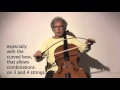
Der hochgewölbte BACH.Bogen

2

https://youtu.be/yVJVMlsV4uw


(3)

J. S. Bach, Chaconne in d-moll

J. S. Bach, Suite in d-moll, Sarabande

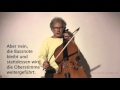
Akkordbehandlung mit dem flachgewölbten BACH.Bogen

3

https://youtu.be/7PzE4RQSZAU


(4)

J. S. Bach, Suite in G-dur, Prélude, Allemande, Sarabande

Differenzierte Akkordbehandlung

4

https://youtu.be/lS9ku6RWzRc


(5)

J. S. Bach, Suite in G-dur, Courante, Gigue

Einstimmiges Spiel und kurze Notenwerte

5

https://youtu.be/Xa2_vvTyYxs


(6)

J. S. Bach, Suite in G-dur, Prélude, Allemande

Saitenwechsel

6

https://youtu.be/wJwbG0Dgfek


(7)

John Cage and Michael Bach Bachtischa, ONE13 (1992)

Michael Bach Bachtischa, locus amoenus (2014)

Diverse Rundbogentechniken mit dem hochgewölbten BACH.Bogen

7

https://youtu.be/5KQhLe6O494


(8)

Der Rundbogen,

historischer Kontext und neue kompositorische Herausforderungen

8

https://youtu.be/JmKZ_5hl5J0


Urtext = Plain Text ? – An Analysis of the Sarabande in d minor, Part 3 (Bar 20-28)

Britain


This is a translation of the post

Urtext = Klartext? – eine Analyse der Sarabande in d-moll, Teil 3 (Takt 20-28)

by Dr. Marshall Tuttle.


Michael Bach

This is the third part of the analysis of the

“Sarabande” in D minor


For glossary and facsimile of the manuscript of Anna Magdalena Bach see Analysis Part I:
https://www.bach-bogen.de/blog/thebachupdate/urtext-plain-text-an-analysis-of-the-sarabande-in-d-minor-part-1-bar-1-10


Sarabande d 21-24 005

Sheet music example mm. 21-24


M 21

Now the minor tonic is expected, but with the two notes Bb2-D3 the cadence is interrupted with a DC. (Although only the interval of a third is heard, there is no alternative to the DC, as the mSub is virtually impossible after the Dom.)

Again the note E3 surprises, instead of the diatonic pitch ES3 of the DC. The 2-Slur accentuates the resulting tritone Bb2-E3, which should resolve to A2-F3, the RM (see. m. 17).

Instead, a half note can be found in the second beat in the bass. The upper part F3 forms a sevemth with G2, a seventh whose harmonic function is indeterminate again because the third is missing. Due to the emphasis on the sixteenth note E3 (2-slur), together with the repetition of the bass note G2, the secondary Dom of the RM is suggested.

Note

A similar process as in m. 11 takes place here with the change of E3 and F3. That is, the notes G2 and E3 announce the secondary Dom of RM, F3 is the suspended fourth. The main difference, however, is that here the secondary Dom of RM is indicated by its third E3 or at best introduced, while the reverse process takes place in the first half of the movement: The third E3 is withheld there and finally supplied.

M 22

The harmony does not change on the first beat. Again the seventh G2 F3 is highlighted by the 2-slur, but continues to the octave-G2 G3, and does not go back to the sixth G2-E3.

The resolution to RM is now expected, but the second beat surprises in the two lower voices, instead of the notes F2 and A2 we hear the notes C#2 and Bb2. Thus, the RM, is thwarted again, as in the previous measure. You will hear the iDom chord. The two sixteenth notes are alone and emphasize the following chord on account of the 2-slur.

M 23

On the first beat we hear the only four note chord in the movement. Although it consists of the supply of tones of minor tonic, which is expected as a resolution of the iDom-chord, it seems dissonant. The reason is that neither the third, C#2 nor the seventh, G3 in the previous measure resolves to the expected D2 or F3 respectively. On the other hand the two notes f2 and a2 of the lower voices are precisely those were expected to arise in the second beat of the preceding measure. Thus the collection of tones of the minor tonic is mixed with that of the RM and later in addition to that with that of the Dom.

The drama is heightened by the shorter note values in the bass, by the lack of a slur on the first beat, (emphasis on the third C#4 of the Dom, with the resolution to D4), by the 2-slur on the second sixteenth note of the second beat, the dissonant harmony of G2-F3 and the trill on the third beat.

The last trill G3-F3 is the most extraordinary of the whole “Sarabande” in D minor. Does it consists of the third F3 the minor tonic and the seventh, G3 of the Dom?

Or could resolution to RM still occur, what would lead to interpretation of the pitches G3 and F3 as fifth of the secondary Dom and root of the RM? This interpretation is suggested by the fact that the note C#4 is missing in the last beat. The 2-slur accentuates the open fifth A2-E3, which finally, along with the passing note D3 is decisive for theminor tonic.

M 24

The octave leap D3-D2 could now complete the end of the movement in the minor tonic. But no, with the quick onset of the rising melodic minor scale, after only a sixteenth note on the bass D2, we move into a coda. A long slur emphasizes the next beat.


Sarabande d 25-28 006

Sheet music sample mm. 25-28


M 25

Now the harmony is suddenly very cryptic. The third F3-A3 belongs to the minor tonic. But, on account of the following note B3 which enters a sixteenth note early in comparison with the rhythmic structure of mm. 21F, the minor tonic is contradicted because it forms a tritone with the lower voice F3. This tritone would resolve to the secondary Dom of RM. The following note on Bb3 (not B3, as is often assumed!) finally allows the RM to be more likely. (By the way, on the crowded first beat we can find the name “Bach”).

Now the lower voice remaining on F3 and the upper note Bb3 simply resolving to A3 would arrive at the RM. But the upper voice ascends to the note C4, and in the lower voice surprisingly rises to the note F#3, again making a tritone. This would normally resolve to the Sub. Again, the RM has been bypassed.

The slurs in this measure twice accentuate the note B3: In the first beat the unexpected tritone is stressed, and in the third beat the resolution to the Sub (in major) is suggested.

M 26

The full chord G2-D3-B3 actually promises the Sub. Already the next note C#4 however, again only a sixteenth note later, denies the Sub. This note C#4 announces instead the Dom and insists, because it does not return to C4 (in contrast to the melodic-harmonic events in the preceding measure). This C#4 prepares the transition to the tritone G#3-D4 which embodies the DD7-chord, which appears just once in this movement.

According to the Slur Code, the entry of the chord of the Sub is emphasized by the slur in preceding measure. The first beat is slurred as a result of the quarter note value of the lower voices, which in turn causes the DD to be unstressed. The drama is not on the arrival of the DD7-chord but in the abrupt reinterpretations of harmonies before its appearance. Furthermore, as just described, the tritone is prepared in this measure, whereas the tritone in the preceding measure appears unexpectedly, and thus receives a stronger impetus.

It is particularly noted that neither the third F#3 in the preceding measure nor even the third G#3 here resolves directly to G3 or A3 respectively. The rising middle voice F3 – F#3- (G3) – G#3 – (A3), (the fictitious pitches are bracketed) leads to the conclusion that the note G#3 is more to be understood as leading tone to the Dom than as the third of the DD.
Unlike the preceding measure, where the descending half step C4-B3 evokes the resolution and complementary half step F#3-G4 which doesn’t really happen (the lower voice pauses) in this measure the ascending whole step D4-E4 prevents the resolution of the half step G#3 to A# in the lower voice.

(Correct resolution of DD would require G#3-D4 to be followed by A3-C#4.) Thus, the DD remains unresolved or to put it bluntly: without a resolution, albeit fictional, there is also no DD.

The slurred E4-F4 in the upper part already indicates the resolution to the minor tonic.

M 27

The return to the minor tonic is indirect and fleeting through the Dom. A 2-slur in the first beat accentuates the first sixteenth note D4.
M 28

The double octave leap D4-D2 is the clear answer to the moving harmonic changes, by embracing that great pitch space which was the scene of these harmonic intricacies.


Urtext = Plain Text ? – An Analysis of the Sarabande in d minor, Part 2 (Bar 11-20)

Britain


This is a translation of the post

Urtext = Klartext? – eine Analyse der Sarabande in d-moll, Teil 2 (Takt 10-20)

by Dr. Marshall Tuttle.


Michael Bach

This is the second part of the analysis of the

“Sarabande” in D minor


For glossary and facsimile of the manuscript of Anna Magdalena Bach see Analysis Part I:
https://www.bach-bogen.de/blog/thebachupdate/urtext-plain-text-an-analysis-of-the-sarabande-in-d-minor-part-1-bar-1-10


Sarabande d 11-16 003

Sarabande” in D minor, Edition Michael Bach
Sheet music example mm 11-16
Slurs that are understood from the polyphony and therefore not notated by JSB are added in parentheses.


M 11

Suddenly a single note answers the powerful chords, the missing E3! This note is now the resolution of the suspended fourth F3 of the secondary Dom from the previous measure. Immediately thereafter, the note F3 appears again: Is this a re-suspensded fourth – or already the RM keynote? A large interval leap down to the bass note C2, and then the G2, however, confirm the secondary Dom of the RM. The suspended fourth is then resolved again to E3.

M 12

The octave leap F3 to F2 concludes the first half of the movement with the RM.

M 13

The slurred note Eb3 to the note F3 suggests the seventh of the RM. Might the RM evolve into the secondary Dom of the SRM, which would then be expected on the 2nd beat? The resolution would then be the interval D3-Bb3.

Instead, the notes are Eb3 and A3 are not resolved and the upper part receives a trill with the note Bb3. Is the note Eb3 now the minor sixth of the Neapolitan and Bb3 its third? Does the note A3, as third, still belong to the RM?

Interesting here is the detached eighth note Bb3 (without bass note). This clearly indicates that the note D3 in the following measure can not be perceived as the immediate resolution to the note Eb3 (SRM) – the two pitches are separated from each other.

M 14

Nevertheless, the question remains whether the resolution to SRM is still to be carried out in this measure, that is, whether the note D3 is the third of the SRM. The two sixteenth notes of the upper voice are slurred again, so that the bass note D3 is connected and stressed with the note Bb. This could mean the expected resolution of the tritone Eb3 A3 from the previous measure. By the way, in addition to the resolution to the SRM, deceptive resolution to mSub would also be possible.

But no, nothing like that occurs, for in the 2nd beat suddenly is heard the third F#3, the third of the interval D3-C4 on the first beat. (This is roughly comparable to the “subsequently delivered” third E3 in M 11). However, “in familiar style” the F#3 is obscured with a trill to the note G3, i.e. this suspended fourth foreshadows the coming modulation to the mSub. The following sixteenth note Eb3 could be either the Ninth of the secondary Dom of mSub or already the minor sixth of the mSub, and therefore the Neapolitan.


Note

The repetition of the 2nd half of the measure, develops the harmonic context a little differently. The third F3-A3 of m. 13, after returning to D minor in the final beat, now reappears as belonging to the Minor tonic. The eighth note Eb3 and the trill between A4 and Bb4 is no longer associated with the RM. So the bass note which G2 appears in m. 14 could be construed solely as the root of the mSub in the repetition. In other words, the start of the 2nd half of the movement for the second time has a consistent minor character with less harmonic volatility.

M 15

As in m. 3 the mSub seems to establish itself with the notes Bb2 and G3. But with the rising intervals of the notes A2, F#3 and Eb4, the secondary Dom appearss again as a Dom9 chord. (This demonstrates an enormous difference to the indifferent tone sequence in m. 3).

M 16

Its resolution to mSub seems to follow in the chord G2-D3-Bb3 of the first beat – were it not for the trill with the note C4! A trill does not traditioanlly occur on a note of resolution. Accordingly, the harmonic development will be continued and there is still no conclusion. The secondary Dom of mSub remains with the seventh C4 and the subsequent eighth note A3 present. One possible resolution, albeit very discreetly, could be seen in the note G3 on the third beat.


Sarabande d 17-20 004

Sheet music example mm 17-20


M 17

The note D3, instead of the expected Note Eb3 (minor sixth of the mSub), is a surprise after the previous Eb’s. In conjunction with the Bb2 (secondary Dom) it forms a tritone, which resolves in the 2nd beat with the notes a2-f3, yet again to the RM.

M 18

The note D3, similar to the note E3 in the preceding measure, appears to be a third, here that of the SRM. Therefore, the listener anticipates another descending fifth from RM to SRM. Now, however, the subsequent note Ab2 is a surprise, which is not derived from the SRM. It forms with the preceding note D3 another tritone, the secondary Dom of Eb major derives from the SRM. Or reinterpreted, Eb major could be the Neapolitan (mSub with minor sixth Eb instead of the fifth “D”). The latter is promptly confirmed with the notes G2 and Eb3 in the second beat.

M 19

The note C#3 clearly indicates again a third, here that of the Dom. Thus the mSub, respectively or the Neapolitan, turns again into the Dom. It is interesting that the note C#3 receives no trills: JSB would like this time to unambiguosly establish the Dom (see m. 4.).

M 20

This measure also reigns in the Dom. A 2-slur accentuates its root, A2.

Note

It is noteworthy that the last 5 measures have no slurs. This means that no pitches are emphasized over a longer period of time, which corresponds to the searching nature of the music up to m. 19. With the appearance of a Dom ther is an “awakening”, indicated by the large interval upwards (C#3 Bb3) and the incipient sixteenth note movement. Both mm. 19f consolidate the Dom before the harmony gets complicated again.


Urtext = Plain Text ? – An Analysis of the Sarabande in d minor, Part 1 (Bar 1-10)

Britain


This is a translation of the post

Urtext = Klartext? – eine Analyse der Sarabande in d-moll, Teil 1 (Takt 1-10)

by Dr. Marshall Tuttle.


Michael Bach

This is the first part of the analysis of the

“Sarabande” in D minor


Interpretation of the “Sarabande” in D minor
Michael Bach, Violoncello with BACH.Bogen

https://youtu.be/ZnUPLFZCgWA


Sarabande d AMB -
Copy by Anna Magdalena Bach, digital scan of the Staatsbibliothek zu Berlin – PK


Glossary

JSB = Johann Sebastian Bach
AMB = Anna Magdalena Bach

2-slur, 3-slur, 4-slur = Slurs over 2, 3 or 4 notes.
Three 2-slurs = three slurs over 2 notes
m, mm = measure, measures

C4 = middle C

Sub = subdominant
Dom = dominant
mSub= minor subdominant
mDom = minor dominant
RM = relative major
Rm = relative minor
SRM = subdominant of the relative major
DC = deceptive cadence
DD = dominant of the dominant
D7-chord = dominant seventh chord
Dom9 = dominant ninth chord
iDom9 = incomplete dominant ninth chord (missing the root)


The Slur-Code

Here I codify some insights that have emerged from my detailed analyses of all the “Suites” in the copy of AMB, almost as axioms advance. I call them the “Slur-Code” in the works for solo cello. In this “Sarabande“, the following rules apply:

1

The first note under a slur is emphasized, as is the first note after the slur. The longer the slur, the stronger the subsequent noteis emphasized and the weaker is the first note of the slur. This sometimes leads to the extreme case that an exceptionally long slur has to start very quietly, while the subsequent pitch is very strongly accentuated (e.g. m 13 of the “Allemande” in G Major).

2

When one slur directly follows another, the first note of the second slur receives emphasis, and the subsequent, linked notes decrescendo. The first note after the second slur is consequently unstressed.

3

Slurs are not normally notated when the polyphony defines them. The longest note determines the stroke of the bow and the length of the slur (legato) over the shorter note values. If a slur is notated over the shorter notes, this signifies a breaking of this rule. That is, this slur is to be performed and consequently the longer note values are divided in accordance with the slur. The pitches of the longer note values are thus repeated.


Analysis of the “Sarabande” in D minor

 

Sarabande d 1-4 001


Sarabande” in D minor, Edition Michael Bach
Sheet music example mm 1-4

Slurs that are understood from the polyphony and which JSB therefore did not have to notate are added in parentheses.


Preliminary note

The unusually large number of trills in the “Sarabande” in D minor is striking. There are a total of 7 trills, but not 8 as generally assumed, because no trill is notated by AMB in m. 5. 1). As remarked in the analysis of the “Sarabande” in E Flat Major 2), JSB used the trill, to refer to two harmonies. A trill is ergo no mere ornament, which is carried out according to traditional rules prescribed by decorating tables. Such a convention does not exist in the solo cello works. This signifies primarily that a compositionally relevant trill cannot be omitted nor can any other trill be added.

M. 1

Furthermore, the “Sarabande” opens unusually in D minor with a unison. The spelling of JSB is always a single note head with two Stems 3). Hardly any cellist plays this unison D3-D3. But from the unison there develops a dissonant interval of the second, D3-E3 which is even more rarely executed. This interval of the second is, however, essential because the interference of dissonance gives an oscillating sound effect similar to a trill. In addition, the second is the inversion of the interval of the seventh, which achieves its own expression in this movement.

Also, as pointed out previously in the “Sarabande” in E Flat Major, dissonant intervals must really sound to be perceived as such. It is true in no way to the thesis that here the note D3 when it is not played, is extended by the listener’s imagination, to form a dissonance with the sounding E3. Listeners can, due to listening habits, sometimes anticipate resolutions of dissonances, but the obverse does not happen, dissonances are not fictionally added. Human comprehension tends to resolve complex harmonic structures and complex intervals into simpler sonorities.

By the way, a remark on the meter: 1. If the first beat is played as a single note (rather than as a unison interval between two notes) it could easily give the incorrect metrical impression of a mere upbeat to the following double stop with trill.

The slurring of the notes in the upper voice, due to the quarter note D3 in the second voice (see “Slur Code”), emphasizes the 2nd beat.

The 2nd beat consists of the fifth A2-E3 with a trill on the note E3. The fifth over A2 suggests a Dom function. Although the third of the minor Dom is missing, the trill E3-F3 could be regarded as a combination of the fifth E3 of the minor dominant and the third F3 of the minor tonic.
The prerequisite for the major Dom is missing, namely the absolutely necessary sounding of the third “C#”. Moreover, the interval A2-F3 alternatively could represent the minor tonic or RM.

The trill, which is right at the beginning of the movement, and therefore can not be a conventional resolution trill of something foregoing, symbolizes the vague harmonious affiliation of these two beats. The pitch of the trill intensifies the irritation, as customarily a fourth is trilled, which then resolves to the tonic. That would mean here that the secondary Dom of the RM could be heard on the 2nd beat. However, the bass note a2 (the sixth of the secondary Dom of the RM) contradicts this interpretation.

It follows that in m. 1 an initial harmony, a tonic has not yet been established. Of course, it can be assumed that all of the sets of “suites” start with the tonic. But doubts about the harmonic stability are aroused by the harmonic interval of a second (D3-E3) and by the trill.

Back in the 2nd and 3rd beat slurring occurs in the upper voice because of the half note value of the bass note. According to the “Slur Code” the tied notes decresendo to the resolution in the next measure. The two sixteenth notes are not a short Nachschlag, but form a melodic transition to the third of the chord of the tonic minor. (JSB has never notated a Nachschlag to the trills in the „Suites“.)

M. 2

Now for the first time the full chord of the tonic minor is heard.

M. 3

The notes Bb2 and G3 indicate the mSub. Thereafter, it is questionable given this sequence of sixteenth notes whether the Dom of the RM, or the Dom9 of the tonic will arise. The relatively long slur over these notes clearly emphasized the 1st beat of the following measure. The pitches are equalized under the slur, they can not be distinguished in harmonic function or weighted (as opposed to m. 7).

T 4

The note C#3 is clearly the third of the dominant. But it is obscured by the trill with D3, the root of the minor tonic (as opposed to m. 19). Accordingly, the basic D minor chord persists. As in m. 1, this is not a resolution trill, for the entirety of m. 4 remains, with the notes B2, A2, and the seventh G2, on the dominant.

 

Sarabande d 5-10 002

Sheet music sample mm 5-10

M 5

The 3-note chord of the 1st beat unquestionably represents the minor tonic.

The following fifth A2-E3 now receives no trill, contrary to widespread performance convention! The reason is that this measure can not be a repeat of m. 1 because D minor has since established itself as the home key. This second beat is also not preceded by an interval of a second. The perfect fifth, without the trill to F3, behaves more as “Dom” than the 2nd beat in m. 1

Note

Perhaps somewhat speculative is a hypothesis that due to the abandonment of the trill E3-F3 in this “varied repeat” of m. 1 the appearance in m. 8 is all the more important.

M. 6

The expected minor tonic sounds as in m. 2. M. 7.

Again, as in m. 3, the question arises whether after the initial mSub, the Dom of the Rm or the Dom9 chord develops, although the Dom9 chord is excluded with the sounding of the note C4. But the three 2-Slurs continue to accentuate the pitches of still conceivable harmonies: the third Bb3 of the mSub, the root C4 of the Dom of the RM and the third A3 of the RM. However, with the notes C4 and A3 the mDom, is probably most obvious after the mSub.

M. 8

The trill E3-F3, in contrast to the trill in m. 4 is now unstressed, unaccented and ambiguous: is it a conjunction of the Dom of the RM with its resolution (third E3 of the dominant and root F3 of the RM) or the mDom with the minor tonic (fifth E3 of the mDom and third F3 of the minor tonic)?

M. 9

The next two measures produce a diffuse situation with their dissonances. The 1st beat could mean the minor tonic or RM.

The chord of the 2nd beat could be the mSub or Sub of the RM, both containing the non-harmonic note A3 in the upper voice. On the other hand the note Bb2 in the bass could be the minor sixth of the minor tonic.

As a result of the 2-slur in the 1st beat the bass note is A2 is repeated and sounds together with the seventh G3. However, the chord lacks the necessary third C# for a Dom7 chord.

The dotted quarter note in the two lower voices of the 2nd beat is remarkable. Because of this, both slurred sixteenth notes G3 and F3 sound alone. The simultaneous sounding of the notes Bb2-D3 in the lower voices together with G3 would complete the chord of the mSub, while F3 would complete the chord of the Sub of the RM. Both shouldn’t appear here, so complete chords with their thirds are avoided (see m. 21).


Note

The seventh Bb2-A3 would be interchangeable with a trill A3-Bb3 in the upper voice, omitting the bass note Bb2. This suggests that the presence of two harmonies, either the minor tonic with the mSub or RM with its Sub. This analogy reveals the essential relationship of seconds, sevenths and trills, which is virtually celebrated in this “Sarabande“.

M. 10

Again, the first beat remains harmonically ambiguous. Although now the minor tonic is finally eliminated by the notes Bb2 and G3. Still the mSub and the secondary Dom of the RM are present as alternatives. In the upper part, a 2-slur is again above the sixteenth notes, which accentuates the seventh Bb2-A3. But it is still missing the clarifying third of the chord to distinguish between the competing harmonies.

The 2nd beat brings strong dissonances. The chord G2-F3-Bb3 could be described as a secondary Dom (Dom7 chord) of the RM with suspended fourth F3. However, on account of the bass note G2, instead of the possible note C3, and the upper Bb3 the sound still has a certain Sub flavor.

Now follow the two sixteenth notes C4 and D4 in the upper voice instead of the possible notes A3-G3, which might be expected in analogy with the previous measure. The harmony of G2-F3-C4 intensifies the previous dissonance. With the pitches “F” and “C” the mSub has been displaced and the Dom of the RM now seems solely to rule.

Consequently, this explosive dissonance transforms the previous mSub definitively into the Dom of RM, which is a rarity in this movement. Usually the mSub converts into the Dom, because the notes “G” and “Bb” can be reinterpreted as a seventh and and ninth of the Dom. Both notes will, however, turn into the fifth and seventh of the Dom of RM. (The fact that the transformation of the mSub either into the Dom or into the Dom of RM is an issue that has already been indicated in m. 3 of the “Sarabande“. In m. 4, the preferred resolution happens to be the Dom.)

Notable here are the note values of the two lower voices: Unlike in the previous measure, JSB notates a half note. In conjunction with the 2-slur on the two sixteenth notes in the upper voice, this causes a repetition in the lower voices. Indeed, these three pitches G2-F3-C4 should sound together, creating a very sharp dissonance.


Note

The minor tonic, which was latently present for 9 bars and which could be sustained in a pedal point on a “D” in the bass – is ousted in this measure. The RM and its Dom are rigorously asserting themelves.

Remarkable, however, is the fact that the actually indispensable third “E” of the Dom of the RM is missing, so that an unambiguous statement that this is a secondary Dom is not possible.


1)
AMB listed a “tr”, sometimes shortened to a “t”. Other symbols of ornamentation do not appear in the “Suites” on except a single grace note in the “Allemande” in G Major. This singular grace note is also harmonically based.

2)
The “Sarabande” in E Flat Major contains only a single trill, which is unusually placed on the last note of the first half of the movement.

3)
The identical spelling is also found in the transcripts of Johann Peter Kellner and the two from the 2nd half of the 18th century.


Urtext = Klartext? – eine Analyse der Sarabande in d-moll, Teil 3 (Takt 21-28)

Germany


Michael Bach

Dies ist der dritte Teil der Analyse der

Sarabande in d-moll


Glossar und Faksimile der Abschrift von AMB siehe Analyse Teil 1:
https://www.bach-bogen.de/blog/thebachupdate/urtext-klartext-eine-analyse-der-sarabande-in-d-moll-teil-1-takt-1-10


Sarabande d 21-24 005

Notenbeispiel T 21-24


T 21

Nun wird die Moll-Tonika erwartet, doch mit den beiden Noten b2-d3 ist der sogenannte Trugschluß mit dem tG eingetreten. (Obwohl nur ein Terz-Intervall erklingt, ist der tG insofern alternativlos, als die Moll-Sub nach der Dom so gut wie unmöglich ist.)

Wiederum überrascht die Note e3, anstelle der leitereigenen Tonhöhe es3 des tG. Der 2er-B akzentuiert den so entstehenden Tritonus b2-e3, welcher sich zu a2-f3 auflösen sollte, also zur tP (vgl. T 17).

Statt dessen findet sich in der 2. Zz eine 1/2-Note g2 im Baß. Die Oberstimme f3 bildet mit g2 eine Septim, deren harmonische Funktion wieder unbestimmt ist, da die Terz fehlt. Infolge der Akzentuierung der 1/16-Note e3 (2er-B), zusammen mit der Repetition der Baßnote g2, wird die ZD der tP nahegelegt.

Anmerkung

Mit dem Wechsel von e3 und f3 findet hier ein ähnlicher Vorgang wie in T 11 statt. D. h. die Noten g2 und e3 kündigen die ZD der tP an, f3 ist der Quartvorhalt. Der wesentliche Unterschied besteht allerdings darin, daß hier die ZD der tP mit ihrer Terz e3 angedeutet oder bestenfalls eingeführt wird, währenddessen in der ersten Satzhälfte der umgekehrte Vorgang stattfindet: Die Terz e3 wird dort vorenthalten und zu guter letzt nachgeliefert.

T 22

Die 1. Zz tritt harmonisch immer noch auf der Stelle, es erfolgt keine Veränderung. Nochmals wird durch den 2er-B die Septim g2-f3 hervorgehoben, die jedoch zur Oktav g2-g3 weitergeführt wird, und nicht mehr zurück zur Sext g2-e3.

Die Auflösung zur tP wird nun erwartet, aber die 2. Zz bringt überraschend in den beiden Unterstimmen, anstatt der Noten f2 und a2, die Noten cis2 und b2. Damit wird die tP, wie im Vortakt, erneut vereitelt. Es erklingt der Dv-Akkord. Die beiden 1/16-Noten stehen alleine und betonen mit dem 2er-B den nachfolgenden Akkord.

T 23

Es erklingt in der 1. Zz der einzige 4-stimmige Akkord in diesem Satz. Obwohl er aus dem Tonvorrat der Moll-Toniika besteht, die als Auflösung des Dv-Akkords erwartet wird, wirkt er dissonant. Der Grund liegt darin, daß sich weder die Terz cis2 des Dv-Akkords im Vortakt zum Grundton d2 der Moll-Tonika, noch die Septim g3 nach f3 auflösen. Andererseits sind die beiden Noten f2 und a2 der Unterstimmen genau diejenigen, mit denen in der 2. Zz des Vortakts gerechnet wurde. So vermischt sich der Tonvorrat der Moll-Tonika mit demjenigen der tP und im weiteren Verlauf zusätzlich mit demjenigen der Dom.

Die Dramatik wird erhöht durch die kürzeren Notenwerte im Baß, durch den fehlenden Bindebogen in der 1. Zz (Betonung der Terz cis4 der Dom sowie der Auflösung d4), durch den 2er-B auf der zweiten 1/16-Note der 2. Zz, den dissonanten Zusammenklang von g2-f3 und den Triller der 3. Zz.

Der letzte Triller g3-f3 ist der außergewöhnlichste der gesamten „Sarabande” in d-moll: Besteht er aus der Terz f3 der Moll-Tonika und der Septim g3 der Dom?

Oder könnte immer noch die Auflösung zur tP erfolgen, was die Tonhöhen des Trillers als Quint g3 der ZD und Grundton f3 der tP interpretierbar machen würde? Dafür spricht, daß die Note cis4 in der letzten Zz fehlt. Der 2er-B akzentuiert die leere Quint a2-e3, welche zusammen mit der Durchgangsnote d3 schlußendlich doch den Ausschlag zur Moll-Tonika gibt.

T 24

Der Oktavsprung d3-d2 könnte nun der Schluß des Satzes in der Moll-Tonika vollenden. Aber nein, mit der hurtig einsetzenden Tonfolge nach oben (melodisches Moll), nur 1/16-Notenwert nach der Baßnote d2, wird zu einer Coda übergeleitet. Ein langer Bindebogen betont die nächste Zz.


Sarabande d 25-28 006

Notenbeispiel T 25-28


T 25

Nun wird es schlagartig sehr kryptisch. Die Terz f3-a3 gehört noch der Moll-Tonika an. Bereits die folgende Note h3 jedoch, die im Vergleich mit der rhythmischen Struktur der Te 21f um 1/16-Notenwert verfrüht einsetzt, schließt die Moll-Tonika aus, weil sie einen Tritonus mit der Unterstimme f3 bildet. Dieser Tritonus würde sich zur ZD der tP auflösen. Die übernächste Note b3 (nicht h3, wie oft angenommen wird!) läßt schließlich die tP wieder wahrscheinlicher werden. (Übrigens finden sich in der 1. Zz auf gedrängtem Raum die Notennamen „b-a-c-h”).

Jetzt müßte in der 2. Zz die Unterstimme auf der Note f3 verweilen und sich die Note b3 schlicht zu a3 auflösen, um die tP zu erreichen. Aber die Oberstimme ersteigt die Note c4 und in der Unterstimme erklingt überraschend die Note fis3, erneut einen Tritonus bildend. Dieser würde sich normalerweise zur Sub auflösen. Abermals ist die tP umgangen worden.

Die Bindebögen in diesem Takt akzentuieren zweimal die Note h3: In der 1. Zz wird damit der unerwartete Tritonus betont und in der 3. Zz die Auflösung zur Sub (in Dur) anheimgestellt.

T 26

Der vollständige Akkord g2-d3-h3 verspricht tatsächlich die Sub. Bereits die nächste Note cis4 jedoch, wieder nur einen 1/16-Notenwert später, verwirft die Sub wieder. Diese Note cis4 kündigt stattdessen die Dom an und insistiert, weil sie nicht zu c4 zurückgeführt wird (im Unterschied zum melodisch-harmonischen Geschehen im Vortakt). Dieses cis4 bereitet den Übergang zum Tritonus gis3-d4 vor, der den DD7-Akkord verkörpert, welcher hier ein einziges Mal in diesem Satz auftaucht.

Gemäß des Bindebogen-Kodex ist der Eintritt des Akkords der Sub betont, da ein Bindebogen im Vortakt vorausgeht. Die 1. Zz ist infolge des 1/4-Notenwerts der Unterstimmen gebunden, was wiederum bewirkt, daß die DD unbetont ist. Die Dramatik liegt nicht auf dem Erreichen des DD7-Akkords sondern in den abrupten Umdeutungen der Harmonien vor seinem Erscheinen. Außerdem, wie gerade beschrieben, wird der Tritonus in diesem Takt vorbereitet, wohingegen der Tritonus im Vortakt unversehens erklingt und damit einen stärkeren Impetus erhält.

Es gilt insbesondere festzuhalten, daß weder die Terz fis3 im Vortakt und noch die Terz gis3 hier unmittelbar zu g3 respektive a3 aufgelöst werden. Die aufsteigende Mittelstimme f3-fis3-(g3)-gis3-(a3), die fiktiven Tonhöhen sind eingeklammert, läßt den Schluß zu, daß die Note gis3 mehr als Leitton der Dom und weniger als Terz der DD verstanden wird.

Im Unterschied zum Vortakt, wo nach dem Tritonus der absteigende Halbtonschritt c4-h3 den auflösenden und komplementären Halbtonschritt fis3-g4 nach oben evoziert, ohne daß dieser real erfolgt (die Unterstimme pausiert), verhindert in diesem Takt der Ganztonschritt d4-e4 nach oben den auflösenden Halbtonschritt vom gis3 zum a3 in der Unterstimme. (Eine korrekte Auflösung der DD wäre gis3-d4 nach a3-cis4.) Somit bleibt die DD unaufgelöst oder überspitzt formuliert: ohne eine Auflösung, wenn auch nur fiktiv, existiert auch keine DD.

Die gebundenen Spitzennoten e4-f4 leiten bereits die Auflösung zur Moll-Tonika ein.

T 27

Die Rückführung zur Moll-Tonika erfolgt indirekt und flüchtig über die Dom. Ein 2er-B in der 1. Zz akzentuiert die erste 1/16-Note d4.

T 28

Der doppelte Oktavsprung d4-d2 ist die klare Antwort auf die bewegten Harmoniewechsel, indem er jenen großen Tonraum umfaßt, der Schauplatz dieser vertrackten harmonischen Verwicklungen war.