Category Archives: Allgemein

Urtext = Klartext? – eine Analyse der Sarabande in D-Dur, Teil 2 (Takt 9-16)

Germany

Michael Bach

Dies ist der zweite Teil der Analyse der

Sarabande in D-Dur

Gast:
Burkard Weber

Video:
Interpretation der “Sarabande in D-Dur”
Michael Bach, Violoncello mit BACH.Bogen:
https://youtu.be/YuqXQgfPKkg


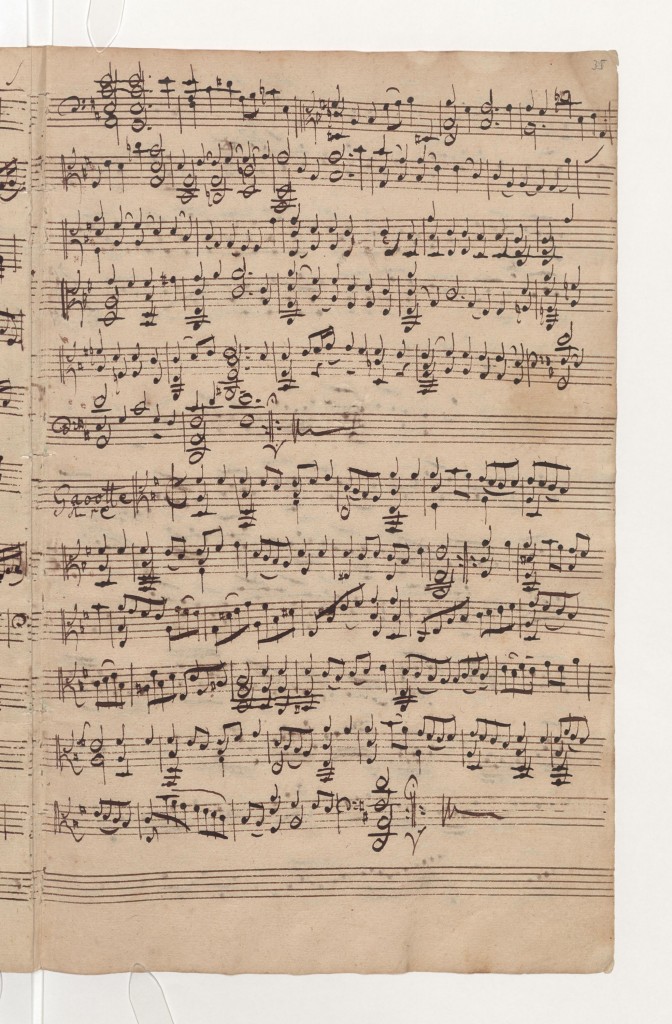
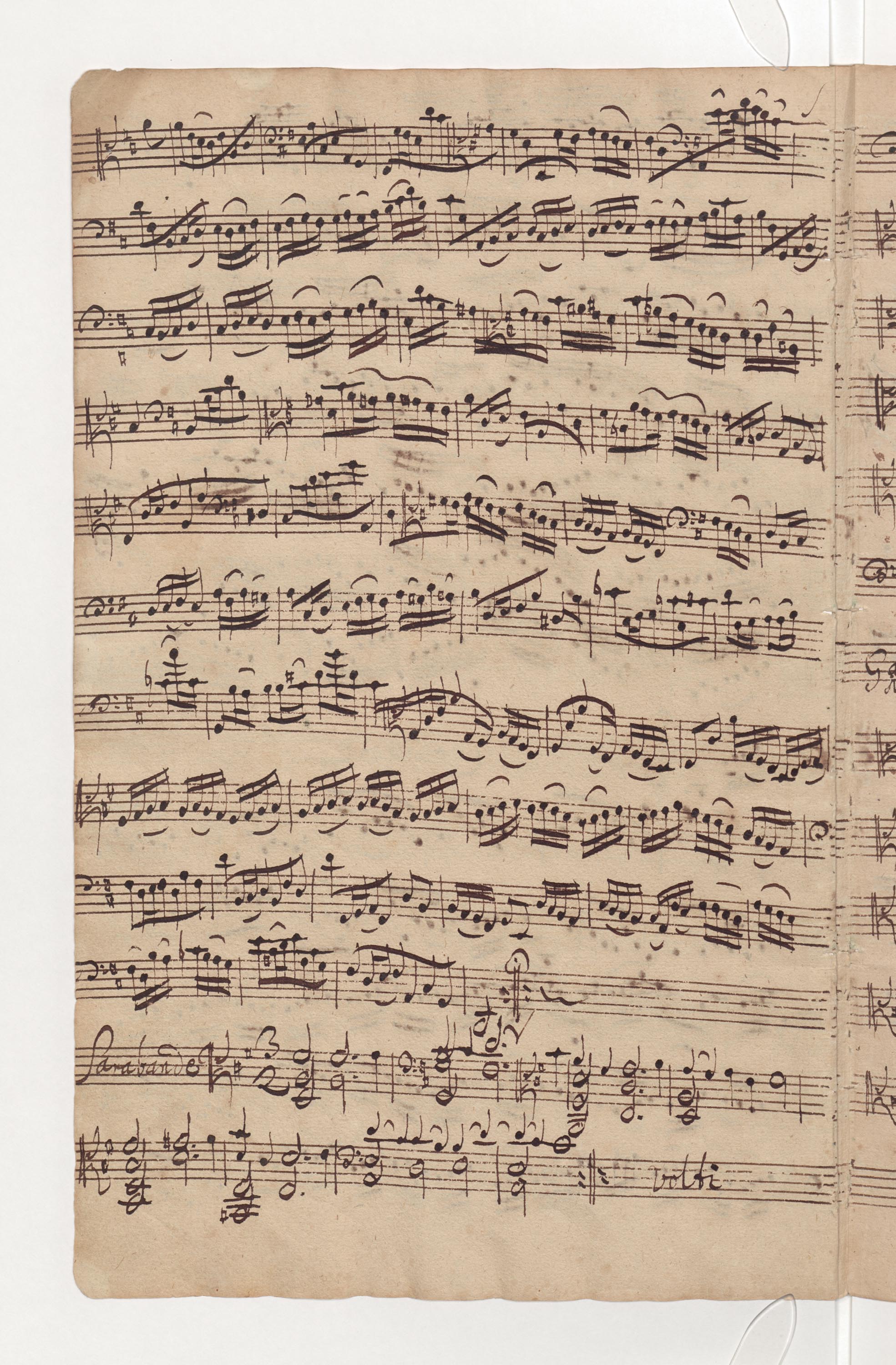
Abschrift von Anna Magdalena Bach, Digitalisat der Staatsbibliothek zu Berlin – PK

Teil 2

Sarab D-Dur Bindebögen- 002

Takt 9

Wir haben 2 vierstimmige Akkorde. Ich lasse beim 2. Akkord einen Ton (e) weg, damit ich die G-Saite nehmen kann. Die 2. Zählzeit ist ausnahmsweise auch betont.

Takt 10

Jetzt kommt: [spielt die 1. Zählzeit von Takt10] Das könnte die Auflösung sein, man könnte sich auch die Tonikaparallele vorstellen, man könnte sich den Tonikagegenklang vorstellen, je nachdem, wie es jetzt weitergeht.

In der 2. Zählzeit erwartet man ein d [spielt bis zur 2. Zählzeit von Takt 10], weil wir wieder dieses Umspielungsmotiv haben Aber Bach schreibt stattdessen ein dis. Wenn so etwas erklingt, dann wissen wir eigentlich, aufgrund von Hörgewohnheiten, daß das eine Zwischendominante ist, die sich wahrscheinlich nach e auflöst.

Stellt sich eigentlich nur noch die Frage: nach e-moll oder nach E-Dur? [spielt E-Dur und dann e-moll] Zu diesem Zeitpunkt wäre beides noch möglich.

Wir kennen das ja z. B. von der G-Dur Suite: da kommt in Takt 5 schon gleich die Tonikaparallele e-moll, und dann nach der Dominante D-Dur kommt nochmals e-moll als Trugschluß (Takt 8), und in Takt 13 erscheint auf einmal auch ein dis, das sich wieder in Takt 14 nach e-moll auflösen müßte. Die Tonikaparallele wird hier sogar eingeführt mit ihrer eigenen Zwischendominante.

Nun macht Bach im Prélude etwas ganz anderes, nämlich das Gegenteil, was er hier in der Sarabande macht, er verdeckt die Auflösung: [spielt die 1. Takthälfte von Takt 14 des Prélude in G-Dur]

Das ist keine deutliche Auflösung, keinesfalls z. B. so etwas: [spielt einen arpeggierten e-moll Dreiklang]. Das sind zwar Töne von e-moll [spielt nochmals die 1. Takthälfte von Takt 14], sie bleiben aber in diesem engen Tonraum gefangen, umspielen ihn und führen dann weiter zu anderen Harmonien.

Hier, in der Sarabande D-Dur ist es tatsächlich so, daß Bach [spielt nochmals die 1. Hälfte von Takt 10] – und mit dem c wissen wir es – nach e-moll gehen wird. Wenn Bach ein cis geschrieben hätte, wäre die Zielharmonie E-Dur.

Sarab D-Dur Bindebögen- 003

Takt 11

In Takt 11 bringt Bach nochmals den gesamten Akkord, die Zwischendominante von e-moll. Und er bindet sogar die beiden Achtelnoten, d. h. die 2. Achtelnote ist unbetont. Die Achtelnote g, die auch für e-moll steht und nicht für E-Dur, verdeckt Bach ein wenig (mit einem Bindebogen, dessen letzte Note stets unbetont ist).

Takt 12

In Takt 12 auf der 2. Zählzeit bringt er die Auflösung. Auch hier ist die 2. Zählzeit “zufälligerweise” betont. Es findet sich auch wieder das Umspielungsmotiv: [spielt die 1. Hälfte von Takt 12]

Continue reading

Urtext = Klartext? – eine Analyse der Sarabande in D-Dur, Teil 1 (Takt 1-8)

Germany

Michael Bach

Dies ist der erste Teil der Analyse der

Sarabande in D-Dur


Gast:
Burkard Weber

Video:
Interpretation der “Sarabande in D-Dur”
Michael Bach, Violoncello mit BACH.Bogen:
https://youtu.be/YuqXQgfPKkg

Analyse:
https://youtu.be/3vUgrV05eZg
Bach Digital
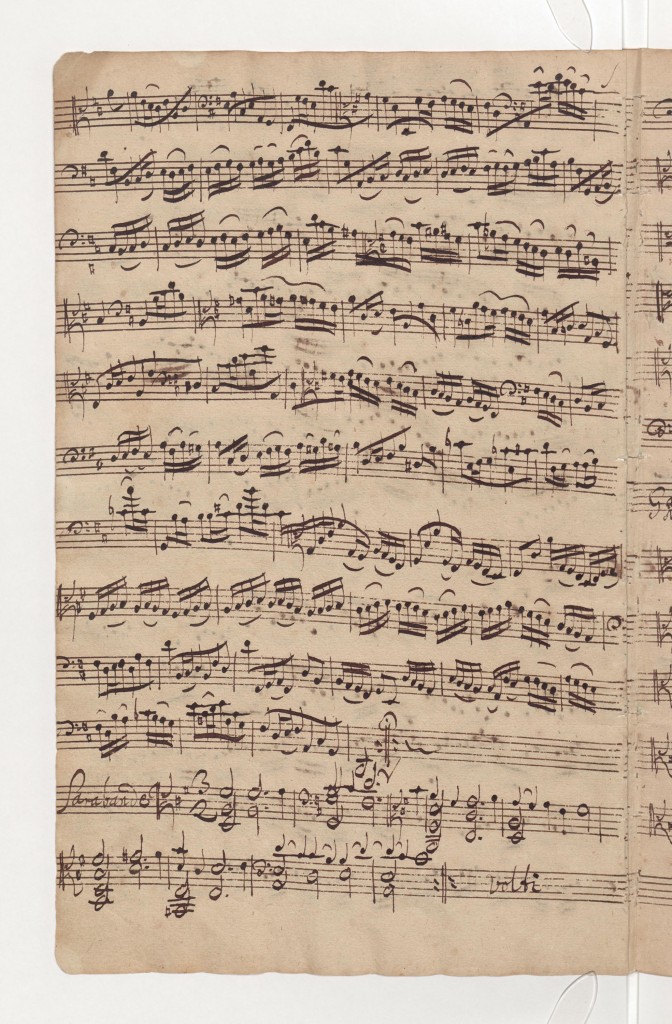
Abschrift von Anna Magdalena Bach, Digitalisat der Staatsbibliothek zu Berlin – PK


Teil 1

MB (Michael Bach): Hier, in diesem Stück, hat es einen harmonischen Sinn, warum wir einstimmige Passagen haben, warum wir zwei-, drei- und vierstimmige Passagen haben.

Es gibt viele Musiker, oder fast alle, die behaupten, die notierten Notenwerte seien nicht so genau zu nehmen. Meiner Ansicht nach ist es ganz eindeutig so, daß sie genau zu nehmen sind.

Weil, auffällig in diesem Satz ist z. B., daß der Baß meist nicht aufgelöst wird. Das hört man nur dann erst, wenn der Baß auch bis zu Ende gehalten wird.

Sarab D-Dur Bindebögen- 001

Takt 1

Nehmen wir den ersten Takt, wir haben also D-Dur. [spielt Takt 1]

Was ist der 2. Klang? Wir haben einen reduzierten D-Dur-Klang.

Wenn darauf ein Schwerpunkt wäre, hätte Bach derart komponiert: [spielt zuerst den zweistimmigen und dann den dreistimmigen Zusammenklang]

Man würde denken, das ist fast das Gleiche.

Wenn man sich aber die ersten 8 Takte anschaut, dann ist die 2. Zählzeit immer reduziert in der Stimmenanzahl. Oft ist ein vierstimmiger Akkord in der 1. Zählzeit und dann ein zweistimmiger, manchmal auch ein dreistimmiger und manchmal sogar ein einstimmiger Klang auf der 2. Zählzeit.

Also, ich kann mir nicht vorstellen, daß das so gespielt wird: [betont den Doppelklang der 2. Zählzeit anstatt den Akkord der 1. Zählzeit]

Es ist eher umgekehrt, daß die 2. Zählzeit eben “unvollkommen” ist und ich spiele sie dynamisch etwas zurückgenommen, weil wir nicht wissen, …

Bei Bach ist das immer so, wenn er von der Mehrstimmigkeit in die Zweistimmigkeit wechselt, dann hat das etwas zu bedeuten. In diesem Fall ist es eine Öffnung zu anderen Harmonien.

Weil, ich könnte mir jetzt diese Harmonie vorstellen: [spielt h-moll]

Nur, der Hörer macht das nicht, weil er muß erst dazu bewegt werden. Z. B. ein cis im Baß (Tonikagegenklang fis-moll) stellt er sich nicht vor. Aber es wäre ja möglich, daß das g nicht am Ende des Takts erscheint, sondern ein gis. Und dann wären wir im Tonikagegenklang oder in der Dominantparallele.

Es erscheint aber das g, und da ist wiederum interessant, daß das einstimmig ist.

Wenn Bach nun dieses vorherige a hätte liegen lassen, dann würde eine kleine Septim entstehen. Das haben wir in dem Stück später, das ist der Takt 13: [spielt Takt 13]

Darüber werden wir noch sprechen. Jedenfalls, wenn ich diese Septim höre, dann denke ich schon an eine Dominante, nämlich das: [spielt a – cis – e – g]


Takt 2

Das passiert aber nicht, sondern es geht weiter mit dem g der Subdominante in der 1. Zählzeit des 2. Takts.

Und hier ist tatsächlich der Schwerpunkt auf der 2. Zählzeit, das ist die Auflösung nach D-dur. Obwohl wir nur 2 Töne haben, ist es klar, das ist D-dur.

Interessant ist nun der 1. Akkord des 2. Takts: Erstens, er ist nicht spielbar. Die 6. Suite ist ja für ein fünfsaitiges Instrument geschrieben. Wir haben die Schwierigkeit, daß wir die E-Saite nicht haben und deshalb gibt es ein paar Modifikationen.

Aber hier, bei diesem Akkord: [spielt g – g – h – e], das wäre noch spielbar auf einem fünfsaitigen Instrument, aber nicht mehr das: [spielt g – g – h – cis] Das ist nicht mehr spielbar, weil das cis unterhalb der E-Saite liegt.

D. h., man muß hier einen Ton weglassen, wenn man nicht brechen will. Ich habe übrigens noch nie einen Cellisten gehört, der alle 4 Töne spielt.

Welchen Ton lassen wir nun weg? Es gibt 2 Möglichkeiten. Wir haben zunächst diesen Akkord: [spielt g – g – h – e] Da lasse ich auch einen Ton weg, das verdoppelte g, das ist “schmerzlos”.

Weiterhin könnte man so spielen: [spielt g – g – cis], das h weglassen, das oktavierte g, das vorher weggelassen wurde, nun aber spielen. Da haben wir eine gewöhnliche Auflösung vom Tritonus (g – cis) nach D-Dur (fis – d).

Ich mache das nicht, sondern ich möchte die Dissonanz noch verstärken und spiele: [spielt g – h – cis] diese starke Dissonanz mit cis und h.

BW (Burkard Weber): Das ist eine scharfe Auflösung, ist aber schön.

MB: Ja, es steht so da.

Da kommt jetzt noch eines hinzu: die notierten Notenwerte. Es sind in den Unterstimmen Halbe Notenwerte und in der Oberstimme Viertelnoten.

Normalerweise wären jetzt diese Viertelnoten gebunden. Weil immer dann … [spielt eine kurze Passage aus der Gavotte II in D-Dur, Takte 12ff] Hier stehen auch keine Bindebögen, aber in der Unterstimme sind Viertel und in der Oberstimme Achtel.

Das bedeutet in der Regel, also in fast allen Fällen bei Bach, daß die Oberstimme dann gebunden ist. Das bedeutet außerdem, daß die angebundene 2. Note unbetont ist.

Das ist meine Beobachtung, die ich gemacht habe bei der Untersuchung der Bindebögen. Ich spreche da von einem Bindebogen-Kodex. Es gibt ungefähr 10 Regeln mit kleinen Modifikationen.

Eine Regel ist die, daß wenn in einem Akkord, unten oder oben, längere Notenwerte stehen und eine Stimme sich bewegt, dann ist diese gebunden.

Und dann kommt noch eines hinzu, was ich erst beim Studium der Chaconne für Violine solo entdeckt habe. Das hängt damit zusammen, daß wir am Cello nicht so stark akkordische Sätze haben, wo so etwas vorkommt. Daß wenn längere und kürzere Notenwerte zusammen gespielt werden, dynamisch so gespielt wird, als ob ein alles umfassender Bindebogen da wäre.

Ich nehme mal das: [spielt Takt 4] Daß nämlich nach dem Bindebogen die erste Note betont ist.

Das ist alles ein wenig schnell und kompliziert und vielleicht nicht so leicht nachvollziehbar …

Hier, in der Sarabande in D-Dur, gibt es nun diese Ausnahme, daß Bach manchmal einen Bindebogen notiert (Takte 4 und 7) und manchmal nicht in solchen Fällen (Takte 2, 3 und 6).

Das bedeutet, z. B. wenn er in Takt 4 einen Bindebogen schreibt [spielt 1. Zählzeit in Takt 4], ist die Auflösung (fis) unbetont und der nächste Ton (g) betont. Hätte er diesen Bindebogen nicht geschrieben, dann wäre die Auflösung nicht unbetont, sagen wir mal so. Das kommt an anderer Stelle auch vor (Takt 23).

Und das bedeutet, daß immer dann, wenn kein Bindebogen steht, der 2. Zusammenklang nicht abgeschwächt ist, sondern eher sogar noch verstärkt wird [spielt 1. Zählzeit von Takt 2].

Interessant ist ja hier, auch wieder, daß der Baß nicht aufgelöst wird. Er könnte ja vom g zum fis gehen. Das fis findet sich in der Stimme oben, aber nicht im Baß [spielt 2. Zählzeit von Takt 2].

Die Tatsache, daß Bach nicht auflöst, steigert die Erwartungshaltung.

Im folgenden Takt erklingt zwar D-Dur [spielt 1. Zählzeit von Takt 3], aber eine direkte Auflösung ist das nicht.

Wir werden jetzt sehen, wie sich das weiter entwickeln wird. Der 1. Takt hat uns bereits den Hinweis gegeben, ein Fragezeichen: Warum läßt Bach hier, in der 2. Zählzeit, den Baß weg?

Hier hingegen [spielt Takt 2 und 3] ist die 2. Zählzeit betont, das ist das Paradoxe in diesem Stück, daß oft die 2. Zählzeit betont ist, obwohl sie in der Stimmenanzahl reduziert ist.

Continue reading

Introduction to Curved Bow for String Instruments


in 8 videos by and with

Michael Bach, Violoncello with BACH.Bogen


Video: Renate Hoffleit

Translation: Dr. Marshall Tuttle


(1)

J. S. Bach, Suite in G-major, Menuett I and II

Development of the BACH.Bogen, prototypes,

drawings, plans. Fundamentals of playing technique with the new frog

1

https://youtu.be/HCCGNsJfqA8


(2)

Niccoló Paganini, Caprice (1828)

John Cage, ONE8 (1991)

John Cage and Michael Bach Bachtischa, ONE13 (1992)

Dieter Schnebel, With These Hands (1992)

The highly curved BACH.Bogen

2

https://youtu.be/3wED0K1cKgg


(3)

J. S. Bach, Chaconne in d minor

J. S. Bach, Suite in d minor, Sarabande

Handling chords with the gently curved BACH.Bogen

3

https://youtu.be/Uz3qQun-37w


(4)

J. S. Bach, Suite in G major, Prélude, Allemande, Sarabande

Differentiated chord treatments

4

https://youtu.be/F-yFVXYzlUE


(5)

J. S. Bach, Suite in G major, Courante, Gigue

Monophonic playing and short note values

5

https://youtu.be/h3-VTN7NQKk


(6)

J. S. Bach, Suite in G major, Prélude, Allemande

Changing Strings

6

https://youtu.be/zx0XTc2mw30


(7)

Michael Bach Bachtischa, locus amoenus (2014)

Various curved bow techniques with the highly curved BACH.Bogen

7

https://youtu.be/DjGdB9KAuto


(8)

The Curved Bow

historical context and new compositional challenges

8

https://youtu.be/KLa30-FMdps


Einführung Rundbogen für Streichinstrumente


in 8 Videobeiträgen von und mit

Michael Bach, Violoncello mit BACH.Bogen


(1)

J. S. Bach, Suite in G-dur, Menuett I und II

Entwicklung des BACH.Bogen, Prototypen, Zeichnungen, Pläne

Grundsätzliches zur Spieltechnik mit dem neuen Frosch

1

https://youtu.be/KLSL2x9AHo0


(2)

Niccoló Paganini, Capriccio (1828)

John Cage, ONE8 (1991)

John Cage und Michael Bach Bachtischa, ONE13 (1992)

Dieter Schnebel, Mit diesen Händen (1992)

Der hochgewölbte BACH.Bogen

2

https://youtu.be/yVJVMlsV4uw


(3)

J. S. Bach, Chaconne in d-moll

J. S. Bach, Suite in d-moll, Sarabande

Akkordbehandlung mit dem flachgewölbten BACH.Bogen

3

https://youtu.be/7PzE4RQSZAU


(4)

J. S. Bach, Suite in G-dur, Prélude, Allemande, Sarabande

Differenzierte Akkordbehandlung

4

https://youtu.be/lS9ku6RWzRc


(5)

J. S. Bach, Suite in G-dur, Courante, Gigue

Einstimmiges Spiel und kurze Notenwerte

5

https://youtu.be/Xa2_vvTyYxs


(6)

J. S. Bach, Suite in G-dur, Prélude, Allemande

Saitenwechsel

6

https://youtu.be/wJwbG0Dgfek


(7)

John Cage and Michael Bach Bachtischa, ONE13 (1992)

Michael Bach Bachtischa, locus amoenus (2014)

Diverse Rundbogentechniken mit dem hochgewölbten BACH.Bogen

7

https://youtu.be/5KQhLe6O494


(8)

Der Rundbogen,

historischer Kontext und neue kompositorische Herausforderungen

8

https://youtu.be/JmKZ_5hl5J0


Urtext = Plain Text ? – An Analysis of the Sarabande in d minor, Part 3 (Bar 20-28)

Britain


This is a translation of the post

Urtext = Klartext? – eine Analyse der Sarabande in d-moll, Teil 3 (Takt 20-28)

by Dr. Marshall Tuttle.


Michael Bach

This is the third part of the analysis of the

“Sarabande” in D minor


For glossary and facsimile of the manuscript of Anna Magdalena Bach see Analysis Part I:
https://www.bach-bogen.de/blog/thebachupdate/urtext-plain-text-an-analysis-of-the-sarabande-in-d-minor-part-1-bar-1-10


Sarabande d 21-24 005

Sheet music example mm. 21-24


M 21

Now the minor tonic is expected, but with the two notes Bb2-D3 the cadence is interrupted with a DC. (Although only the interval of a third is heard, there is no alternative to the DC, as the mSub is virtually impossible after the Dom.)

Again the note E3 surprises, instead of the diatonic pitch ES3 of the DC. The 2-Slur accentuates the resulting tritone Bb2-E3, which should resolve to A2-F3, the RM (see. m. 17).

Instead, a half note can be found in the second beat in the bass. The upper part F3 forms a sevemth with G2, a seventh whose harmonic function is indeterminate again because the third is missing. Due to the emphasis on the sixteenth note E3 (2-slur), together with the repetition of the bass note G2, the secondary Dom of the RM is suggested.

Note

A similar process as in m. 11 takes place here with the change of E3 and F3. That is, the notes G2 and E3 announce the secondary Dom of RM, F3 is the suspended fourth. The main difference, however, is that here the secondary Dom of RM is indicated by its third E3 or at best introduced, while the reverse process takes place in the first half of the movement: The third E3 is withheld there and finally supplied.

M 22

The harmony does not change on the first beat. Again the seventh G2 F3 is highlighted by the 2-slur, but continues to the octave-G2 G3, and does not go back to the sixth G2-E3.

The resolution to RM is now expected, but the second beat surprises in the two lower voices, instead of the notes F2 and A2 we hear the notes C#2 and Bb2. Thus, the RM, is thwarted again, as in the previous measure. You will hear the iDom chord. The two sixteenth notes are alone and emphasize the following chord on account of the 2-slur.

M 23

On the first beat we hear the only four note chord in the movement. Although it consists of the supply of tones of minor tonic, which is expected as a resolution of the iDom-chord, it seems dissonant. The reason is that neither the third, C#2 nor the seventh, G3 in the previous measure resolves to the expected D2 or F3 respectively. On the other hand the two notes f2 and a2 of the lower voices are precisely those were expected to arise in the second beat of the preceding measure. Thus the collection of tones of the minor tonic is mixed with that of the RM and later in addition to that with that of the Dom.

The drama is heightened by the shorter note values in the bass, by the lack of a slur on the first beat, (emphasis on the third C#4 of the Dom, with the resolution to D4), by the 2-slur on the second sixteenth note of the second beat, the dissonant harmony of G2-F3 and the trill on the third beat.

The last trill G3-F3 is the most extraordinary of the whole “Sarabande” in D minor. Does it consists of the third F3 the minor tonic and the seventh, G3 of the Dom?

Or could resolution to RM still occur, what would lead to interpretation of the pitches G3 and F3 as fifth of the secondary Dom and root of the RM? This interpretation is suggested by the fact that the note C#4 is missing in the last beat. The 2-slur accentuates the open fifth A2-E3, which finally, along with the passing note D3 is decisive for theminor tonic.

M 24

The octave leap D3-D2 could now complete the end of the movement in the minor tonic. But no, with the quick onset of the rising melodic minor scale, after only a sixteenth note on the bass D2, we move into a coda. A long slur emphasizes the next beat.


Sarabande d 25-28 006

Sheet music sample mm. 25-28


M 25

Now the harmony is suddenly very cryptic. The third F3-A3 belongs to the minor tonic. But, on account of the following note B3 which enters a sixteenth note early in comparison with the rhythmic structure of mm. 21F, the minor tonic is contradicted because it forms a tritone with the lower voice F3. This tritone would resolve to the secondary Dom of RM. The following note on Bb3 (not B3, as is often assumed!) finally allows the RM to be more likely. (By the way, on the crowded first beat we can find the name “Bach”).

Now the lower voice remaining on F3 and the upper note Bb3 simply resolving to A3 would arrive at the RM. But the upper voice ascends to the note C4, and in the lower voice surprisingly rises to the note F#3, again making a tritone. This would normally resolve to the Sub. Again, the RM has been bypassed.

The slurs in this measure twice accentuate the note B3: In the first beat the unexpected tritone is stressed, and in the third beat the resolution to the Sub (in major) is suggested.

M 26

The full chord G2-D3-B3 actually promises the Sub. Already the next note C#4 however, again only a sixteenth note later, denies the Sub. This note C#4 announces instead the Dom and insists, because it does not return to C4 (in contrast to the melodic-harmonic events in the preceding measure). This C#4 prepares the transition to the tritone G#3-D4 which embodies the DD7-chord, which appears just once in this movement.

According to the Slur Code, the entry of the chord of the Sub is emphasized by the slur in preceding measure. The first beat is slurred as a result of the quarter note value of the lower voices, which in turn causes the DD to be unstressed. The drama is not on the arrival of the DD7-chord but in the abrupt reinterpretations of harmonies before its appearance. Furthermore, as just described, the tritone is prepared in this measure, whereas the tritone in the preceding measure appears unexpectedly, and thus receives a stronger impetus.

It is particularly noted that neither the third F#3 in the preceding measure nor even the third G#3 here resolves directly to G3 or A3 respectively. The rising middle voice F3 – F#3- (G3) – G#3 – (A3), (the fictitious pitches are bracketed) leads to the conclusion that the note G#3 is more to be understood as leading tone to the Dom than as the third of the DD.
Unlike the preceding measure, where the descending half step C4-B3 evokes the resolution and complementary half step F#3-G4 which doesn’t really happen (the lower voice pauses) in this measure the ascending whole step D4-E4 prevents the resolution of the half step G#3 to A# in the lower voice.

(Correct resolution of DD would require G#3-D4 to be followed by A3-C#4.) Thus, the DD remains unresolved or to put it bluntly: without a resolution, albeit fictional, there is also no DD.

The slurred E4-F4 in the upper part already indicates the resolution to the minor tonic.

M 27

The return to the minor tonic is indirect and fleeting through the Dom. A 2-slur in the first beat accentuates the first sixteenth note D4.
M 28

The double octave leap D4-D2 is the clear answer to the moving harmonic changes, by embracing that great pitch space which was the scene of these harmonic intricacies.