
This is a translation of the post
Urtext = Klartext? – eine Analyse der Sarabande in D-Dur, Teil 2 (Takt 9-16)
by Dr. Marshall Tuttle
Michael Bach
This is the second part of the analysis of the
“Sarabande” in D Major
Guest:
Burkard Weber
Video:
Interpretation of “Sarabande in D Major”
Michael Bach, Violoncello with BACH.Bogen:
https://youtu.be/YuqXQgfPKkg
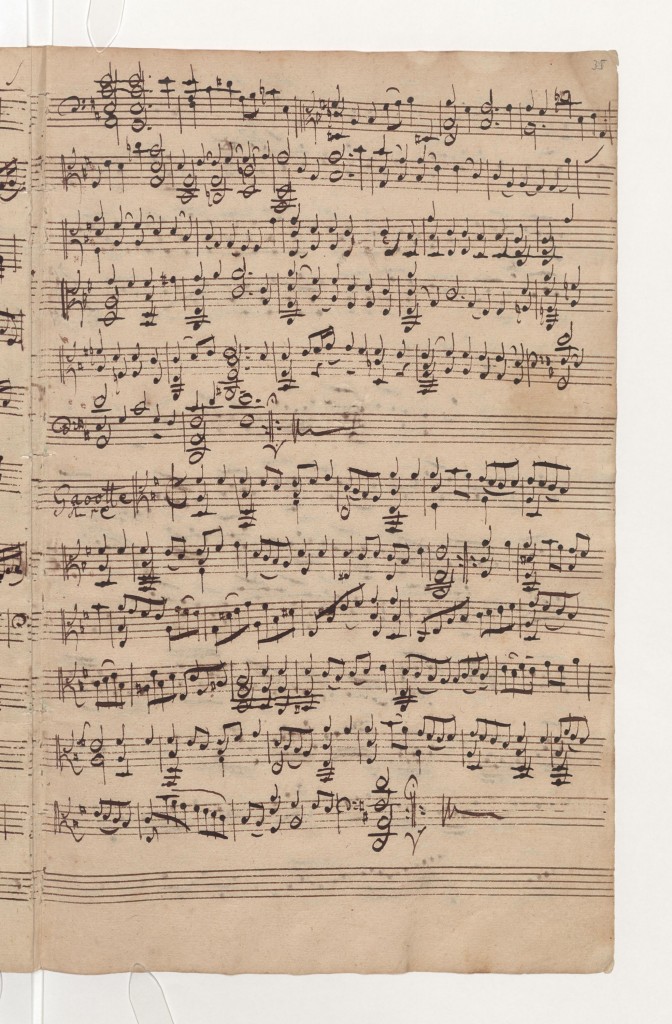
Copy of Anna Magdalena Bach, digital copy from the Staatsbibliothek in Berlin – PK
Part 2

Measure 9
We have 2 four-voice chords. I leave a note (E) out of the second chord, so I can take the G string. The second beat is also exceptionally emphasized.
Measure 10
Now comes: [plays the first beat time of measure 10] That could be the resolution, one could also imagine the relative minor, or one could imagine the mediant, depending on how it develops.
In the second beat one expects a D,
[plays up to the second beat of bar 10]
because we have again this cambiata motive. But Bach writes instead a D#. If such a thing sounds, we know, because of listening habits, that this is a secondary dominant, which probably resolves to E.
The only question is: in E minor or in E major?
[plays E major and then E minor]
At this point both would still be possible.
We know this, for example, from the G major suite: in bar 5, the relative key is E minor, and then after the dominant D major is again E minor as a deceptive cadence (bar 8), and suddenly a D# appears in bar 13 also, which would have to resolve again in bar 14 to E minor. The relative minor is even introduced here with its own secondary dominant.
Bach, in the Prélude, does something entirely different, namely, the opposite of what he does here in the Sarabande, he conceals the resolution: [plays the first half of bar 14 of the Prélude in G major]
This is not in any way a clear resolution, for example, something like this: [plays an arpeggiated E minor triad. These are tones of e minor,
[plays the first bar of bar 14]
but they remain trapped in this narrow tonal space, play around, and then lead to other harmonies.
Here, in the Sarabande D major, it is actually the case that Bach
[plays the first half of bar 10]
… and with the C we know it – will go to E minor. If Bach had written a C#, the target key would be E major.

Measure 11
In bar 11, Bach again brings the entire chord, the secondary dominant of E minor. And he even slurs the two eighth notes, that is, the second eighth note is unstressed. The eighth note G, which is also for E minor and not for E major, conceals Bach a bit (with a slur, the last note of which is always unstressed).
Measure 12
The second beat of bar 12 brings the resolution. Again, the second beat is “accidentally” emphasized. There is also the cambiata:
[plays the first half of bar 12]
Measure 13
So, and now: [plays 1st double note of bar 13] – about it we have already spoken in connection with bar 1 … one would think: Dominant.
The first beat is not slurred [continues playing], there is a C, which means retroactively no dominant, otherwise there would be a C#.
Now we are thinking:
[plays D major with Seventh C]
This is the secondary dominant of the subdominant, D major with seventh, which now comes to sound. You can intone the C a bit lower, so that the seventh is more effective.
I therefore play these notes together [plays A – C] so that this effect in fact results, and especially these two notes:
[plays D – C].
Now we are thinking about the resolution to G major or to e minor. Then E minor, which was already there in the bar before, would be the deception.
Now the following: I have already spoken about the different note values in the case of multiple voices. We have a dotted half note in the lower part and a half note on beat 2 in the upper part.
This means that the first two beats are a unit. The notes are not bound with the bow, but the third beat is emphasized.
Here is the first case, where the third beat is emphasized – and the E still stands for E minor. One might think we are going back to E minor.
Measure 14
Here the F# of the secondary dominant,
[plays bar 14]
which so far was missing, is very important, and now the subdominant will follow. [plays the chord of the 3rd beat]
No deceptive cadence, no E minor, but G major. Bach, so to say, came from E minor, the relative key, to G major, almost without any intermediate secondary dominant, over a few stray paths. The full chord is on the 3rd beat.
Measure 15
And now the previous chord is repeated,
[plays bar 15]
only the note B is now down in the bass. Now, in the upper voice an E, that is again E minor.
This is a particularly interesting spot because Bach is now writing slurs which must be interpreted. They are absolutely clear in the copy of Anna Magdalena Bach, because the slurs are notated between the note stems. So there is no misunderstanding.
It is not so:
[plays bar 15 with a slurring of the upper part on each beat]
But it is like this: [plays the ties, the syncopations] This is a tie, which connects the upper part of the second beat, and again a tie on the F#.
You can not play it like that, even with the curved bow, so I separate the ties.
But the ties indicate here that we can not apply a rule of the Slur Code, namely those with the longer and shorter note values in the case of multiple voices.
If Bach had not notated any slurs, then the second beat would be emphasized, the third beat would be unstressed, and the first beat of the following measure would be emphasized again.
I interpret these ties in such a way that this rule of the Slur Code Code is broken, that we have a uniform crescendo here.
And in particular, that the E is not tied:
[plays the first beat]
Because there are two harmonies. One can not simply say that this is the subdominant with added sixth E, and without the fifth D. On the other hand, I see the harmony in E minor again. It is emphasized with the tie.
Here is a very extreme dissonance
[plays the second beat]
… which is also emphasized – between the G and the F#, a major seventh. Bach would have been able to write as well:
[plays the chord in the second beat B – A – F#].
That would also go, but it is by no means so dissonant.
And therefore, the tie is on the F#, so that the dissonant coincidence is emphasized. And now Bach has notated a slur on the third beat, to the G. The G is thus no longer stressed.
Here (3rd beat), the “intermediate beat” is no longer emphasized by syncopation, but rather the downbeat of the next measure is emphasized.

Measure 16
This is G major (2nd beat of measure 16), although only 2 pitches are notated. In the middle voice, there is once again the cambiata C – A – B).
The subdominant is once again reached, which was already there in bar 14. But there it is simply understated.
But here it appears grandios,
[plays again from bar 15 to bar 16]
even though only in two-parts.
And then it continues with the subdominant.