
This is a translation of the post
Urtext = Klartext? – eine Analyse der Sarabande in D-Dur, Teil 3 (Takt 17-24)
by Dr. Marshall Tuttle
Michael Bach
This is the third part of the analysis of the
“Sarabande” in D Major
Guest:
Burkard Weber
Video:
Interpretation of “Sarabande in D Major”
Michael Bach, Violoncello with BACH.Bogen:
https://youtu.be/YuqXQgfPKkg
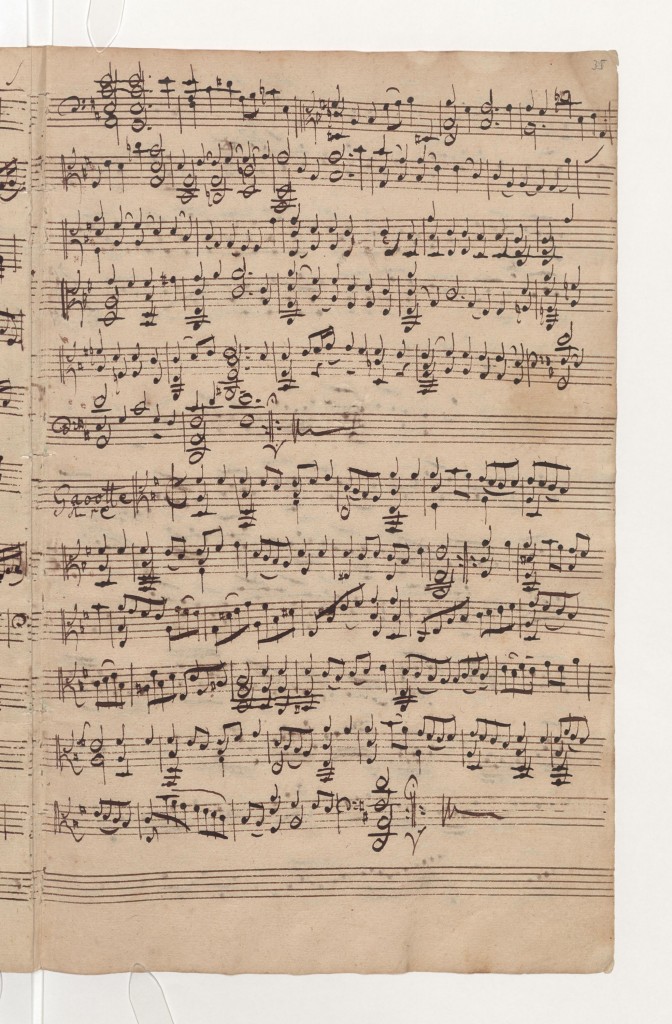
Copy of Anna Magdalena Bach, digital copy from the Staatsbibliothek in Berlin – PK
Part 3

Measure 17
Here we have a monophonic passage. Now we are at the subdominant, go once briefly to the tonic and the dominant and everything has calmed down.
It is also quite typical how Bach makes this:
[begins to play in bar 17]
… that is, the subdominant, the dominant emerges via the sixth.
Measure 18
The C# of the first beat of bar 18 is emphasized. And then the 3rd beat is emphasized, the G, which becomes the seventh of the dominant. The up beat A is tied and therefore unstressed.
Measure 19
The tonic in the third beat (D) is emphasized [plays further], which I will explain immediately.
Measure 20
The G of the second beat is emphasized.

Measure 21
Now the dominant is sounding.
Measure 22
In the first beat the subdominant sounds, but we still have also the pitches of the dominant and the tonic. If scales are there or two-parts in this way, harmony is often not clear.
One can listen to several harmonies, it remains open where this will lead. But here [plays further] we have a complete dominant chord at the measure end,
Measure 23
… followed by the seventh G. Now the tonic with suspended fourth G, then the resolution to F#. In contrast to bar 4, where the resolution is tied, it is clearly played here. Why?
Because Bach immediately goes to the relative minor (3rd time). This is the same chord, which is in bar 5. Only there is the cambiata between the tonic and the relative minor settled. There is no intervening time.
Measure 24
And then the dominant in the next bar.
What is still interesting here is that Bach does not write half notes in the bass. This of course draws attention to the upper voice.
Yes, actually one would expect a G in the upper voice, that is, the dominant with sevemth [plays a dominant seventh chord on the first beat of bar 24].
Attention is directed to the upper voice and the note G#. This is melodic.
I used to play these chord tones together. Today: [plays the lower 3 notes of the first beat of bar 24 and then the G# alone]. It is also very difficult to finger the two fifths at the same time. But all 4 tones to play together I do not consider necessary. On the contrary, I find this way of playing better.
Measure 17ff
In the passage from bar 17 onwards, Bach has now notated several slurs. They always connect two notes.
Here, in the first beat of bar 19, there is no slur. Then, again, two-note slurs, and at the end of bar 20, none, because Bach wants to expose the seventh of the dominant.
All Urtext editions “correct” this, of course, and write in bar 19 also a two note slur on the first beat with a repetition of the two note chord on the second beat.
This is clearly different from the manuscript. It is also clear why, because the stresses are shifting.
Thus, in bar 17, the subdominant of the second beat is emphasized. As a result of the regular two note slurs the C# of the dominant of the next bar is emphasized.
I’m not playing the second slur in bar 17 for bow based reasons, so I’m on the C# in bar 18 in down bow. But the stresses of the notated slurs remain the same.
For this reason, I must omit, for the sake of compensation, the last slur of the bar, but I do not emphasize the high A.
In bar 19, on the first beat, there is no slur, that is, we have an interruption of the regular series of slurs, and it is a fresh start.
Instead, we have a tie, which is connected with a slur. This means an even stronger accent on the note D of the 3rd beat. It is the tonic.
The first beat of bar 20 is unstressed. The G of the second beat is again emphasized. Whether it is the subdominant remains questionable, because it goes on to the seventh G of the dominant.
In bar 21, there is only one slur, which emphasizes the tonic of the second beat: [plays further] This sounds dominant, this subdominant.
The chord of the first beat of bar 22 is clearly the subdominant [continues to play], … dominant, subdominant, and then clearly the dominant at the measure’s end. Here the harmony is clear and the following two measures have already been discussed.