Category Archives: Allgemein

20 Years ago Presentation of the BACH.Bogen in Paris

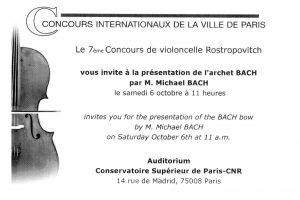
Invitation to the presentation of Michael Bach’s BACH.Bogen in Paris on October 6, 2001, extended by Mstislav Rostropovich.

Documentation of the Paris Presentation by the International Cello Society

http://www.cello.org/Newsletter/Articles/bachbogen/bachbogen.htm

“Presentation of the BACH.Bogen®on the
occasion of the Concours Rostropovitch in Paris”
October 6, 2001
Auditorium Conservatoire Supérieure de Paris


by Michael Bach
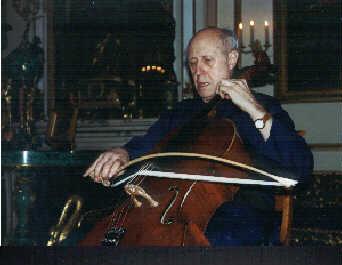
 

Photo used with permission of Renate Hoffleit © 1999


(The following is a transcript of a presentation on BACH.Bogen®)

Michael Bach: Bonjour Mesdames, Messieurs.

This is the BACH.Bow [BACH.Bogen®], a curved bow that makes polyphonic and monophonic play possible on a string instrument. There is a lever mechanism at the frog that affects the tension and release of the bow hairs.

I would like to start with a composition dedicated to Mstislav Rostropovich. The title is 3 Pitches, 21 Sounds. I wrote the piece in 1997 and the first performance took place in Jerusalem in 1998.
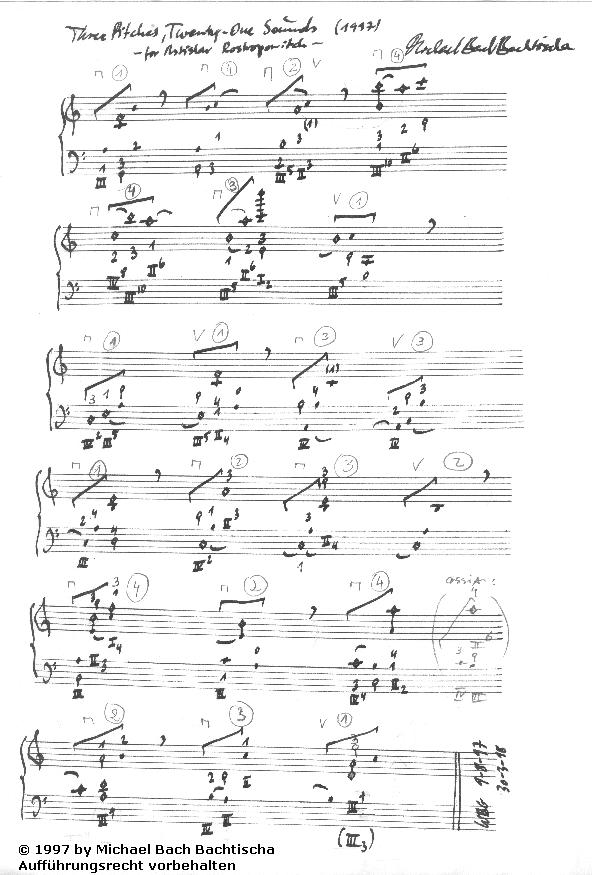
 

3 Pitches, 21 Sounds for Cello (Version 06102001)


As you have heard, I used only three pitches to compose this piece — it is a birthday piece. There is a tradition when composing such a piece: one uses the letters in a name as a theme. It’s easy with the name like “Sacher,” but with Mstislav Rostropovich you are lost. [Laughter] I looked for “musical” letters in his name, because one cannot use the “M“ — I don’t know which pitch that would be, and also the “P“,or the “V“.

David Geringas: “Mi”

Michael Bach: OK, but what about the “T”? So, I decided to only make use of the “A“, “H“ — which is “B“ in English, but in German it is an “H“ — and “C“. I also chose the French spelling of the name [Mstislav Rostropovitch] which has 21 letters, and I composed 21 chords out of these three pitches. Every chord is different, no chord repeats itself: this was my idea for Maestro Rostropovich.

As an aside, I would like to mention something that probably has nothing to do with the bow; I not only composed the piece, I created some visual artwork along with it, which I call “Fingerboards.” [shows the Fingerboard 13 out of the series Fingerboards VI] These are prints on the cello, I made 21 of these boards, just like I used the 21 chords. They show the fingerings: I put them underneath the strings [demonstrates], and I take color. Then I print these boards with the pitches I play on the cello. So it’s a choreography on the cello fingerboard with the pitches. Because I made both together, the visual art and the music, one could say I “composed” the boards and have “painted” the music. This connection between both works is important to me.
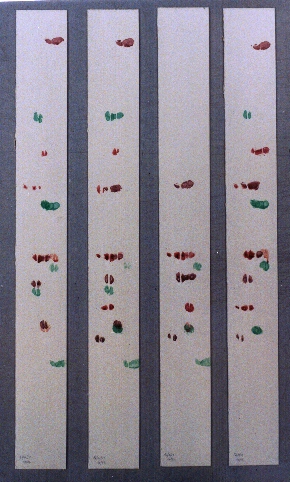
 Fingerboards VI, No. 13-16
 

I am not the first to compose for the curved bow; John Cage was the first. I showed John Cage the curved bow in 1990 — a very primitive version at that time — and I played for him. He said, “Well, you have four times one string,

[Plays A, D, G, C]

three times two strings,

[Plays A+D, D+G, G+C]

two times three strings,

[Plays A+D+G, D+G+C]

and one times four strings.”

[Plays A+D+G+C]

This is a very typical Cagian remark.

When we worked in New York one year later I had built two other bows, which were still very primitive. As you can see, they are curved differently: this one is for four strings and this one is for three strings.

At that time, I was not very concerned about the development of the curved bow, but more with the research on what I could finger with my left hand. It is also a question of the left hand: if you have four strings and five fingers there are many finger combinations possible on the cello, which I didn’t fully understand at the beginning. In order to figure out the system behind all finger combinations I did some research, which is published in my book, Fingerboards & Overtones. In it I describe the polyphony on the cello with the left hand and the overtones,i.e. harmonics.

This research was very important when preparing the new cello work [by John Cage], which is named One8 — “one” means just a solo piece, and “8” means the 8th solo piece — in this case for cello.

We have created, as an example, the following chord:
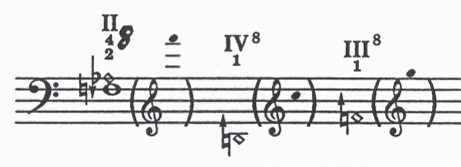


This is very complicated, it’s the 8th partial of the C string, the 8th partial of the G string, and this pitch, an F on the D string. But this “F” is not played in this high position:


It is played in the first position, as the 8th partial of a fingered pitch; it is therefore an artificial harmonic. Traditional cello technique goes until the 6th partial but not the 8th.

I should also mention that at the beginning of the 20th century a vivid discussion arose about the curved bow: the spiritual father was Albert Schweitzer, who wrote a book about Johann Sebastian Bach in 1905. He demanded that it should be possible to play the chords on the violin, or the cello, just as they are written in the score. He thought, maybe, that such a curved bow had existed in Bach’s time — I’ve never seen one — but it should be possible to play harmonic progressions like this:

 

Chord progression D – d


The German violinist, Rudolf Gähler, wrote a book about all the controversial texts concerning the curved bow for violin that were published since that time: Der Rundbogen für die Violine – ein Phantom? [The Curved Bow for the Violin — a Phantom?] And he also recorded all Bach’s Partitas and Sonatas for violin with a curved bow. There he demonstrated that it is, generally speaking, possible to play the score of Bach as it is written.

I myself think a little bit differently about this, I think that what is important is the flexibility, the richness of modulation that you can have with the curved bow:

[Plays Sarabande C-Major … spontaneous applause]

[Plays Bourrée I C-Major … applause]

I have designed the curved bow for contemporary music, but you can also play Johann Sebastian Bach with it.

In 1995 I was sure that it was worth the effort to improve the curved bow. (I still had the very primitive bows that I mentioned before.) I had built two other bows according to my own plans. One of these bows is this one [BACH.Bogen 5]. This bow made the acquaintance of Maestro Rostropovich. [to Mstislav Rostropovich]: Do you remember?

This bow is too light, it’s not a cello bow, actually, it’s a violin bow. I had no other curved bow, so I used it. But at that time I already had plans to change and improve the curved bow.

Rostropovich and I met in 1997, but this was only the first encounter of many where we discussed new prototypes of the curved bow. I have some of them here:

[Michael Bach demonstrates and explains various curved bows: BACH.Bogen 1, BACH.Bogen 10, Prototype A, B, C, and D, BACH.Bogen 20, BACH.Bogen 30.]

The last curved bow that I showed you in Amsterdam earlier this year was this one [BACH.Bogen 34], which is even more ergonomic. One holds this bow in the hand like a conventional bow. It just needs the force to tighten the hairs, so one needs to strengthen some muscles. I showed this curved bow to you in Amsterdam, in June 2001, and then, we decided to present it to the cellists.

I don’t know, is there anything you would like to say?

Mstislav Rostropovich: My dear friends, my dear colleagues, we also have history in our long life. When we changed the bow, changed a little bit the cello. Why do we change the bow, or an instrument? Because of the composers. They have another idea about the old material what we have: the bow, less the cello….

This notion of making a polyphonic bow, I think, is very interesting, and a great idea! But, how can we convince composers of this idea, of this new possibility for the cello? We need a new repertoire for the cello. My friend, who designed this new curved bow, also composes. But now he must influence another composer to write for these Neuigkeiten — for this new development and idea. Only after composers start to write for the new curved bow will we better know how great this invention is.

*

More about Mstislav Rostropovich and the BACH.Bogen

For the broader history of the collaboration between Mstislav Rostropovich and Michael Bach and the development of the BACH.Bogen, see:

Mstislav Rostropovich and the BACH.Bogen


P. I. Tschaikowski, Valse Sentimentale op. 51, N° 6

🇩🇪 Deutsch

Video auf YouTube

Partituren für Violin, Viola und Cello

Die Komposition Valse Sentimentale für Klavier solo aus dem Jahr 1882 ist von einem ausgeprägten Wechselspiel zweier gegensätzlicher Stimmungen geprägt: Zwischen dem melancholischen Moll des Hauptthemas und dem heiteren Dur des Mittelteils entsteht eine geradezu janusköpfige musikalische Gestalt.

Ein weiteres charakteristisches Element ist der überraschende harmonische Einbruch im Mollteil: Die zweite Stufe der Tonart wird jeweils um einen Halbton erniedrigt und erzeugt dadurch eine eigentümliche, unerwartete Klangfärbung. Dieses harmonische Ereignis kehrt mehrfach in nahezu unveränderter Gestalt wieder. Die vorliegende Bearbeitung greift diese wiederkehrende Spannung auf und gestaltet sie in freier Form weiter, mit besonderen Auswirkungen auf den Mittel- und Schlussteil.

In Bearbeitungen für Streichinstrument und Klavier wird der Mittelteil in der parallelen Durtonart häufig vollständig ausgelassen. Sein einfaches, beinahe derbes Motiv steht in starkem Kontrast zum melancholischen Hauptthema in f-Moll. Auch der ungefähr gleich lange Schlussteil, der den Anfang weitgehend wiederholt, wird häufig stark gekürzt.

Eine solche Reduktion auf das Mollthema stellt jedoch einen wesentlichen Eingriff in die formale und harmonische Gestalt des Werkes dar. Die beiden gegensätzlichen Charaktere des Stücks werden dadurch aufgehoben; zurück bleibt vor allem ein wehmütiges Mollthema.

Die vorliegende Solofassung versucht dagegen, die kontrastierende Gesamtgestalt des Werkes auch auf einem einzigen Streichinstrument zu erhalten.

Der Eingangstakt

Die beiden solistischen Anfangsnoten bilden keinen konventionellen Auftakt. Das zeigt bereits der Beginn mit einer Viertelpause, durch den der erste Takt metrisch vollständig ist. Seine harmonische Funktion wird zunächst noch nicht eindeutig erkennbar. Erst bei der Wiederholung des Themas zeigt sich, dass es sich um einen Dominantseptimakkord der Molltonika mit auflösungsbedürftigem Quartvorhalt handelt.

Der Eingangstakt, der in der Bearbeitung stets erhalten bleibt, besitzt damit eine besondere strukturelle und programmatische Bedeutung.

Als markanter Übergang kehrt dieser Dominantseptimakkord mit Quartvorhalt in Takt 53 wieder. Er führt vom ersten Seitenthema ab Takt 37 zurück zur Molltonika in Takt 54. Dabei wird der Grundton der Dominante der Tonikaparallele chromatisch zur Terz des Dominantseptimakkords erhöht. Auf diese Weise wird die Rückkehr zum Mollthema durch dessen eigene Dominante vorbereitet und nicht als Trugschluss nach der Zwischendominante gestaltet.

Auch der Übergang vom Mittelteil in der Tonikaparallele zum Schlussteil in Moll erfolgt über eine charakteristische harmonische Verbindung. In Takt 133 werden Quinte und Terz der Tonikaparallele schrittweise in Terz und Septime des Dominantseptimakkords der Molltonika überführt.

Das harmonische Prinzip des Mollthemas

Das schlichte Motiv des Mollthemas besteht aus dem aufsteigenden Dreiklang der Molltonika, einem leittönigen Vorhalt zur Quinte und einer abfallenden diatonischen Tonfolge bis zur gleichen Tonhöhe.

Darauf folgt eine charakteristische Harmonieabfolge, die durch die chromatische Erniedrigung der zweiten Tonstufe in den Takten 5 und 6 geprägt ist.

Naheliegend wäre es, diese erniedrigte Note als Septime der auflösenden Tonikaparallele zu verstehen und damit als Bestandteil einer Zwischendominante zur Subdominantparallele. Tatsächlich erscheint in Takt 6 die Subdominantparallele nach der Auflösung des Vorhalts zu ihrer Terz. Takt 7 führt anschließend in die terzverwandte Molltonart.

Der überraschende harmonische Einschnitt in Takt 5 lässt sich jedoch nicht einfach als Zwischendominante erklären. Ober- und Unterstimme werden gleichzeitig zur erniedrigten zweiten Stufe geführt, während die Mittelstimmen auf den Tönen des vorhergehenden Taktes verharren. Dadurch entsteht eine Durchgangsharmonie: ein Durakkord auf der erniedrigten zweiten Stufe der Molltonika. Seine Töne entsprechen dem Neapolitanischen Sextakkord.

Der zweite thematische Anlauf ist durch das Erreichen des Dominantseptimakkords in Takt 8 bereits vorbereitet. Danach stagniert die harmonische Bewegung. Dieser viertaktige Stillstand wird nochmals wiederholt und erweitert damit die ansonsten regelmäßig achttaktige Phrase um vier Takte.

Darauf folgt der Eintritt des Mollthemas mit dem stark betonten Dominantseptimakkord und der vertrauten Harmoniefolge der ersten achttaktigen Phrase.

Mit der erneuten Wiederholung des Themas ab Takt 29 wird die bisherige Spitzennote bis zur Quinte der Grundtonart gesteigert. Die folgende Akkordreihe beginnt nun – unter Auslassung der Zwischendominante – unmittelbar mit dem Neapolitanischen Sextakkord in erster Umkehrung. Auch die Subdominantparallele erscheint in Takt 34 nicht mehr. Damit bildet die Molltonika bereits an dieser Stelle den vorläufigen Abschluss des einleitenden Mollteils.

Es folgt das erste Seitenthema in Dur über zwei mal acht Takte. Anschließend beendet das wiederholte Hauptthema in Moll den ersten Formteil.

Der Mittelteil

Der Mittelteil entwickelt sich in der Tonikaparallele. Sein kaum verändertes, bewusst einfache und beinahe derbe Motiv wird viermal vorgetragen. Die Harmonik ist ebenso schlicht.

Im originalen Klaviersatz wird die Wiederholung des Motivs von oktavierten Akkorden begleitet und dadurch zunehmend gesteigert. Diese klangmächtigen Akkordkaskaden lassen sich auf einem einzelnen Streichinstrument nicht unmittelbar wiedergeben.

In der Solofassung wird das robuste Durmotiv deshalb ohne begleitende Akkorde präsentiert und stattdessen durch reine Obertöne klanglich erweitert.

In dieses markante Durmotiv ist ein schlichtes, elegisches Motiv in der Molldominante eingebettet. Der wiederholte Sextvorhalt in der Oberstimme lässt dabei chromatische Zusammenklänge in den Unterstimmen entstehen.

Mit dem letzten Auftreten des Motivs in der Tonikaparallele endet der Mittelteil. In Takt 133 übernimmt erneut der Dominantseptimakkord des Hauptthemas das musikalische Geschehen und leitet den dritten Formteil ein.

Der Schlussteil

Grundsätzlich wird der Anfangsteil erneut aufgegriffen, einschließlich des Seitenthemas. Eine besondere Veränderung betrifft jedoch das letzte Erscheinen des Hauptthemas.

Am Ende des Werkes wird dessen Spitzennote um eine Oktave nach oben versetzt. Eine anschließend dramatisch abwärts führende Tonfolge führt in die Bassregion zur Mollsubdominante. Es folgen die Molltonika, deren Dominantseptimakkord und schließlich dessen erneute Auflösung zur Molltonika.

Die Solofassung für Violine, Viola und Cello

Die Bearbeitung für ein solistisches Streichinstrument variiert insbesondere den sich wiederholenden Dominantseptimakkord mit Quartvorhalt sowie die Begleitstimmen.

Aus spieltechnischen und klanglichen Gründen wird das Stück von f-Moll nach e-Moll für Cello und Viola beziehungsweise nach h-Moll für Violine transponiert. Dadurch können die leeren Saiten und ihre Obertöne in die klangliche Gestaltung einbezogen werden.

Nach der Molldominante des Mittelteils ist ab Takt 117 eine kurze, acht Takte umfassende Kadenz ad libitum vorgesehen. Sie besteht ausschließlich aus Obertönen, die bis zum fünften Partialton jeder Saite reichen. Auf diese Weise lassen sich die wichtigsten harmonischen Funktionen des Werkes andeuten: Molltonika, Mollsubdominante, Molldominante, Tonikaparallele, Parallele der Mollsubdominante und Dominante.

Die Bearbeitung versucht damit, die charakteristischen Gegensätze und die harmonische Dramaturgie der Valse Sentimentale auch in einer Fassung für ein einziges Streichinstrument erfahrbar zu machen.

Michael Bach Bachtischa
Wissembourg, Februar 2021


Entdecken Sie weitere Bearbeitungen für Violine, Viola und Cello solo, die das Solo-Repertoire der Streichinstrumente um neue Werke ohne Klavierbegleitung erweitern, in der Music Scores-Sammlung.


🇬🇧 English

Video on YouTube

Scores for Violin, Viola and Cello

Pyotr Ilyich Tchaikovsky’s Valse Sentimentale, Op. 51 No. 6, is characterised by a striking contrast between two different musical worlds. The main theme in F minor has a distinctly melancholic character, while the middle section moves into the major and introduces a lighter, almost cheerful atmosphere. The return of the minor section brings these contrasting moods together again and gives the piece its characteristic formal and harmonic tension.

In arrangements for string instrument and piano, the middle section is sometimes omitted or the reprise is shortened. This places the emphasis almost entirely on the minor theme, but in doing so changes the formal and harmonic character of the original. The present solo arrangement therefore aims to preserve the complete structure and, in particular, the contrast between the two principal tonal areas on a single string instrument.

The Opening Bar

The two opening notes might initially appear to form a short upbeat. However, the piece actually begins after a quarter-note rest, so the first bar is metrically complete.

The harmonic function of these opening notes becomes clearer when the theme is repeated. They form part of a dominant-seventh harmony of the tonic minor, with a fourth suspension resolving into the chord. This combination of melodic motion and harmonic suspension is characteristic of the piece and recurs in various forms throughout the arrangement.

The Harmonic Principle of the Minor Theme

The opening theme begins with an ascending minor tonic triad. The leading tone appears as a suspension before resolving onto the fifth, followed by a descending diatonic line.

Another characteristic feature occurs in bars 5 and 6, where the second scale degree is lowered. This creates the sound of a Neapolitan sixth chord and gives the otherwise relatively simple harmonic progression a particular expressive tension.

The subsequent thematic passage is characterised by a certain harmonic stagnation. Instead of immediately moving towards a new harmonic area, the music remains suspended, allowing the melodic material to unfold over an extended harmonic framework.

At bar 53, the transition back to the minor tonic begins with a dominant-seventh chord containing a fourth suspension. The harmonic movement leads into the return of the minor theme at bar 54.

The Middle Section

The middle section moves into the parallel major key and presents a striking contrast to the melancholy opening. Its basic motif is simple and almost deliberately rough in character, being repeated four times.

In Tchaikovsky’s original piano version, the motif is reinforced by powerful octave chords. Such massive harmonic structures cannot be transferred literally to a single string instrument. The solo arrangement therefore presents the motif through natural harmonics, preserving its characteristic outline while giving it a sound appropriate to the instrument.

Within this major section, an elegiac motif appears in the minor dominant. A repeated sixth suspension in the upper voice creates chromatic sonorities in the lower voice and introduces a darker colour into the otherwise brighter middle section.

The transition from the middle section to the final minor section occurs at bar 133. Here, the fifth and third of the major tonic are transformed into the third and seventh of the dominant-seventh chord leading back to the minor tonic.

The Final Section

The final section returns to the opening material, including the secondary thematic passage. The high point of the melody is transposed an octave higher, intensifying the return before the music moves dramatically downwards towards the minor subdominant.

From there, the harmony proceeds towards the minor tonic, followed by a dominant seventh and its resolution back to the tonic.

The recurring dominant-seventh chords with their fourth suspensions are treated somewhat differently in the solo arrangement, as are several of the accompanying figures. The original key of F minor is transposed to E minor for cello and viola, and to B minor for violin. These keys allow the open strings of the instruments to participate in the harmonic resonance and make greater use of their natural overtones.

The Solo Arrangement

One of the central challenges in creating a solo version of Valse Sentimentale is to preserve not only the melody but also the harmonic structure that originally depends on the piano accompaniment.

From bar 117 onwards, following the minor dominant of the middle section, the arrangement introduces an eight-bar ad libitum cadenza based entirely on harmonics. Harmonics up to the fifth partial are used to outline the essential harmonic progression. Within this limited but sonically rich material, the principal harmonies can be represented: the minor tonic, minor subdominant, minor dominant, the tonic parallel, the parallel of the minor subdominant, and the dominant.

The use of harmonics allows several harmonic levels to resonate simultaneously, creating an impression of polyphony on a single instrument. The aim is not to reproduce the piano texture literally, but to retain the harmonic and formal functions that shape the original composition.

The arrangement can be performed with a conventional bow. Its purpose is to make the characteristic contrasts and harmonic drama of Tchaikovsky’s Valse Sentimentale perceptible even in a version written for a single string instrument.

Michael Bach Bachtischa
Wissembourg, February 2021


Discover more solo arrangements for violin, viola and cello, created to expand the solo repertoire without piano accompaniment, in the Music Scores collection.