Category Archives: Allgemein

Urtext = Plain Text ? – An Analysis of the Sarabande in D Major, Part 4 (Bar 25-32)


Britain

This is a translation of the post

Urtext = Klartext? – eine Analyse der Sarabande in D-Dur, Teil 4 (Takt 25-32)

by Dr. Marshall Tuttle


Michael Bach

This is the fourth part of the analysis of the

“Sarabande” in D Major

Guest:
Burkard Weber

Video:
Interpretation of “Sarabande in D Major”
Michael Bach, Violoncello with BACH.Bogen:
https://youtu.be/YuqXQgfPKkg
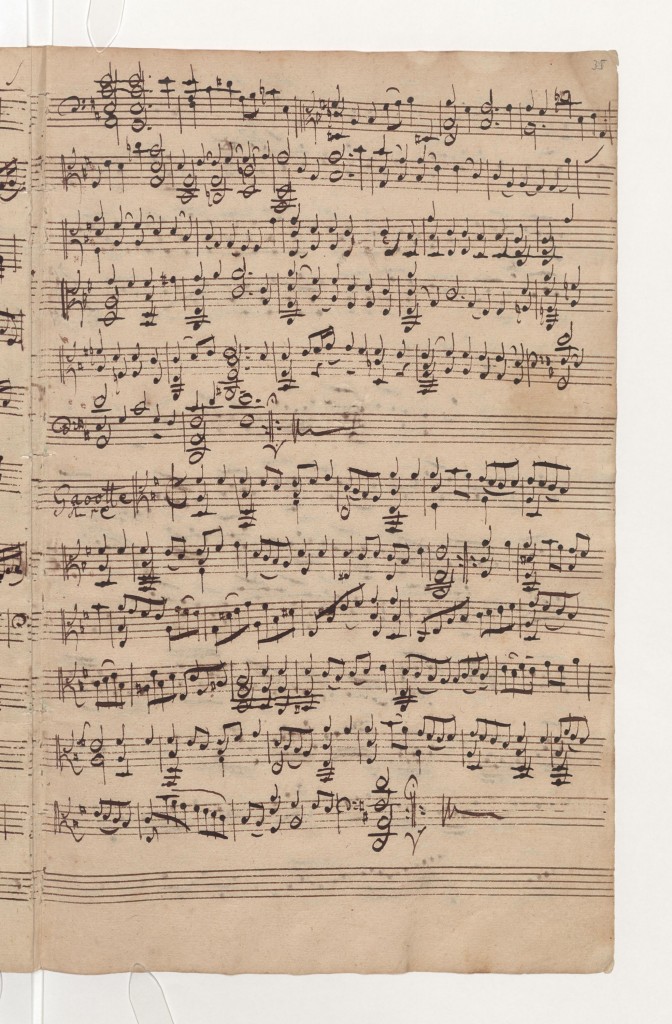
Copy of Anna Magdalena Bach, digital copy from the Staatsbibliothek in Berlin – PK

Part 4

Measure 25

In the following 3 bars, four-voice chords are on the first beat. The first is also emphasized, the second also … only by being four-voice. This must also be taken into account, as I shall say, by the fact that the rules of the Slur Code [intersect]…

There are times when the slurs suggest that a beat is unstressed, but there is suddenly a four-voice chord. This is, of course, accentuated.

In bar 25, Bach wrote a tie in connection with a slur. That is, the intermediate beat between the 2nd and 3rd beats is emphasized. This is the tonic.

So, we were “thrown out of rhythm”, so to speak.


Measure 26

On the first beat Bach notates a slur. The tritone of the second beat is emphasized, the E is tied the repetition of the E can not be tied, nevertheless, as a result of the dotted half note in the upper voice, a decrescendo arises:


Measure 27

To D minor, which is a surprise. D major is actually expected, but D minor appears.
 

Measure 28

The dominant is sounding. The note A# in the bass indicates the dominant of B minor.

Harmony in B minor, which had not yet been prepared, is now established by means of a four-voice chord with the memorable A# in the bass, that is, with its own dominant.

 

Measure 29

This is the relative minor: B minor (first beat).
 
Incidentally, in the previous beat the first eighth note is tied but not both eighth notes. Therefore the note E is accentuated. Bach wants the eighth note to be explicit.

Bach writes here for the first time rests in the lower voice. This is very unusual.

I also asked myself what harmonies do we have here? Could that be the dominant, for example? [plays the second beat with C# and A in the lower voices] Could be possible.
 
Or do we slowly return from B minor to G major, to the subdominant? It could even develop the tonic.

I once looked up – when it comes to pitches, I sometimes look at Kellner, this is the 2nd transcript we have. Actually, the first one, created before that of Anna Magdalena Bach.

There I actually found something i was looking for, because Kellner writes a small grace note before the E, namely a C#. Thus, the dominant is clear. But, I believe that is an ingredient of Kellner’s. Sometimes you find something like this, he was a composition student of Bach’s.

But Kellner has obviously also “scratched his head”: What are actually here for harmonies, where these rests are? Bach could have written a few more notes, so we could know where we are in harmony. Bach purposefully did not do that.

And then a special feature at this point: There is a small slur and is actually a tie above the high G.

This is so uncommon to link a sixteenth note syncopated before the next beat, so that I have been wondering for a long time whether this slur has just gotten out of place. Would not this slur really be on the F#? But the F# is the third of the tonic and would thus be more highlighted with a small slur …

In any case, no matter where the slur stands, the top note G would be accentuated in both cases.

So if I play [plays the slur on the note F#], the second beat would be accentuated with the top note G, according to the Slur Code.

If, on the other hand, I play [playing a tie on the note G], the top note G is also accentuated. I even prolong the G a little.

This version seems to me to be more exceptional. That is why I play this slur as it stands. There is no reason, from my point of view, to play it differently.

And now, on the third beat is a clear dominant seventh chord, more precisely, the secondary dominant to the subdominant. There is another pause in the bass in the bar.


Measure 30

The resolution to the subdominant with sixth takes place, it is the same chord as in bar 2, exactly the same pitch constellation. Here, however, with a slur, thereby emphasizing the tonic of the second beat.

In the second beat is not a slur, but again in the third beat, whereby the dissonance in the following bar is emphasized.

 
Measure 31

The harmony of the first beat is unclear, we do not yet know what the result of this will be: [plays the first beat with a slur]

The second beat is unstressed. There could be a resolution in the upper voice [plays D – C#], but it does not happen. The note G is not  tied. although half notes are in the bass and in the upper part. But we have already discussed the exception in this movement.

In the third beat we have only two-part voicing.
 
 
Measure 32

Here is the four-part chord. I already mentioned that because you spoke of the sonority at the beginning, …

BW: Yes, of course.

MB: … in connection with the end of the first part, because you add  more notes. Here we see that Bach omits pitches on the third beat of the preceding bar. He could have left the note A in the bass.

The reason is the following, Bach would like the volume of the  four-voice chord in the end to distinguish it from the preceding sound.

– (the harmonic situation is clear) – and this is emphasized more by moving from two-voices to four-voices, than from three-voices to a four-voices..

And, there is one more thing, it is here the first time, where the tonal space extends under the G-string. This deep D had not previously occurred. Everything played has been over the G string.

And, at the same time, there arises an interference between the lowest and highest strings, namely, between D and C#, a major seventh.  This I can just play with the gently curved bow. you can of course execute it more smoothly with the highly arched bow.

The bass note D I try to keep as long as possible. The conclusion is then two-part, somewhat more sonorous than the end of the first part.

BW: This has a certain greatness that Bach is still producing this friction with the C# in this chord in another situation. This makes the door open a little once again. This extension is not expected, but rather a final conclusion. And then that friction comes in. That’s just Bach.

MB: Yes, and it is also thematic. I had already spoken about the cambiata [plays G – E – F#], and from this develops [plays G – F# – G – E – F# from bar 4], and [the upper voice of bar 7f] And from this develops [plays the bars 16ff and the bar 21], now even two-part.

And these repetitions are actually the result of the  augmentation of this small cambiata: [plays G – E – F# (measure 4), then E – C# – D (measure 2)]

This is exactly what we have in the end: [plays mid-voice of bar 31 and the upper-voice of bar 32]

BW: Yes, beautiful. It’s totally interesting. Very good, really.

MB: Yes, you can do it all only with the curved bow.

BW: The curved bow is absolutely necessary for this piece. I mean, only the curved bow makes it possible to explore the meaning of this work. Arpeggiating with the straight bow change… the breaking of the chords shifts the existing rhythm. The listener, as a result of the decomposition of the chords with the straight bow, must reconstruct them mentally again.

MB: This is one thing. If we have a consonant chord, like G major or D major, one could theoretically not need to keep all the notes to the end.
We can also play them like this: [plays a three-part D major sound and continues this two-part, then ending with the upper voice alone.]

BW: Yes, of course, but important is how it starts: [sings pa-da-]

MB: I wanted to say something else. It is not just that all notes of a chord sound together at the beginning and then  the upper voice is sustained for melodic reasons, and the lower notes are left. This is possible when we have resolutions such as at the end: [plays measure 32 with an arpeggio]

Here I could imagine something like that too. But in this movement it is as we have seen [the beginning of bar 2] that the bass note should be sustained because it is not resolved here.

In this movement, only one bass note is immediately resolved, namely, at the end (bar 28f) to B minor: [plays A# – B]

Thus: [plays measure 28 with resolution to the bass note B.] Such effects can only be obtained if the other bass notes, which are not resolved, can also be sustained. This can only be done with the curved bow.

You can not break chords up and then down again: [plays a D major chord with an arpeggio up and then down] If you want to end a chord including the bass note, you can only use a bow that allows you to have multiple voices.

I’m just wondering if … I do not know a single movement from the suites where I do not play, if possible, the notated note values.

Because, there is always a compositional reason for the note values. It is so, I play the note values not merely because they are writtten so, but because they make sense.

In this movement this was shown. But there are still quite different cases, where Bach even notates a prime in the bass in the Chaconne for violin (bar 13). Even if you can do it on the violin, it does not go on the cello. The prime will hardly play  because you do not hear it.

This prime has a reason: that the lower voice is accentuated, that further development takes place in the lower voice. This can be done wonderfully with the curved bow by simply playing the full chord and releasing the upper notes to sustain the bass note: [plays D major and ends with the bass note]

You do not have to play like this: [plays arpeggio up and then down]

BW: That makes no sense.

MB: Traditionally, this is done like that with the straight bow.

Continue reading

Urtext = Plain Text ? – An Analysis of the Sarabande in D Major, Part 3 (Bar 17-24)

Britain

This is a translation of the post

Urtext = Klartext? – eine Analyse der Sarabande in D-Dur, Teil 3 (Takt 17-24)

by Dr. Marshall Tuttle


Michael Bach

This is the third part of the analysis of the

“Sarabande” in D Major

Guest:
Burkard Weber

Video:
Interpretation of “Sarabande in D Major”
Michael Bach, Violoncello with BACH.Bogen:
https://youtu.be/YuqXQgfPKkg

Copy of Anna Magdalena Bach, digital copy from the Staatsbibliothek in Berlin – PK

Part 3

Measure 17

Here we have a monophonic passage. Now we are at the subdominant, go once briefly to the tonic and the dominant and everything has calmed down.

It is also quite typical how Bach makes this:

[begins to play in bar 17]

… that is, the subdominant, the dominant emerges via the sixth.

Measure 18

The C# of the first beat of bar 18 is emphasized. And then the 3rd beat is emphasized, the G, which becomes the seventh of the dominant. The up beat A is tied and therefore unstressed.   

Measure 19

The tonic in the third beat (D) is emphasized [plays further], which I will explain immediately.

Measure 20

The G of the second beat is emphasized.

Measure 21

Now the dominant is sounding.
Continue reading

Urtext = Plain Text ? – An Analysis of the Sarabande in D Major, Part 2 (Bar 9-16)

Britain

This is a translation of the post

Urtext = Klartext? – eine Analyse der Sarabande in D-Dur, Teil 2 (Takt 9-16)

by Dr. Marshall Tuttle


Michael Bach

This is the second part of the analysis of the

“Sarabande” in D Major

Guest:
Burkard Weber

Video:
Interpretation of “Sarabande in D Major”
Michael Bach, Violoncello with BACH.Bogen:
https://youtu.be/YuqXQgfPKkg


Copy of Anna Magdalena Bach, digital copy from the Staatsbibliothek in Berlin – PK

Part 2

Measure 9

We have 2 four-voice chords. I leave a note (E) out of the second chord, so I can take the G string. The second beat is also exceptionally emphasized.    

Measure 10

Now comes: [plays the first beat time of measure 10] That could be the resolution, one could also imagine the relative minor, or one could imagine the mediant, depending on how it develops.

In the second beat one expects a D,

[plays up to the second beat of bar 10]

because we have again this cambiata motive. But Bach writes instead a D#. If such a thing sounds, we know, because of listening habits, that this is a secondary dominant, which probably resolves to E.

The only question is: in E minor or in E major?

[plays E major and then E minor]

At this point both would still be possible.

We know this, for example, from the G major suite: in bar 5, the relative key is E minor, and then after the dominant D major is again E minor as a deceptive cadence (bar 8), and suddenly a D# appears in bar 13 also, which would have to resolve again in bar 14 to E minor. The relative minor is even introduced here with its own secondary dominant.

Bach, in the Prélude, does something entirely different, namely, the opposite of what he does here in the Sarabande, he conceals the resolution: [plays the first half of bar 14 of the Prélude in G major]

This is not in any way a clear resolution, for example, something like this: [plays an arpeggiated E minor triad. These are tones of e minor,

[plays the first bar of bar 14]

but they remain trapped in this narrow tonal space, play around, and then lead to other harmonies.

Here, in the Sarabande D major, it is actually the case that Bach

[plays the first half of bar 10]

… and with the C we know it – will go to E minor. If Bach had written a C#, the target key would be E major.

Measure 11

In bar 11, Bach again brings the entire chord, the secondary dominant of E minor. And he even slurs the two eighth notes, that is, the second eighth note is unstressed. The eighth note G, which is also for E minor and not for E major, conceals Bach a bit (with a slur, the last note of which is always unstressed).

Continue reading

Heute vor 20 Jahren starb Tossi Spiwakowski

23.12.1906 – 20.07.1998

Sein Rundbogenspiel. Seine Bachinterpretation.


Tossi Spiwakowskis Artikel über die Solowerke für Violine von J. S. Bach 1) aus dem Jahr 1967 war mir durch Rudolf Gählers Buch, Der Rundbogen für die Violine – ein Phantom? 2) bekannt und auch die Tatsache, daß Spiwakowski einen Rundbogen, den VEGA BACH BOW des dänischen Geigenbauers Knud Vestergaard verwendete, der ursprünglich für den Geiger Emil Telmányi (1892 – 1988) entworfen wurde. Bedauerlich war aber, daß bislang keine einzige Tonaufnahme mit Spiwakowski und dessen Rundbogen aufzutreiben war. Mehr oder weniger zufällig gelang es mir, Kontakt mit der Fotografin Ruth Voorhis, der Tochter von Spiwakowski, aufzunehmen und erhielt von ihr einige Fotografien von dessen VEGA BACH BOW zugesandt, sowie die Information, daß ein Live-Mitschnitt der Chaconne, gespielt von Spiwakowski mit dem Rundbogen, gerade veröffentlicht wurde 3).

Ich kenne diesen VEGA BACH BOW (Abb. 1) seit Anfang der 90er Jahre genau, da Rudolf Gähler ein Exemplar in seiner Sammlung beherbergt. Eine detaillierte Dokumentation dieses Rundbogens wird auf der ungarischen Website https://www.vonokeszites.hu/de/bogen/emil-telmanyi bereitgestellt.

VEGA BACH BOW 150dpiAbb. 1

Auffallend war für mich, daß der Rundbogen Spiwakowkis sehr starke Gebrauchsspuren aufweist, was für mich die zweifellos beträchtliche Bedeutung dieses Rundbogens für ihn aufzeigt. Hier müssen sich heroische Kämpfe in der Bezwingung dieses Bogenwerkzeugs abgespielt haben. Zweitens, Spiwakowski hatte den Arretiermechanismus ausgebaut 4), welcher eigentlich dafür gedacht ist, den Daumen im einstimmigen Spiel und den damit einhergehenden hohen Zugkräften der Bogenhaare zu entlasten. Diese Elimination des Einrastmechanismus ist für mich ein deutlicher Hinweis dafür, daß Spiwakowski herausfand, daß derartige Mechanismen für die Entlastung der Muskeln umständlich zu handhabend sind, letztendlich doch eher eine spieltechnische Barriere bedeuten, also kontraproduktiv sind. Denn jedwede zusätzliche Apparatur, die die Unmittelbarkeit des Spielvorgangs behindert, minimiert die Kontrolle über die sensiblen haptischen Bewegungsabläufe. Ich selbst erkenne in einem solchen Hilfsmechanismus ein Indiz für eine nicht ausgereifte Konstruktion und sehe mich durch Spiwakowski darin bestätigt, daß mechanische Hilfen genauestens auf ihre Zweckmäßigkeit untersucht werden sollten und sich in der Praxis beweisen müssen.

VEGA BACH BOW Kräfteparallelogramm 150dpiAbb. 2

Dieser unvorteilhaft große Kraftaufwand, die der VEGA BACH BOW erfordert, rührt daher, daß der Hebel relativ kurz ist (Abb. 2) und seine Position bei gespannten Bogenhaaren einen Winkel zu den Haaren von etwa 90 Grad aufweist. Beide geometrischen Charakteristika, die physikalisch dazu führen, daß die rechte Hand des Geigers kräftemäßig über Gebühr belastet wird, sind eigentlich unüberbrückbare Hindernisse. Die Griffmulden auf der Oberseite des Griffs sind zusätzliche Behelfe, um die Hand trotz dieser Kraftanstrengungen in Position zu halten. Um die Probleme für die rechte Hand zu verringern, ist es für den Konstrukteur jedoch erforderlich, nicht symptomatisch vorzugehen, sondern zunächst die ursächlichen Prinzipien zu verstehen und dann geeignete Lösungen zu finden. Der Frosch des VEGA BACH BOW hat noch eine weitere Öffnung für den Daumen, damit das einstimmige Spiel im arretierten Zustand des Frosches erleichtert wird. Der Daumen wechselt also während des Spiels zwischen zwei Positionen, was eine abermalige Erschwernis darstellt. Zu den nachteiligen Eigenschaften des Griffs kommt hinzu, daß die Bogenstange in der oberen Hälfte, also von der Mitte bis zur Bogenspitze hin, eine hohe Wölbung beibehält. Somit sind zwar vierstimmige Akkorde über die gesamte Länge des Rundbogens spielbar, der Schwerpunkt liegt aber dementsprechend hoch, so daß das einstimmige Spiel zusätzlich erschwert wird.

Schroeder Rundbogen 150dpiAbb. 3

Diese konstruktiv bedingten Nachteile tauchen bei dem konkurrierenden Rundbogenmodell (Abb. 3) von Rolph Schroeder (1900 – 1980) weit weniger auf, da der Hebel zum Spannen und Entspannen der Haare länger ist. Gemäß dem Hebelgesetz reduziert dies den Kraftaufwand, verlängert aber die Distanzen für den Daumen. Doch dies ist kein wirkliches Manko, wie die Spielpraxis aufzeigt. Zweitens, im gespannten Zustand wird der Hebel in den Griff eingeklappt, so daß der Drehpunkt des Hebels einen Anteil (F1) der Zugkräfte (F) im einstimmigen Spiel aufnimmt (Abb. 4). Telmányi, der seinerseits das Rundbogenspiel in den 30er Jahren von Schroeder vorgeführt bekam, konnte leider nicht dessen Prototyp erstehen, so daß er damals auf eine eigenständige, neu entworfene Konstruktion angewiesen war. Spiwakowski hingegen kannte seinerseits alleinig nur den Rundbogen von Telmányi und hatte kaum eine andere Wahl, als damit zu operieren. Gewissermaßen war es für ihn einfacher und rascher, sich im Jahr 1957 von Vestergaard einen VEGA BACH BOW zu besorgen, als eine zeitaufwendige Neukonstruktion mit ungewissen Ergebnissen zu versuchen.

Schroeder Rundbogen Kräfteparallelogramm 150dpiAbb. 4

Ich erinnere mich, als ich im Jahr 1990 erstmals die Aufnahmen der Rundbogenspieler Rolph Schroeder, Emil Telmányi und Otto Büchner (1924 – 2008) von Rudolf Gähler vorgeführt bekam, wie mich allein schon dieser mehrtönige Klang der Geige faszinierte. Trotzdem sind Telmányis Schwierigkeiten der Beherrschung dieses sehr extrem ausgeformten VEGA BACH BOW in seinen Bachaufnahmen von 1954 unüberhörbar. Insofern war ich äußerst gespannt auf die neuerliche Veröffentlichung des Mitschnitts des Schwedischen Rundfunks aus dem Jahr 1969 mit Tossi Spiwakowskis Interpretation der Chaconne. Die Überraschung war perfekt, denn aufgrund dieses Tondokuments möchte man meinen, daß Spiwakowski ein anderes Rundbogenmodell zur Verfügung gehabt hätte. Fast nichts von den enormen spieltechnischen Problemen, die dieser VEGA BACH BOW aufwirft, ist bei seinem Spiel konstatierbar. Diese Leistung Spiwakowskis als eine Selbstverständlichkeit zu goutieren, ist für mich unvorstellbar. Die Zuhörer Spiwakowskis müssen regelrecht vom Stuhl gefallen sein, bei einem so meisterlichen Vortrag der Chaconne mit dem Rundbogen.

Michael Bach


1) Tossy Spivakovsky, Polyphony in Bach’s Works for Solo Violin, published in 1967 in The Music Review, Vol. 28, No. 4

2) Rudolf Gähler, Der Rundbogen für die Violine – ein Phantom?, Conbrio Verlag, Regensburg 1997

3) Live-Mitschnitt, Schwedischer Rundfunk, Stockholm, 26. Januar 1969, DOREMI DHR-8025-8

4) siehe Foto: Tossi Spiwakowski, Einführung zur Interpretation von J. S. Bachs Solowerken für Violine mit dem Rundbogen

Tossy Spivakovsky died 20 years ago today

December 23, 1906 – July 20, 1998

His playing with the curved bow. His Bach interpretation.


Tossy Spivakovsky’s article on the solo works for violin by J. S. Bach 1) from 1967 became known to me through Rudolf Gaehler’s book, The Curved Bow for the Violin – a Phantom? 2) and also by the fact that Spivakovsky used a curved bow, the VEGA BACH BOW made by the Danish violin maker Knud Vestergaard, which was originally designed for the violinist Emil Telmányi (1892 – 1988). I found it regrettable, however, that until now not a single recording of Spivakovsky performing with his curved bow was available. More or less coincidentally, I managed to contact the photographer Ruth Voorhis, the daughter of Spivakovsky, and received some photographs of his VEGA BACH BOW. She told me that a live recording of the Chaconne, played by Spivakovsky with the curved bow, had just been released 3).

Since the beginning of the nineties I was well acquainted with this VEGA BACH BOW (Fig. 1) because Rudolf Gaehler has a copy of it in his collection. A detailed documentation of this curved bow is available on the Hungarian website https://www.vonokeszites.hu/en/bows/emil-telmanyi.

VEGA BACH BOW 150dpi
Fig.1

It is striking to me that Spivakovky’s curved bow shows very strong traces of use, showing me the undoubtedly considerable significance this curved bow had for him. Heroic battles must have taken place in the control of this bow tool. Secondly, Spivakovsky had removed the locking mechanism intended to relieve the thumb 4), since otherwise it would have had to withstand the high pulling power of its hair during single-voice playing. This elimination of the snap-in locking function is a clear indication to me that Spivakovsky found out that such mechanisms, in order to relieve the muscles, are complicated to handle, are ultimately more of a technical barrier and therefore counterproductive. Any additional equipment that hinders the immediacy of the playing process minimizes one’s control over the sensitive haptic movements. I myself recognize in such an auxiliary mechanism an indication of a construction that was not fully developed and see myself confirmed by Spivakovsky in the fact that mechanical aids should be scrupulously examined for their expediency and have to prove themselves through experience.

VEGA BACH BOW Kräfteparallelogramm 150dpi
Fig. 2

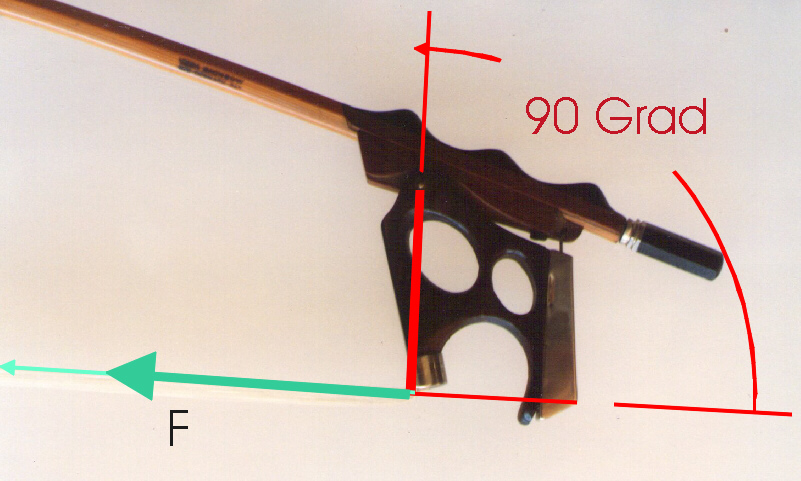
This adverse physical exertion of force required by the VEGA BACH BOW is due to the fact that the lever is relatively short (Fig.2), and its position, when the bow hairs are tightened, shows an angle of about 90 degrees to the hairs. Both of these geometrical characteristics, which physically put too much strain on the violinist’s right hand, are actually insurmountable obstacles. The hollows on top of the grip provide an additional way to hold the right hand in place despite the use of extreme force. In order to reduce the problems for the right hand, however, the designer of a curved bow should seek a solution to the cause of the problem, not just its symptoms. The frog of the VEGA BACH BOW has yet another opening for the thumb, facilitating single-voice playing in the locked position of the frog. The thumb thus alternates between two positions while the bow is in use, and this presents a further complication. In addition to the unfavorable properties of the handle, the bow stick maintains a high curvature in the upper half, i. e. from the middle to the bow tip. Thus, four-part chords over the entire length of the curved bow are playable, but the center of gravity is correspondingly high, complicating single-voice playing further.

Schroeder Rundbogen 150dpi
Fig. 3

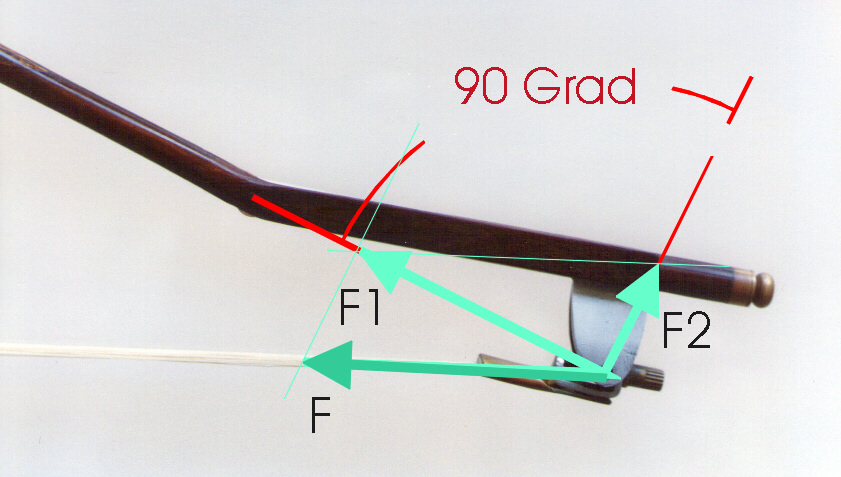
Fewer constructional disadvantages hamper the competing model of the curved bow (Fig. 3) invented by Rolph Schroeder (1900 – 1980), since the lever for tightening and relaxing the hairs is longer. According to the principle of the lever, this reduces the force but the distances covered by the thumb are bigger. But this is not a real drawback, as playing reveals. Secondly, in the tightened position the lever is folded into the handle, so the pivot of the lever absorbs a proportion (F1) of the tensile force (F) while one string is being played (Fig. 4).  Unfortunately, Telmányi, to whom the curved bow by Schroeder had been demonstrated in the 1930s, was unable to buy the prototype by Schroeder. He had to rely on an independent, newly-designed construction. Spivakovsky, on the other hand, knew only Telmányi’s curved bow and had almost no choice but to operate with a similar bow.  It was probably easier and faster for him to acquire a VEGA BACH BOW from Vestergaard in 1957 than to attempt to design on his own a curved bow with uncertain results.

Schroeder Rundbogen Kräfteparallelogramm 150dpiFig. 4

I remember when in 1990 Rudolf Gaehler first let me listen to the recordings of the curved bow performances by Rolph Schroeder, Emil Telmányi and Otto Buechner (1924 – 2008), how fascinated I was just to hear the multi-toned sounds on the violin. However, Telmányi’s difficulties in mastering this very extremely shaped VEGA BACH BOW are clearly audible in his Bach recording from 1954. Therefore I was very excited about the re-release of the Swedish Radio’s 1969 recording of Tossy Spivakovsky’s Chaconne interpretation. Hearing it was a complete surprise, because such an audio document would make one think that Spivakovsky must have had a different curved bow model at his disposal. Almost none of the enormous technical problems this VEGA BACH BOW presents are noticeable in his performance. To take Spivakovsky’s achievement just for granted is inconceivable for me. Spivakovsky’s listeners must have literally fallen off their chairs over such a masterful performance of the Chaconne with the curved bow.

Michael Bach


1) Tossy Spivakovsky, Polyphony in Bach’s Works for Solo Violin, published in 1967 in The Music Review, Vol. 28, No. 4

2) Rudolf Gaehler, Der Rundbogen für die Violine – ein Phantom?, Conbrio Verlag, Regensburg 1997

3) Live Broadcast, Swedish Radio, Stockholm, January 26, 1969, DOREMI DHR-8025-8

4) see photo: Tossy Spivakovsky, Introduction to the Curved Bow for playing Bach’s violin solo works