

Mstislav Rostropovich and the BACH.Bogen
Mstislav Rostropovich played a significant role in the development of the BACH.Bogen. Between 1997 and 2001, Michael Bach and Rostropovich met repeatedly in Kronberg, Berlin, Paris and Amsterdam to discuss, test and develop the curved bow for the cello.
What began with Rostropovich’s spontaneous enthusiasm for the instrument developed into a four-year exchange about its construction, ergonomics and playing technique — and ultimately led to the public presentation of the BACH.Bogen in Paris in 2001.
The First Meeting – Kronberg, 1997
The first meeting took place at Rostropovich’s invitation on October 18, 1997, in Kronberg.
In a fax, Rostropovich had written:
“Please come to Kronberg and show me your fiddle stick.”
Michael Bach presented the curved bow and played the Sarabande from Johann Sebastian Bach’s Cello Suites, one of the movements with the most pronounced chordal structure in the cycle.
Rostropovich reacted with spontaneous enthusiasm. More important than his many “Bravo!” calls, however, was what followed: he wanted a curved bow of his own.
When Michael Bach explained that the instrument had originally been developed primarily for contemporary music but could also be used for Bach’s solo works, Rostropovich replied:
“For Bach, I am delighted. This bow is a very good idea for Bach. I congratulate you.”
This first encounter marked the beginning of a four-year exchange about the further development of the curved bow.
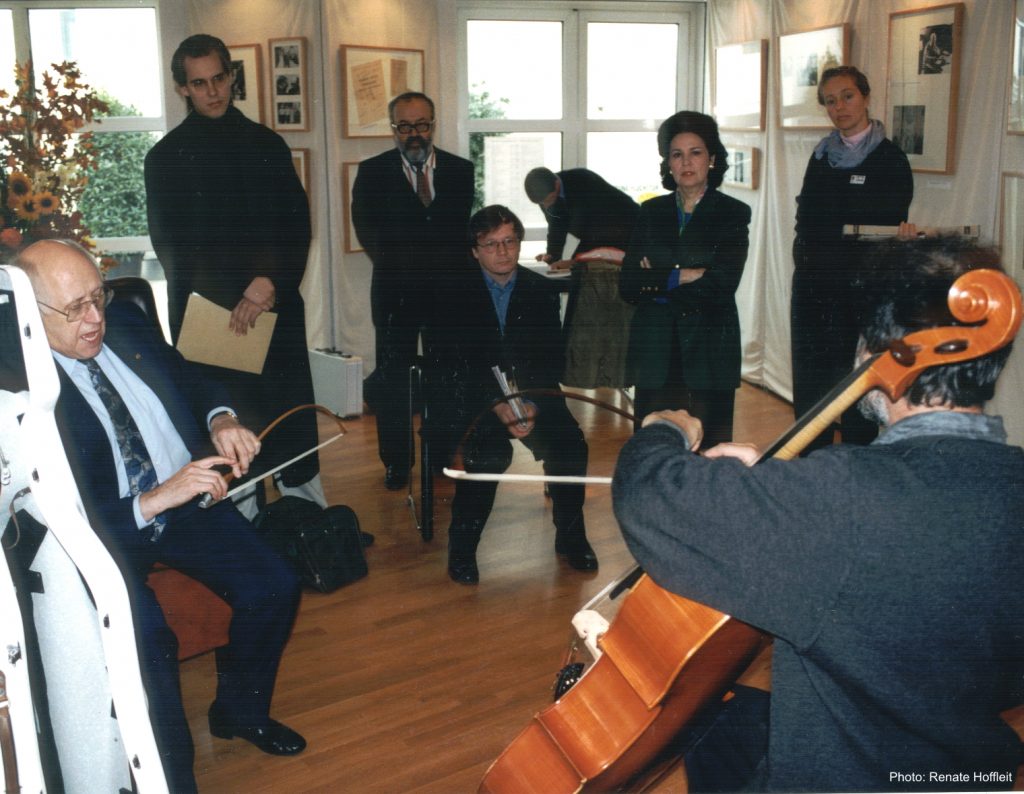
Mstislav Rostropovich and Michael Bach at their first meeting, Kronberg, October 18, 1997. Photo: Renate Hoffleit.
From First Encounter to Collaboration
During the following meetings, Rostropovich did not merely test the curved bow. He increasingly became involved in its development.
In Berlin in June 1998, he tried the instrument on the cello himself for the first time. He suggested an ergonomic improvement to the handle that would provide the hand with greater support.

Mstislav Rostropovich and Michael Bach, Berlin, June 4, 1998. Photo: Renate Hoffleit.
Further meetings followed in Paris in December 1998 and January 1999. Different handle and frog designs were tested and discussed. Rostropovich gradually formulated increasingly specific requirements for the instrument.

Mstislav Rostropovich and Michael Bach, Paris, December 12, 1998. Photo: Renate Hoffleit.

Mstislav Rostropovich and Michael Bach, Paris, January 17, 1999. Photo: Renate Hoffleit.
In May 1999, he proposed replacing the existing thumb lever with a mechanism operated by the index finger.
The idea presented a fundamental technical challenge. The movement of the index finger was too small in relation to the movement required to tension the bow hair, making a mechanically complex solution necessary.
Nevertheless, Rostropovich’s proposal became an important impulse for the further development of the instrument.
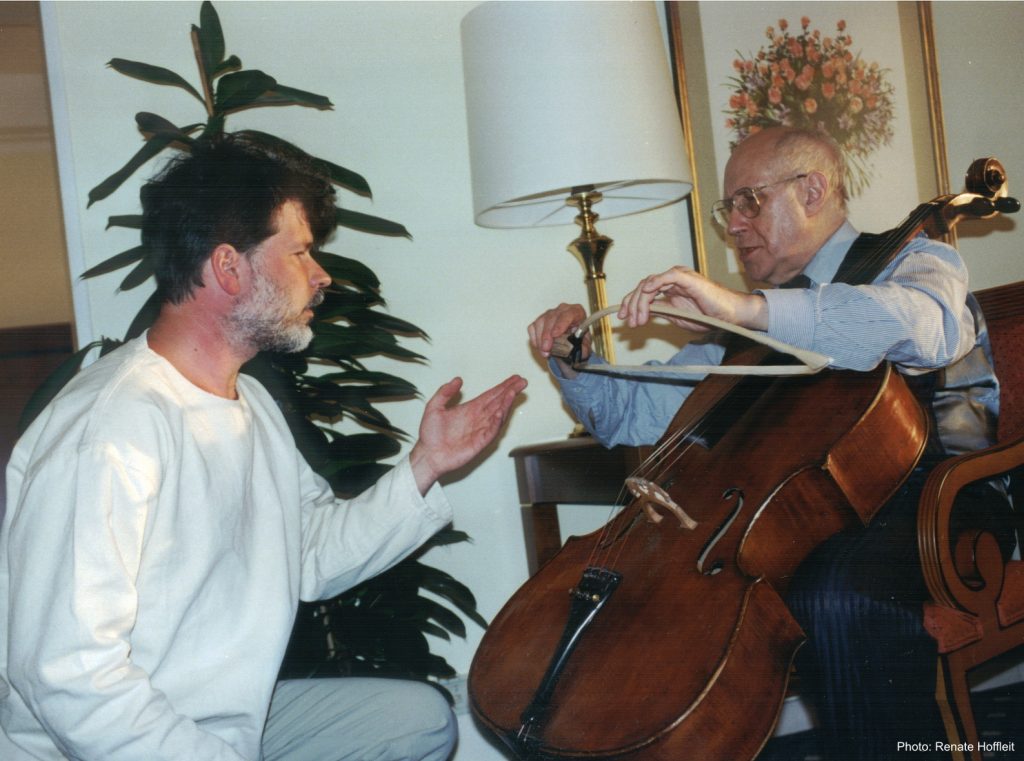
Mstislav Rostropovich and Michael Bach, Berlin, May 17, 1999. Photo: Renate Hoffleit.
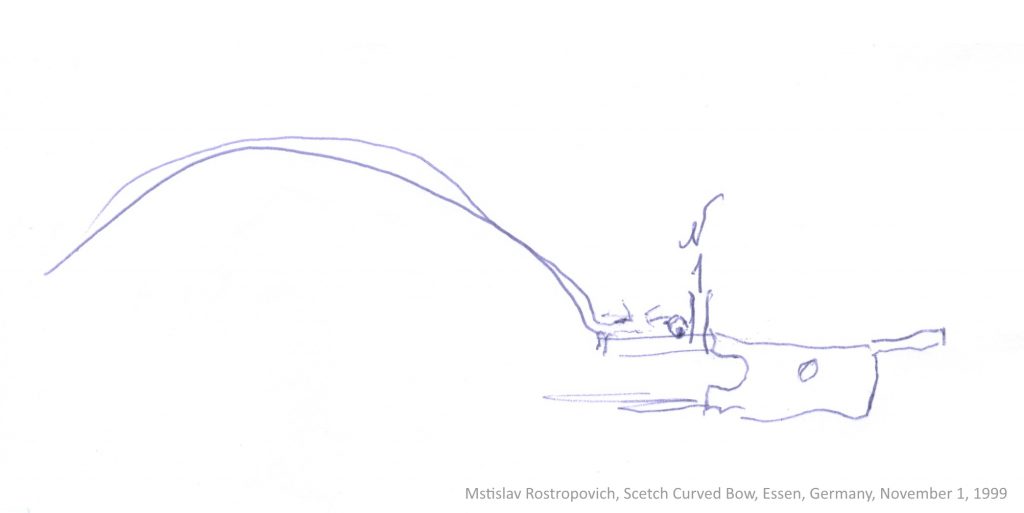
Mstislav Rostropovich’s sketch for a new curved-bow handle and index-finger mechanism, Essen, November 1, 1999.
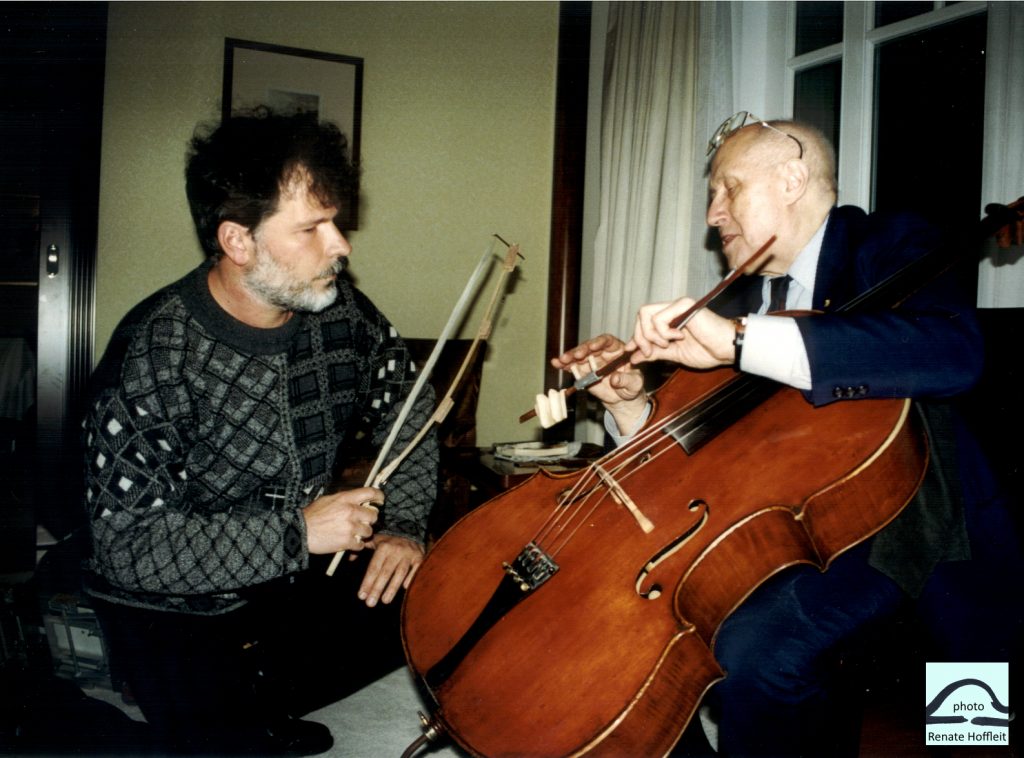
Mstislav Rostropovich and Michael Bach testing experimental curved-bow designs, Berlin, November 8, 1999. Photo: Renate Hoffleit.
The Turning Point
By the end of 1999, the discussion had reached an impasse. During the following months, Michael Bach reconsidered the basic principles of the bow’s construction.
The decisive insight came from his earliest experience with the curved bow. In the initial design, the lever had not been operated by the thumb but by the middle finger.
This led to a fundamentally new approach.
Instead of separating the functions of individual fingers through a thumb or index-finger lever, the new construction allowed the thumb and middle finger to work together as a pair, while the index finger and little finger provided an additional stabilizing force.
The handle was redesigned as a system in which the hand could remain closed around the grip and lever. This distributed the forces among several fingers and improved the control of the bow in all three spatial axes.
The previous scissor-like mechanism was abandoned.
The new construction also allowed the frog to be integrated into the mechanism while retaining the familiar ergonomics of a traditional bow frog. The design required extremely precise construction, with the bow-hair tensioning mechanism and the necessary clearance for the thumb integrated into a very small space.
This became the basis of the later BACH.Bogen design.
Amsterdam, June 2001
On June 26, 2001, Michael Bach travelled to Amsterdam to meet Rostropovich at the Concertgebouw.
He deliberately brought only the newly developed bow, now made with a pernambuco stick. There was no alternative model with an index-finger lever.
As Rostropovich took the bow into his hand, he initially held it upright like a sword without even trying it.
Michael Bach immediately realized that the decisive moment had arrived.
After they had alternately played the new bow, Rostropovich’s unexpected reaction was:
“I am jealous!”
The meeting ended with an invitation from Rostropovich to present the curved bow publicly at the 7ème Concours de violoncelle Rostropovitch in Paris.

Mstislav Rostropovich and Michael Bach with the newly developed BACH.Bogen, Amsterdam, June 26, 2001. Photo: Renate Hoffleit.
Paris, October 6, 2001
On October 6, 2001, Michael Bach presented the BACH.Bogen at the 7ème Concours de violoncelle Rostropovitch at the Auditorium of the Conservatoire Supérieur de Paris.
Rostropovich was present, together with members of the jury including David Geringas, Young-Chang Cho, Tsuyoshi Tsutsumi and the composer Marco Stroppa.
The presentation began with Michael Bach’s own composition 3 Pitches, 21 Sounds, composed in 1998 for Rostropovich’s 70th birthday and first performed in Jerusalem. The three pitches are derived from the notes A, C and H contained in the French spelling of Rostropovitch’s name; from these pitches, 21 three-part sounds are formed, corresponding to the 21 letters of his name.
The presentation continued with sound examples including John Cage’s One8, followed by traditional chordal passages and movements from Johann Sebastian Bach’s Cello Suite in C major.
The Sarabande was followed by spontaneous applause from the specialist audience.
The presentation demonstrated one of the central possibilities of the BACH.Bogen: the combination of a familiar repertoire with the previously unusual experience of polyphonic chordal sound on the cello.
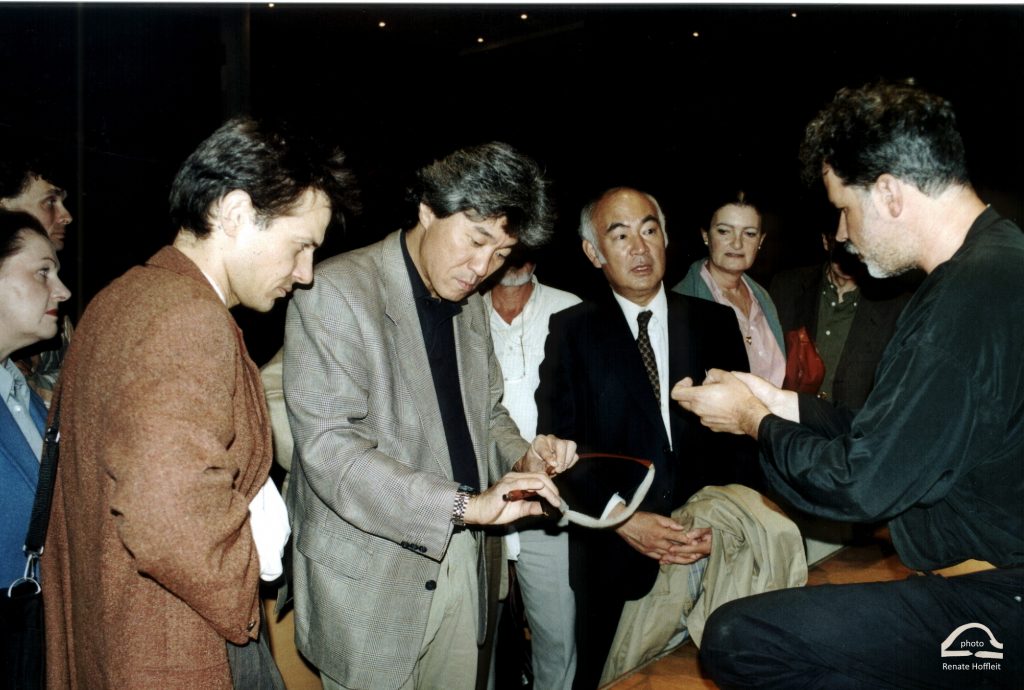
Presentation of the BACH.Bogen at the 7ème Concours de violoncelle Rostropovitch, Conservatoire Supérieur de Paris, October 6, 2001. Photo: Renate Hoffleit.
Rostropovich and the Future of the Curved Bow
During the presentation, Rostropovich also spoke about earlier attempts to develop the conventional bow, mentioning Gaspar Cassadó and Zara Nelsova.
More importantly, he saw the future of the curved bow in the hands of composers. He encouraged Michael Bach to inspire contemporary composers to write new works that would explore the possibilities of the instrument.
This observation points to a fundamental aspect of the BACH.Bogen: a new instrument acquires its artistic significance not only through its construction, but through the music that is created for it.
The collaboration with Rostropovich therefore belongs to an important phase in the history of the BACH.Bogen — not simply because one of the greatest cellists of the twentieth century played it, but because his questions, suggestions and practical testing became part of the instrument’s development.
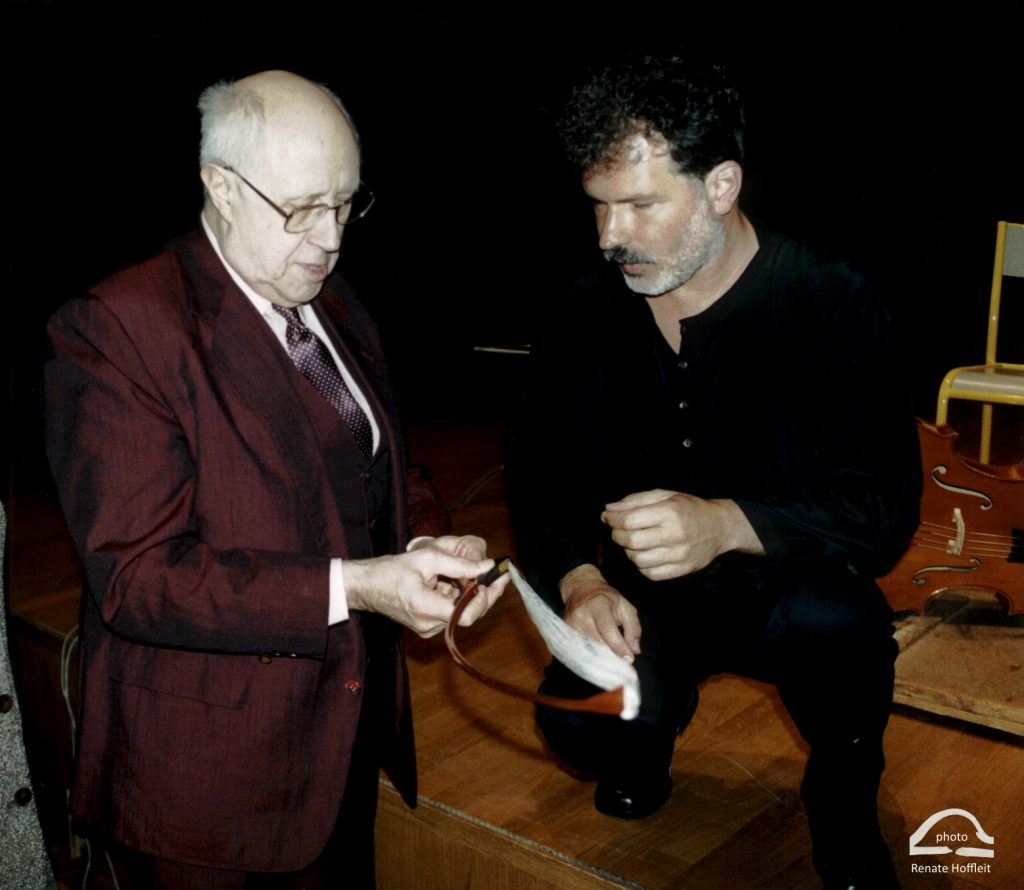
Mstislav Rostropovich and Michael Bach after the presentation of the BACH.Bogen, Paris, October 6, 2001. Photo: Renate Hoffleit.
Documentation of the BACH.Bogen presentation in Paris, October 6, 2001